
The United Arab Emirates (UAE) and Oman, which lie on either side of the Strait of Hormuz, have drawn closer since the Iran war began despite reports that some Gulf states privately accuse Muscat of being soft on Tehran as it casts itself as mediator-in-chief.
Most recently, Sheikh Tahnoon bin Zayed Al Nahyan, UAE’s deputy ruler and overseer of the business interests of Abu Dhabi’s ruling Al Nahyan family, paid a visit to Sultan Haitham bin Tariq Al Said in Oman last week.
The official readout was diplomatically anodyne, citing “strong fraternal ties” and pledging to expand co-operation in the mutual interests of both countries.
While it was unlikely to have featured during the tete-a-tete, a Dublin-listed company has suddenly become an area of common interest: part-owned by Oman’s sovereign wealth fund and, as we learned this week, coveted by a company ultimately controlled by Abu Dhabi’s ruling dynasty.
READ MORE




The Irish Times reported on Tuesday how Kenmare Resources, whose Moma mine in Mozambique produces about 6 per cent of global titanium minerals, had attracted bid interest from Abu Dhabi-based International Resources Holding (IRH).
[ Kenmare shares soar on confirmation of Abu Dhabi bid approach ]
IRH, a unit of International Holding Company (IHC), which is chaired by Sheikh Tahnoon, previously ran the rule over Kenmare two years ago, but it came to nothing.
The investment arm of the sultanate of Oman, meanwhile, acquired a 29 per cent stake in Kenmare a decade ago by committing between $100 million (€89 million) and $275 million rescue fundraising, mainly to pay down debt.
While the Oman Investment Authority has been the biggest seller into share buy-backs by Kenmare over the past five years, it retains a stake of more than 17 per cent (held through a vehicle called Africa Acquisitions) and a seat on the board.
That puts the Omanis in a pivotal position should IRH, a mining and trading group, come up with a bid by the November 17th deadline imposed by the Irish Takeover Panel.
It’s hard, however, to see Abu Dhabi coming up with anything near an acceptable price even if Kenmare has become increasingly uninvestable for long-term institutional investors in recent times.
Shares in the company closed on Monday, before news of the non-binding proposal from IRH, at £1.81 apiece. That was 69 per cent below a £5.30-a-share offer made in March last year by Kenmare’s former long-time managing director Michael Carvill and another Abu Dhabi firm, private equity house Oryx Global Partners.
Kenmare rejected that consortium’s proposal as undervaluing the company, but continued talks for more than three months before walking away when Carvill and Oryx indicated they planned to lower their original pitch.
Tom Hickey, who had succeeded Carvill as managing director in August 2024, told The Irish Times in September last year that the exercise was far from futile and had “shone a light” on the fundamental value of Moma – estimated to have a lifespan of another 100 years – even if the price of titanium minerals such as ilmenite, its main product, has fallen sharply in recent years.
But it also served as a reminder that Kenmare is, as Hickey put it, “a small-cap, single-country, single-commodity” company.
Only months after walking away from the Carvill talks, Hickey was forced to take a $301.3 million impairment charge against its Moma assets as Kenmare lowered its long-term revenue assumptions amid uncertainty over pricing.
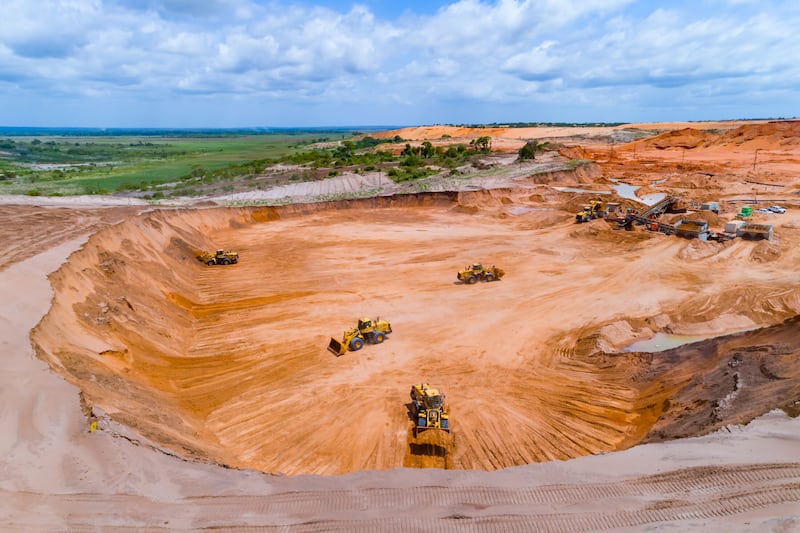
Ilmenite is now well into its fourth year of decline – driven by Chinese producers, operating at home and in Africa, continuing to oversupply the market. And there’s no sign, as yet, of cyclical recovery. Berenberg analysts recently cut their ilmenite forecasts again and they now reckon it will be 2028 before a recovery occurs.
It’s of minor comfort that the price of zircon, which accounts for about a quarter of Kenmare revenues and is used to make ceramic tiles, has stabilised and is starting to increase again.
The biggest reason stock market investors have been sticking to the sidelines is Kenmare having been in talks for about four years with Mozambican authorities on a key royalties agreement covering Moma. The previous 20-year accord expired just before the end of 2024, though the terms were to remain in place until a new one was reached.
Kenmare, which committed $341 million in recent years on a project to upgrade and relocated its main mining plant in Moma, said in mid-August, as it announced interim results, that it was continuing to “engage constructively” with the Mozambique government and that “significant progress” had been made over summer.
But the longer this drags out, the greater the chances that it ends up in international arbitration.
IRH’s parent, IHC, has a market value of more than €200 billion. The company moved into mining in late 2023 by acquiring Zambia’s Mopani copper operations in a transaction valued at $1.1 billion.
Its mining portfolio grew further last year when it paid $367 million for a 56 per cent controlling stake in Mauritius-based Alphamin Resources, giving it exposure to one of the globe’s largest tin-producing mines in the Democratic Republic of the Congo.
IRH’s limited dependence on external debt gives it greater flexibility in financing acquisitions. Its Mopani transaction, for instance, was mainly funded through equity and shareholder loans.
This could allow it to submit a more aggressive offer than a listed mining company or private equity firm could make for Kenmare, both of which might need to secure bank financing to complete a deal.
But would it make a bid before the deadline that’s anywhere near the level that Carvill and Oryx pitched? Unlikely.
Having held out so far, Kenmare may be better served holding its nerve until the ilmenite market at least stabilises and the royalty issue is resolved.
That would offer the best chance of Abu Dhabi putting forward a proposal that its Omani friends – and other big shareholders – would be willing to entertain.
The fifth Irish plc to be subject to a takeover approach this year, Kenmare may be the only one of the quintet to hold on to its independence. For now, at least.