
Just 18 months in, few in political Berlin expect the luckless coalition of chancellor Friedrich Merz to last its full four-year term. And this week a likely cause of his government’s premature demise was pencilled into the death certificate: mutual recrimination.
In May 2025 the coalition of centre-right Christian Democratic Union (CDU) and centre-left Social Democratic Party (SPD) took office facing three inherited problems: a moribund economy, a two-decade reform backlog and an increasingly aggressive Russia.
As they struggle with all three, and haemmorage political support, both have turned instead to finger-pointing, in particular claims the other is flirting with political extremists.
Amplified by social media discourse, the two foundation stones of Germany’s political centre openly accuse each other of undermining the political centre and digging the grave of modern German democracy.
READ MORE


The CDU, backed by the right-wing Springer media group, has denounced the SPD for beginning exploratory talks for a new city-state government in Berlin led by the hard-left Linke.
“A day of disgrace” was the shrill verdict of the Bild tabloid, which sees Linke as a hotbed of woke radicals and proto-Islamists, united by hatred of Jews.
Meanwhile the SPD rounded on the CDU for, in its eyes, stepping up its flirtation with far-right extremism.
In Saxony-Anhalt, 90 minutes southwest of Berlin, CDU MPs were instructed to abstain in a vote to choose a state parliamentary president. Though it was a secret ballot, it is likely four CDU MPs backed the candidate from the far-right Alternative for Germany (AfD) candidate Tobias Rausch.
His was a taboo-shattering victory: for the first time since 1945 a far-right politician holds a parliamentary office in Germany.
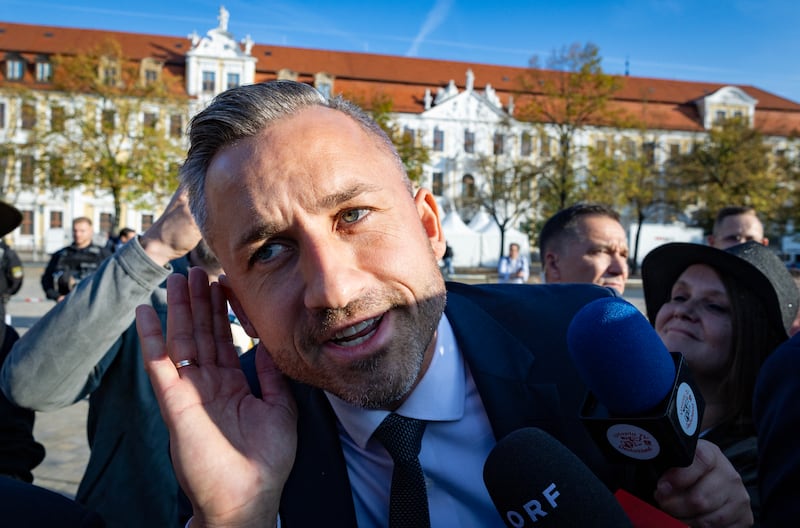
SPD and other parties fear a repeat vote – or worse – when Saxon-Anhalt MPs choose a new prime minister in December – and most likely elect local AfD leader Ulrich Siegmund.
Furious at Tuesday’s outcome, SPD federal politicians in the federal capital called a spontaneous protest march to Bebelplatz, the Berlin square where, in May 1933, books of authors deemed “un-German” by the new Nazi authorities were burned in a pyre.
SPD defence minister Boris Pistorius, who initiated the march to this sensitive spot, called Tuesday’s gathering a “singular event that demanded a singular answer”.
SPD co-leader and vice-chancellor Lars Klingbeil agreed: “The CDU has to explain urgently how this could happen.”
Fighting words from one coalition partner to another. A few streets away, CDU chairman Merz told a public event that “playing with extremists is not compatible with the values of my party”.
A day later, leading CDU politicians chose attack as the best form of defence. They came out en masse to denounce SPD and Green leaders in Berlin state politics for opening preliminary coalition talks with the hard-left Linke.

It stormed to victory in last month’s state election with 25.7 per cent support. The likely next governing mayor of Berlin, Linke leader Elif Eralp, says voters backed her party’s “make Berlin affordable” promise, echoing rent control and cost-of-living interventions of New York mayor Zohran Mamdani.
[ ‘Berlin’s Mamdani’ could carry Left party to power in BerlinOpens in new window ]
As in New York, Linke succeeded in activating first-time voters and a previously neglected demographic: second- and third-generation Germans of Turkish and Arabic descent.
Similarly to the UK Greens and New York Democrats however, Linke faces claims of structural anti-Semitism, in particular in the post-October 7th discourse. Berlin’s Jewish community, in particular, has sounded the alarm at an election that, alongside the Linke surge, saw 16 per cent of voters for the AfD and 4 per cent for the BSW, a Linke-breakaway grouping.
“The vote share for neo-fascists and neo-Stalinists in Berlin combined is 46.7 per cent,” said Max Feldhake, a Berlin-based rabbi. “This is truly alarming and very disconcerting for the city’s Jews.”
Even before formal Berlin coalition talks, the city’s SPD and Greens face stiff headwind from even within their own ranks.
Former Green foreign minister Joschka Fischer and ex-SPD parliamentary speaker Wolfgang Thierse have signed a public letter of alarm over Linke’s failure to distance itself from “anti-Semitic, Islamist, terrorist and criminal structures”.
That letter was a response to a previous letter, signed by 150 Jewish leftist academics and writers in Germany, arguing the repeated allegations against the Linke amounted to “cynical political instrumentalisation which equates almost any criticism of Israeli policy with anti-Semitism”.
Among the criticisms of Linke: an election event with a Berlin rapper who sang a song with lyrics that include “stop the genocide”, “Yalla Yalla Intifada” and “death to the IDF”. Another focus is a Berlin Linke politician with alleged ties to extremist Kurdish and Palestinian groups, as well as an organised crime family.
Predictably, the CDU and SPD have taken umbrage at the other’s accusations – but give no signs of backing down.
Signs of economic recovery may provide a respite from the bickering, but analyst Klaus Schubert fears persistent weak political leadership will prolong this period of what he calls German “Punch-and-Judy-show politics”.
“The population of this conservative country is unsettled,” said Schubert, political scientist at the University of Münster. “Instead of seeking the centre ground, voters are testing the political fringes.”
[ AfD passes milestone with first parliamentary speaker post in Saxony-AnhaltOpens in new window ]
[ The astonishing fall of a German spymasterOpens in new window ]