More than a dozen public and privately owned sites and buildings have been identified by the new Dublin city regeneration authority as essential to the revitalisation of O’Connell Street and the surrounding area.
The Dublin City Development Company, which will be headed by former Department of Health secretary general Robert Watt, is due to be officially incorporated at next month’s Dublin City Council meeting.
The council-owned company will be tasked with regenerating the O’Connell Street area and will have a major emphasis on the adaptation and conversion of underutilised and vacant buildings, and the redevelopment of derelict sites for housing, Watt has said.
Two streets, Middle Abbey Street, to the west of O’Connell Street, and North Frederick Street, off Parnell Square, have already been identified as pilot regeneration projects with a focus on developing empty spaces above shops for accommodation.
READ MORE



However, 13 other sites or buildings have been identified as “major projects” which, through their redevelopment, will spur the revitalisation of the surrounding area.
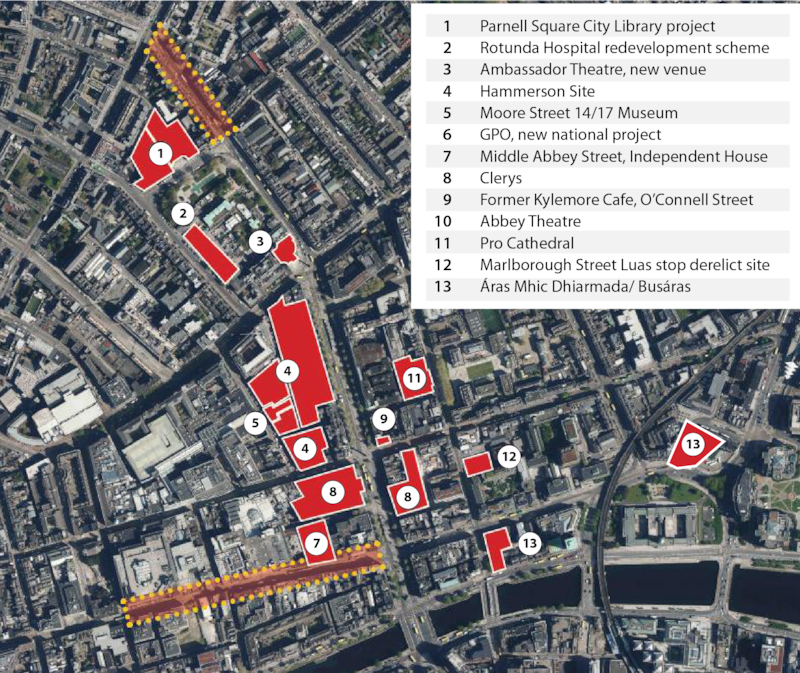
It is expected the vacant sites among the 13 will largely accommodate new apartment development, such as the Carlton site above the proposed O’Connell Street MetroLink station and a derelict site close to the Luas line on Marlborough Street.
The former headquarters of the Irish Independent on Abbey Street has been earmarked for student accommodation, while the former Cafe Kylemore on O’Connell Street was recently sold with permission for a boutique hotel.
Other sites and buildings will have a predominately cultural or entertainment use, such as the Parnell Square city library project, the 1916 museum on Moore Street and the Ambassador Theatre at the top of O’Connell Street.
[ Dealz parent Poundland enters administration heightening threat to Irish jobsOpens in new window ]
Consultants have been sought to develop a strategy for the future use of the GPO on O’Connell Street.
The future development of the GPO complex project is being led by the Office of Public Works, which will feed into the overall framework and delivery plan for the O’Connell Street district.
Masterplans and “urban design briefs” will be prepared for the major project or flagship sites, whether they are publicly or privately owned.
[ Why have Chinese buyers ‘gone Awol’ from the south Dublin property market?Opens in new window ]
Karl Mitchell, the council’s executive manager who has been overseeing the development of the new regeneration body, told councillors on Wednesday that private sector support and funding would be essential to the success of the project.
“We are trying to join the dots in the city centre,” he said. “That is in terms of what’s happening from State involvement and commitment from the State, particularly in relation to O’Connell Street and environs. We’re also trying to make sure that when public money is put into that area we are trying to draw in private funding as well.”
The council has submitted an application for initial Government funding of €114 million and hopes to “have a commitment on that” before the December council meeting, Mitchell said.