
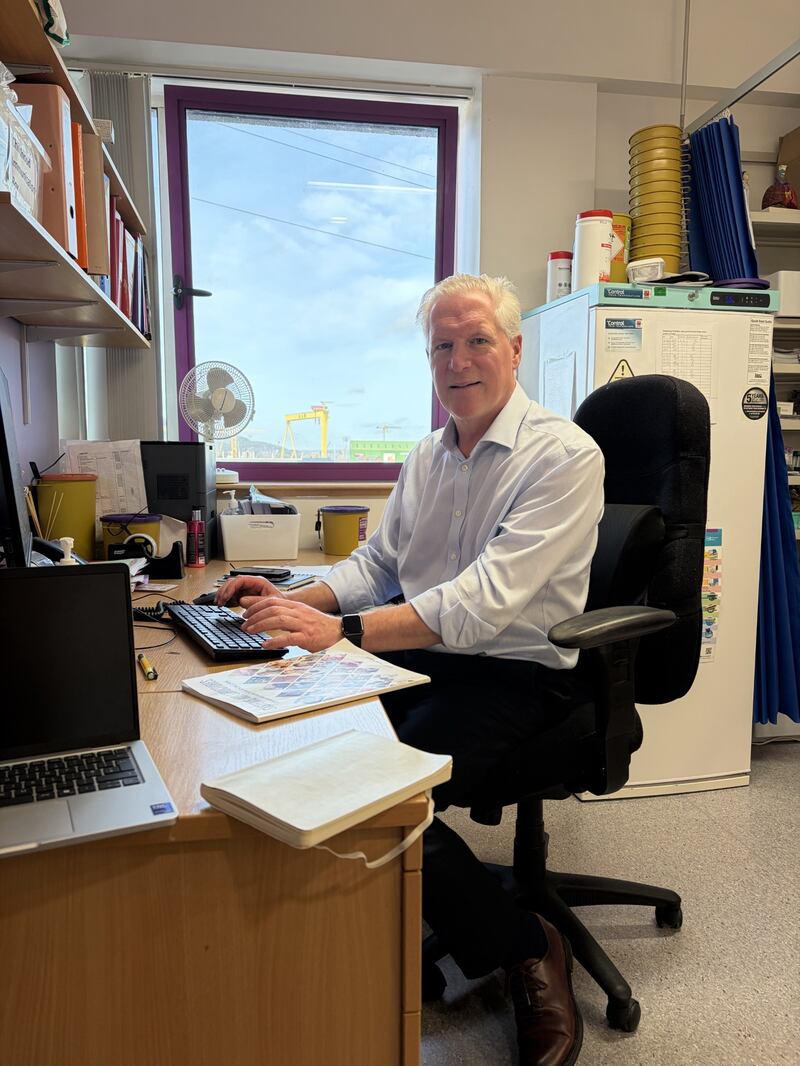
From Alan Stout’s office in the Arches Medical Centre, the Belfast doctor can see the famous Samson and Goliath cranes of the old Harland & Wolff shipbuilding yard in east Belfast that created much of the city’s fortunes.
For more than a century, thousands of mostly Protestant workers left terraced housing on the Lower Newtownards Road and surrounding districts to work inside its gates.
The shipyard left its toll.
“There would have been a lot of respiratory illnesses. When I started, back in 2001, we would’ve had quite a number of patients with asbestosis,” says Stout, referring to the chronic lung disease caused by inhaling asbestos fibres over a long period of time.
READ MORE


“We don’t have that many of those patients now. People unfortunately pass away, far too early.”
Stout, who is chair of the British Medical Association’s Northern Ireland council, remembers a much-liked patient bringing old photographs of “snowball” fights in the yards.
“But it wasn’t snow. It was handfuls of asbestos. They’d hurl them during breaks – didn’t know the dangers,” he says.
If the health legacy left by the shipyards is receding into history, there are plenty of others.
“Walk out the front door here and turn right and you end up in some of the most deprived parts of Northern Ireland,” he says.
[ Hard to see southern voters agreeing to pay €1,500 to €5,000 each for unityOpens in new window ]
“Turn left, and you go straight up to Ballyhackamore. It’s a few miles. You could walk between them. Yet there is a gap of seven or eight years of life, and certainly 10 years of healthy life, between them.”
The state of the health of the population on both parts of the island will come under the microscope on Monday, with the publication of the latest research report from the Dublin-based Economic and Social Research Institute.
The detailed research into health inequalities across the island and the lifestyles that can cause or worsen some of those conditions has been funded by the Irish Government’s Shared Island Unit.
It will show that the majority of Northern Ireland’s health inequalities are caused by “deep-seated structural disadvantage” that is embedded into Northern Ireland’s society.
The inequalities will not be remedied solely by urging people to eat better or drink or smoke less but requires action to remove “entrenched systemic inequalities”, the report will say.
The research shows that people in better-off districts north and south of the Border drink more than poorer counterparts, but alcohol causes more damage to the poor because they binge drink.
Much of the debate about health services in Northern Ireland and the Republic of Ireland centres on the existence of the National Health Service north of the Border in contrast to the medical card and pay-as-you-go model in the South.
For Stout, the argument about the differences between the two misses the point.
“The starkest differences are not about what conditions people present with, but when they present,” he says, emphasising the “when”.
Pointing towards the wealthier end of his district, he says: “This is the absolute travesty of Northern Ireland healthcare. If somebody comes from that direction, they’ll say: ‘I can either pay’ or ‘I’ve got health insurance’.”
“Then we can get them seen quickly by a consultant or whatever. But if they come from the other side, closer to the city, then they have no chance of paying and no chance of being seen.”
For years, Stout has argued trenchantly that Northern Ireland’s health services suffer not from a lack of reform plans, but from a lack of political willingness to enforce the plans already in existence.
[ Fine Gael should have followed Brian Cowen’s cheesy wisdom about unityOpens in new window ]
A 2016 plan led by Rafael Bengoa, the Spanish doctor and health policy expert who worked for the World Health Organisation, was intended to change healthcare in Northern Ireland and correctly identified the main issues: the need for a smaller number of better hospitals, stronger primary care and more and better treatment delivered locally.
Instead of Stormont implementing the Bengoa report, Northern Ireland has gone backwards, he says, quoting figures from memory.
“In the 10 years since Bengoa, the numbers on waiting lists have gone from 225,000 to 504,000,” says Stout.
“The numbers waiting over 52 weeks have gone from 30,000 to 270,000. The numbers waiting over 12 hours in emergency departments every year have gone from 3,900 to 139,100.
“That’s an astonishing figure, and the harm that’s been caused with that. The number of emergency patients seen and discharged within four hours has fallen from 76 per cent to just 43 per cent.”
Stout argues that “a forced helplessness” has been created.
“It’s astonishing when I say to a patient with neurology symptoms that I’ll refer them to a neurologist, but it could be seven years before they see one, that they’ll just shrug their shoulders and go: ‘Oh, well.’”
Too often, Stout has heard Stormont politicians of all hues lay the blame for Northern Ireland’s struggling health service at London’s door and for the failure of the UK treasury to properly to fund it.
The differences between the quality of the National Health Service seen in Northern Ireland compared with England, Scotland and Wales are raised not infrequently at British Medical Association meetings, he says.
“Our GB colleagues say to us that if what was happening here was happening in London, Manchester or Liverpool, they would be protesting on the streets. They just wouldn’t accept it,” he says.
Emergency actions, especially in England, follow when the number of people waiting for more than 12 months exceeds acceptable limits.
“That becomes a catastrophe and they invest heavily,” he says.
“Here, we go from 30,000 to 270,000 waiting over 52 weeks, and nothing happens. Politicians just say: it’s Westminster’s fault, and it’s the treasury’s fault, that they don’t give us enough money.”
For Stout, that is not good enough.
“The challenge here is not just about money. Number one, we have to understand how much money we have, how much resource we have. I’m not sure we do,” he says.
“Number two, we have got to make sure that what money we have, we spend as well and efficiently as possible. And that includes prioritisation. Because we don’t prioritise well, either.”
Stormont’s failure to agree multiannual priorities makes long-term health planning that could tackle deep-seated inequalities impossible, but now it is unable even to agree a yearly budget.
Just months from next May’s Stormont elections, Stout is despondent that anything will change.
“Nobody can lose; the figures change a bit,” he says, “but everybody who wants still gets into government. Nothing changes.”