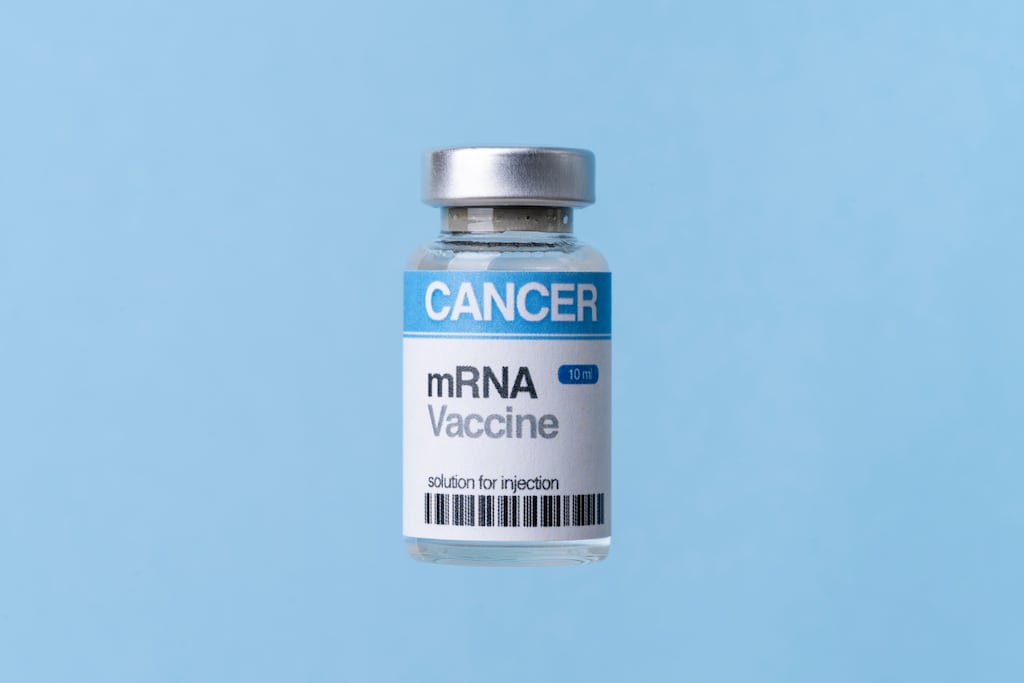
Imagine having surgery to remove a cancer, completing treatment and then receiving a vaccine designed to help your immune system hunt down any remaining cancer cells before they can take hold again.
It sounds like science fiction. But personalised cancer vaccines are moving closer to clinical reality, following landmark trial results in melanoma, the most serious form of skin cancer and the fourth most common cancer in men and women in Ireland. These trials have raised hopes of a new approach to preventing cancer recurrence. Results from a major phase three trial, published in The New England Journal of Medicine in recent weeks, showed that a personalised messenger mRNA vaccine, given alongside an immunotherapy drug, reduced the risk of melanoma recurrence or death by 42 per cent.
Irish doctor Prof Dermot Kelleher, who is dean emeritus of the Faculty of Medicine at the University of British Columbia in Vancouver, Canada, describes the advent of personalised therapeutic cancer vaccines as a “step change” that could revolutionise the management of more challenging cancers. He sees the prospect of an individualised RNA vaccine to protect against melanoma recurring as “really exciting. These latest findings represent an important milestone in long-running scientific efforts to harness the body’s immune system against cancer.”
Unlike conventional vaccines, which prevent infectious diseases, therapeutic cancer vaccines are designed to help the immune system recognise and attack cancer that has already developed. Scientists analyse a patient’s tumour to identify genetic mutations that produce abnormal proteins, known as neoantigens. These can be recognised as foreign by the immune system, providing targets for treatment.
READ MORE



The neoantigens are incorporated into an individualised mRNA vaccine, which trains the patient’s own immune system to recognise them and attack cancer cells carrying the same targets. The aim is to generate a highly targeted response while minimising damage to healthy tissue.
These vaccines are also being combined with established immunotherapy drugs, potentially allowing vaccine-activated T-cells to mount a stronger attack against the cancer.
“It is such a novel approach. It is breathtaking technology. The whole immunotherapy field of cancer treatment has just been totally turned on its head in recent years,” says Prof John Crown, who is a consultant medical oncologist at St Vincent’s University Hospital, Dublin.
The latest results come from INTerpath-001, a phase three trial involving 1,137 patients with high-risk melanoma whose cancer had been surgically removed. Patients in the trial, which was funded by Merck and Moderna, received either the immunotherapy drug pembrolizumab alongside the experimental personalised mRNA vaccine intismeran autogene, or pembrolizumab alone.
[ Life after cancer: ‘I don’t waste time doing things that don’t sit right with me’Opens in new window ]
At two years, estimated recurrence-free survival was 82.2 per cent among patients receiving the combination, compared with 70 per cent in the pembrolizumab-only group. The combination reduced the risk of recurrence or death by 42 per cent.
For patients with melanoma, where recurrence can have devastating consequences, this represents a significant advance.
“It is a great shot in the arm for the whole cancer field; that a radically new technology has been developed which has produced some great results,” says Crown.
The late-stage trial brings cancer vaccines closer to potential real-world clinical use, opening the way for applications for regulatory approval, he says.
Melanoma has been a particularly promising area for cancer vaccine research, partly because it is relatively responsive to immunotherapy. Could this form of vaccine work in other types of cancer, where the immune system hasn’t had as significant a role? That, says Crown, is “the big question”, particularly in relation to cancers with high mutation rates.
Research into potential therapeutic vaccines for breast, brain, lung and bladder cancers is now under way. Pancreatic cancer is another area of focus. One of the most difficult cancers to treat, it has poor, although improving, survival rates and high rates of recurrence even after surgery.
[ Why are hospitals across the country running over budget?Opens in new window ]
Researchers are investigating therapeutic vaccines targeting mutations in KRAS, a gene implicated in the development of most pancreatic cancers.
Early-stage studies of personalised pancreatic cancer vaccines in small patient groups have demonstrated powerful, cancer-specific immune responses, some of which persist for years. However, there was disappointment when a subsequent phase two trial of a different KRAS-targeted pancreatic cancer vaccine failed to meet its primary disease-free survival endpoint. Meaningful clinical benefits in larger patient populations have yet to be established, a measure of the challenges still involved.
“There is still a long way to go before personalised cancer vaccines reach their full potential, but so far they are proving particularly promising in earlier-stage disease, where treatment following surgery could target residual cancer cells and reduce the risk of recurrence,” says Prof Grainne O’Kane, a consultant medical oncologist at St Vincent’s University Hospital, Dublin and inaugural Pat Smullen chair in Pancreatic Cancer at UCD.
The big question for patients in Ireland – a country where 1,400 people are diagnosed with melanoma annually – is how soon they might benefit. Despite the excitement surrounding the latest melanoma trial results, personalised mRNA cancer vaccines remain investigational and are not yet routinely available in clinical practice. Regulatory approval, health technology assessments, pricing and reimbursement decisions will all influence how quickly they could enter clinical practice. Health systems will also need to determine how these treatments can be incorporated into existing cancer care pathways and made equitably accessible.
All of this brings significant logistical and financial hurdles. Each personalised vaccine requires tumour analysis, identification of suitable targets and individual manufacturing. The process must be sufficiently quick and reliable for patients to benefit. The cost is another major unknown, but is likely to be substantial given the specialist laboratory expertise, personalised manufacturing and complex logistics involved.
For Irish patients, participation in international clinical trials may offer the earliest opportunity to access these treatments as they are being developed, O’Kane believes.
[ The public spending pantomime must end. Here’s how to change the scriptOpens in new window ]
Developing research capacity and ensuring Irish cancer centres participate in international studies will be key if Ireland is not to be left behind in gaining access to this new wave of treatments.
Despite all the caveats, the prospect of a vaccine designed to prevent an individual’s cancer from returning represents a remarkable shift in the way cancer treatment has traditionally been approached. The science is advancing rapidly, but the ultimate test will be whether these treatments deliver meaningful and lasting benefits across a range of cancers – and, crucially, whether health systems can make them accessible.
For now, melanoma has provided an important proof of concept. The next few years will determine whether personalised cancer vaccines live up to their early promise.
Priscilla Lynch is a freelance medical journalist