“Literally the odyssey started when I stuck out my thumb on the dual carriageway in Cork to hitch to Belfast to catch Taste playing support to Cream in 1967, and it just went from there.”
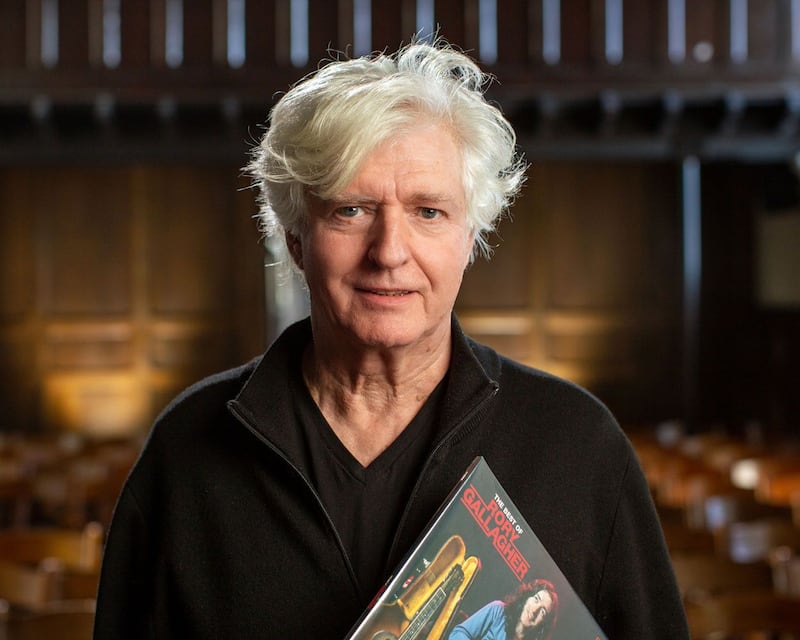
Almost 60 years later, Dónal Gallagher is recalling the time he spent on the road with his older brother, Rory, Ireland’s first truly international rock star, as he talks about his recently published account of their time together, Edged in Blue – A Rock’n’Roll Odyssey with Rory Gallagher.
The book traces the Gallagher brothers from their births – Rory’s in Ballyshannon, Co Donegal in 1948; Dónal’s in Derry’s Bogside in 1949 – to a life rocking all over the world until Rory’s death in 1995.
It tells of their peripatetic early years after their Derry-born father, Danny, met their Cork-born mother, Mona, and how they moved from Donegal to Derry to Cork, to Coventry, back to Cork and back to Coventry again, before finally settling on Leeside, this time minus their father as the marriage had broken down.
READ MORE


It was in Cork that Rory got his first guitar at the age of 11, and Dónal – later to become his manager – tells of how he joined The Fontana Showband, which morphed into The Impact, before making his way to Hamburg to gig there with bandmates bassist Oliver Tobin and drummer Johnny Campbell.
The book charts Rory’s return to Cork and forming Taste (Mark I) with bassist Eric Kitteringham and drummer Norman Damery, and how they began playing Belfast before moving to London.
Taste (Mark II) had just formed, with Richie McCracken on bass and John Wilson on drums, when Rory found himself having to deal with a rather disgruntled John Bonham, later of Led Zeppelin fame, peeved at not being invited to join Rory’s new line-up.
Dónal recalls: “We were playing a club just north of Birmingham and just before Taste were about to go on stage, John Bonham turned up and castigated Rory for not giving him a tryout for Taste – Rory knew John from playing with Tim Rose, who wrote Hey Joe, which was picked up by Jimi Hendrix.
“Rory had met Tim Rose at the Woburn Music Festival in July 1968 – Taste were playing, as were Hendrix, Peter Green’s Fleetwood Mac, John Mayall’s Bluesbreakers and Donovan, and Rory and Tim had hit it off because Tim claimed Irish heritage, so Rory got to know John Bonham too.
“When John turned up at the club near Birmingham, he was angry because he hadn’t been given the audition. So Rory said, ‘Haven’t you done well enough?’ – he had just joined the New Yardbirds, who became Led Zeppelin − but he invited him to gig, so [Bonham] played with Taste that night.”
After Taste split and Rory formed his own band, with constant member Gerry McAvoy on bass and successive drummers − Wilgar Campbell, Rod d’Ath, Ted McKenna and Brendan O’Neill − Lou Martin on keyboards, and Mark Feltham on harmonica, the Gallaghers travelled the world.
They mixed with some of rock’s biggest names – John Lennon, The Rolling Stones, Bob Dylan, Van Morrison, The Kinks, The Byrds, The Faces, Rod Stewart, Fats Domino, Muddy Waters, Canned Heat, Black Sabbath, Kansas, Kiss, Aerosmith, Leon Russell, ZZ Top – the list goes on.
Dónal says John Lennon had praised Taste after seeing them in The Lyceum in London in 1970, and recalls an encounter with the Beatle at a Jerry Lee Lewis concert at The Roxy on Sunset Strip in California, in 1973.
“We went along to see Jerry Lee and when Lennon came into the VIP section, the crowd started looking up at Lennon so Jerry Lee started to rant about how The Beatles and The Stones were shit and nobody could play real rock’n’roll like Jerry Lee Lewis.
“Lennon started egging him on from the balcony and was shouting ‘You’re right, The Beatles are shit,’ and the crowd started laughing and Jerry Lee didn’t hear what Lennon had said so he slammed down the lid of his baby grand piano and rolled it across the stage until it fell off.
“Rory had recorded Satisfaction with Jerry Lee in London, so he went backstage with Tom O’Driscoll, our roadie, afterwards and they were in Jerry Lee’s dressingroom when Lennon came in, and Tom asked Lennon for his autograph and Jerry Lee went completely berserk.
“Jerry Lee reached for his sock, intimating he might have a gun in it but Lennon grabbed Tom’s pen and went over to Jerry Lee, went down on one knee, kissed his feet and said he had been waiting 20 years to get his autograph and that calmed and charmed Jerry Lee no end.”
Rory auditioned for The Rolling Stones in Rotterdam in January 1975 after Mick Taylor left the band, although Dónal recalls Rory telling him he thought was just going to jam with them.
“We were both huge Rolling Stones fans – we had seen them when they played The Savoy in Cork in 1965 and Rory was a great admirer of Brian Jones, so when he got the invite to meet them in Rotterdam, he headed out there and did four days’ recording with them.
“Mick [Jagger] and Keith [Richards] were kind of fond of Rory and, as I say, he was a fan of the Stones so there was quite a mutual admiration society going on ...” However, Dónal says Jagger and Richards were not talking to each other at the time.
“Mick was very keen and he asked Rory to go to talk to Keith, but Keith was on a different planet at the time, so it was a difficult situation for Rory – his attitude was, he had done his bit and met them and it was up to them to step forward but there was no more communication from them.”
Rory in full flow in performance was a different figure entirely from the quiet, shy man he was off stage. But he was a determined person and he refused to allow record company Polydor to edit his song Going to My Hometown or Chrysalis to cut the slide intro to Edged in Blue for a single release, and defied calls for him to drop Belfast from his tour schedule in 1971 due to the Troubles-related violence there.
“Rory was adamant he was going to play there and he could be stubborn and entrenched once he decided something. He wasn’t dismissive – he would listen to the other side of the argument and what you had to say − but he would probably have thought it through a couple of days before you said it. He had this very intuitive thing and, dare I say it, he was usually right. And he insisted on playing Belfast.
“His attitude was ‘I have a northern background. I played Belfast in 1967, 68, 69, 70 – who is somebody to tell me that I can’t play there in 71?’ And of course he had fans on both sides and the statue to him by the Ulster Hall was proposed by people from east Belfast.”
Rory’s acclaimed Irish tour of 1974 features in the book, as do Irish artists such as Van Morrison, Thin Lizzy, The Boomtown Rats, The Hothouse Flowers and The Dubliners, as well as Gary Moore whom he befriended while Moore was playing with Platform Three in Belfast in 1967.
But what prompted Dónal to put to pen to paper now? It is more than 30 years since his brother died, in a London hospital after a failed liver transplant and a long battle with prescription medicines and alcohol, at the age of just 47.
Dónal, who met his wife Cecilia at a Rory concert, says it was always on his mind to write a book, and while there have been other books about Rory, he never contributed to any of them.
In the years after Rory’s death, Dónal’s focus was on preserving his brother’s art and trying to ensure his legacy remained cherished. He has spent years ensuring Rory’s albums and films are available in all the latest formats so that a new generation can enjoy his music.
“There was a lot of work to be done in acquiring and securing the rights to the performances at Rockpalast in Germany and the Montreux Jazz Festival and Taste at the Isle of Wight and then making documentaries and then doing remixes on the albums – it was and still is a 24-seven job.”
How difficult was it to write about Rory’s demise when he became reclusive, feeling the era of guitar-inspired music was being superseded by electronica, and his confidence seemed shot? And then, ultimately, to chronicle his death?
“I suppose with the passage of time, it becomes somewhat easier but you still have to steel yourself. It was a tough time. It’s like you’re conscious of somebody driving badly and you know there’s going to be crash at some point, so writing it was a real rollercoaster emotionally.
“I had written the epilogue, I’ll Admit You’re Gone – all the chapters are named after Rory songs and that was on [1976 album] Calling Card – and it was ready to print when I decided to change it and just tell it straight. It was hard but I hope it may help others in difficulties with certain illnesses.”
What does he think Rory would make of the book, which was written with English journalist Jamie Dickson?
“While Rory was with us,” says Dónal, “I tried several times to have him do an autobiography [but] I guess he preferred lyric writing – even though he was a very well-read person when it came to other people’s life stories.
“Had I thought Rory wouldn’t have approved of my book, I simply wouldn’t have penned it, [but] when he was asked how he might like to be remembered, my brother replied simply: “In song and in story.” And that’s what I have sought to do with this book.”
Edged in Blue: A Rock’n’Roll Odyssey with Rory Gallagher by Dónal Gallagher and Jamie Dickson is published by Red Stripe Press