The head of Israel’s largest Arab party has accused prime minister Binyamin Netanyahu of using “systematic racist attacks” on the country’s Arab politicians to shore up his hold on power following last month’s inconclusive election.
Neither Netanyahu’s far-right coalition nor the bloc of Jewish opposition parties, led by former general Gadi Eisenkot, won a majority in the October 27th poll, leaving Israel’s two Arab groups – the Joint List and Ra’am – as potential kingmakers after a record turnout among Arab voters.
In the weeks since, Netanyahu and his Likud party have railed against the prospect of Eisenkot and the Arab parties combining to oust him, branding Arab politicians “terror supporters”, accusing them of attempting to “steal” the election and claiming that they wanted to “destroy” Israel as a Jewish state.
In an interview with the Financial Times, Yousef Jabareen (54), an academic appointed head of the Joint List this year, accused Netanyahu of “using incitement and delegitimisation with the clear goal of perpetuating his hold on power”.
READ MORE


“Netanyahu has a clear political interest to block co-operation between the Eisenkot camp and the Arab parties because he knows that the way to remove him from power runs through co-operation between us,” he said.
He warned that the rhetoric was fuelling a broader climate of hostility to Israel’s Arab minority, who make up 21 per cent of the country’s 10 million-strong population, and have long faced discrimination from Israeli authorities.
Since the election, in which Israel’s Arab parties won a record 19 seats in Israel’s 120-seat Knesset, there has been a sharp rise in anti-Arab content in Israel’s public sphere, which one Israeli news group described as a “pox of racist rhetoric”.
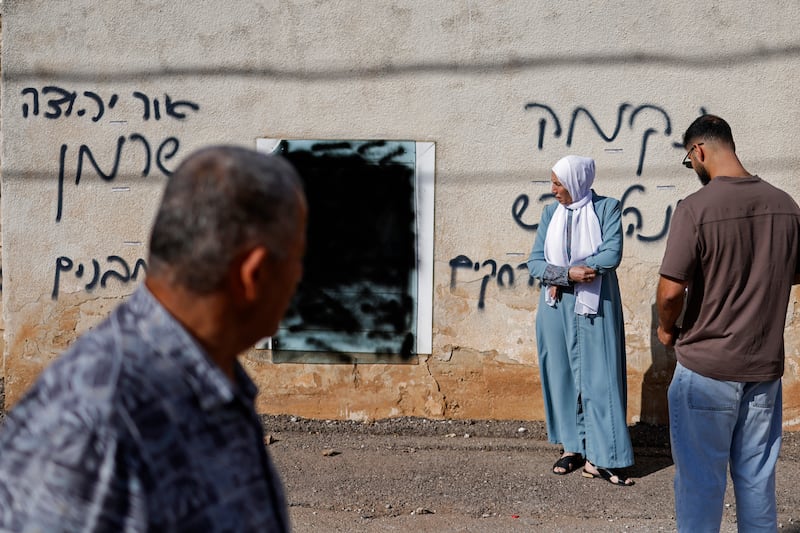
Last week, for example, a mosque in the village of Ed-Dahi in northern Israel was set on fire, with the perpetrators daubing pro-settler graffiti on the walls nearby.
“History teaches us that incitement by officials penetrates to the public,” said Jabareen. “People in the street get these messages and the extreme ones among them – and there are many extreme ones – translate that into actual attacks.”
The prime minister’s office and Netanyahu’s Likud party did not respond to requests for comment.
Among Palestinian citizens of Israel, Netanyahu’s government – in which ultranationalist settlers such as national security minister Itamar Ben-Gvir and finance minister Bezalel Smotrich held significant power – is widely regarded as the most hostile they have experienced.
Jabareen said ousting the veteran prime minister and his far-right allies was “at the top of our priorities” as “this is what our community is struggling for”.
Unlike Ra’am, an Islamist party led by Mansour Abbas, which joined a short-lived government that briefly ousted Netanyahu in 2021, the Joint List – which unites three smaller Arab factions – has said it would not join an Eisenkot coalition, arguing that it could not be part of an Israeli government while the country continues to occupy the Palestinian territories.
[ Will Netanyahu be forced from power? The coming days will decideOpens in new window ]
But the Joint List recommended that president Yitzhak Herzog give Eisenkot the first chance to form a government after last month’s poll, and Jabareen said it would be prepared to support an Eisenkot-led administration “from outside”.
“We cannot be part of a government that oppresses our own people. However, we are in politics ... and we see how Netanyahu and his gang has become an existential threat for our community,” he said. “We are ready to facilitate support ... in order to fulfil our promise of being a safety net for our community, and in order to fulfil the goal of removing Ben-Gvir and Netanyahu.”
In return, he said the party would seek support for priorities including combating organised crime in the Arab community and stopping the demolition of houses built without permits – which disproportionately affects Arab citizens.
“[The Eisenkot bloc] wants to fix what Netanyahu’s government has done,” he said. “And so what I am saying is that part of what you have to fix is Netanyahu’s policy towards us.”
Eisenkot’s bloc remains divided on whether to throw in its lot with Israel’s Arab parties. Some, such as Yair Golan, who leads the leftwing Democrats, back such a move. But others, such as former defence minister Avigdor Lieberman – who has also ruled out backing a minority government – are vehemently opposed.
The bloc has also been exploring other routes to forming a government, including holding talks with one ultra-Orthodox party, and Netanyahu’s Likud.
Jabareen said that although the Joint List was in touch with the Democrats and co-ordinating with other members of Eisenkot’s bloc over day-to-day issues in parliament, it had not yet had official talks with Eisenkot’s Yashar Party about the bigger question of swearing in a new government.
However, he said last week’s vote to appoint a new parliamentary speaker, in which the Jewish and Arab opposition parties voted together to install Matan Kahana, defeating a candidate put forward by Netanyahu’s bloc, was “a good example that co-operation between us can bring change”.
“The ball is in their court,” he said of Eisenkot’s bloc.
“They need to make a decision. If they are serious about removing Netanyahu and presenting new policies, a new path, then they would find us partners for this process of change.” – Copyright The Financial Times Limited 2026