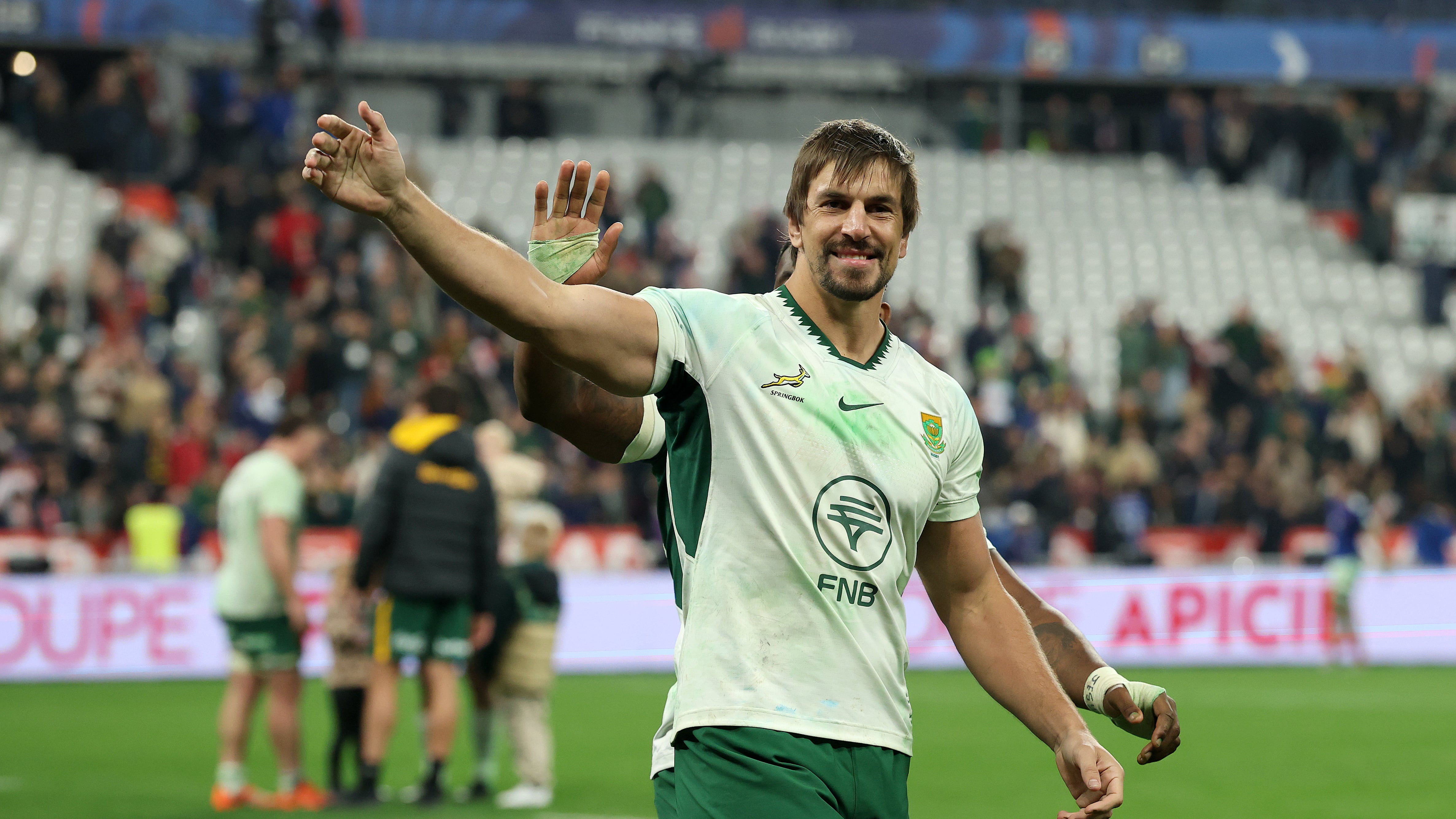

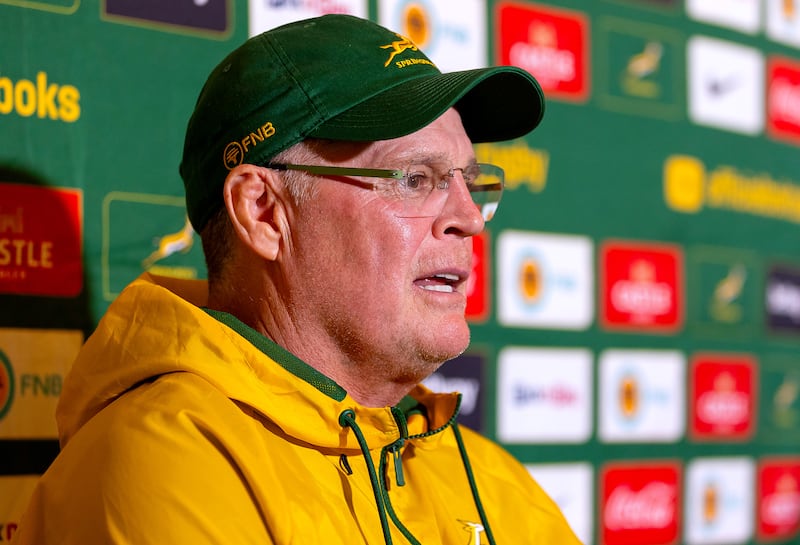
Rassie Erasmus clearly lacks faith in rugby’s disciplinary system. When predicting that Sam Prendergast will play for Ireland this weekend despite an impending citing for an alleged illegal tackle, the Springboks boss was steadfast. Confident, nay, convinced, that the Irish outhalf will get off scot-free.
The reality, though, is that no one can approach this topic with any certainty.
For one, at the time of writing, Prendergast’s citing has not yet been confirmed by the powers that be. Second, and far more importantly, any potential hearing that may happen should Prendergast not accept the citing will be a historic first. Never has a player been disciplined after the fact for a hip-drop tackle, a technique only recently outlawed by World Rugby.
Ahead of this international window, a change to law 9.13 was announced. The new wording around dangerous tackles was amended to include hip-drop tackles. World Rugby defines such a tackle as when a player “is grasped or tackled from the side or behind, and the tackler swings round or through the ball carrier, and drops their hips/body weight down on to the legs or lower limbs of the ball carrier as they are brought to the ground”.
READ MORE


These tackles are dangerous and can lead to significant injury. On the World Rugby website, the section advising of the new law warns that viewer discretion is advised when watching an advisory video.
The Prendergast incident took place during the first half of Ireland’s most recent fixture. Peceli Yato, the Fiji captain and number eight, was tackled by the Irish outhalf. Yato went on to score a try minutes later after a flurry of turnovers. He subsequently left the field due to injury.
While Australia’s Angus Bell saw yellow recently against England for a hip drop, Prendergast is the first player to be cited for such an alleged offence. The citing commissioner believes that any alleged foul play was worthy of a red card. Erasmus, for what it’s worth, agrees: “We all thought it’s an immediate red card, anyone who watched the game live.”
It remains to be seen what those involved in the disciplinary process think. While World Rugby has worked with international coaches to discuss what sorts of tackles should be removed, this is uncharted territory for any potential sanctions.
The main issue, as set out by World Rugby’s guidelines, is the level of contact on the lower limbs of the tackled player. If said contact is deemed to be minimal, then no card is warranted. If that contact is at a “higher level”, the punishment is greater.
Five bullet points are listed when determining if a player sees yellow or red for a hip drop: the level of control in the tackle; whether their feet are on the ground; the speed of the ball carrier; the severity of swinging the carrier around; and then the significance of landing on the limbs. These would all have been considered by the citing commissioner and will have come across the desk of those adjudicating Prendergast’s process.
For Ireland, there is the obvious concern of how much time Prendergast might miss should the citing complaint be upheld. If out for one week, they may well be happy leaving Messrs Frawley and Benson – the latter a potential debutant – in charge this weekend. If longer, do Andy Farrell and co consider calling up cover ahead of a Twickenham final?
Jack Crowley remains out with a vascular injury while a felled Harry Byrne was also not considered for selection ahead of this window. Joey Carbery and Jack Murphy are the outhalves involved in Friday’s second string match against Fiji.
Away from parochial selection concerns, the rest of the world will be watching carefully. Some, like Erasmus, are on the lookout for perceived bias and injustice. Others simply want to know how seriously rugby’s leaders take this new transgression.
It’s not that long ago that World Rugby looked to clamp down on head contact with severe punishment. Yet the game is still dominated by high shots and dangerous clearouts. With the hip drop, one suspects they would want to be more successful in eliminating a dangerous part of the game.
We are once again talking about Prendergast’s tackling. Only this time, for an altogether novel reason.