My mother rang me to say that John McGahern had died. It came as a tremendous shock and I sat looking out at a flock of lapwings turning black and white in the air over the fields behind the house for a long time, trying to absorb what it meant. I did not quite know it until that day, but no public figure had ever made a greater impression on me, or ever would again. It was lunchtime on March 30th, 2006.
I thought briefly about going to the funeral but felt it wasn’t my place, despite having met McGahern on several occasions. I had been taught by him in my final term as an undergraduate at University College Galway in the spring of 1993 and had been struck by his quiet, unshowy charisma. We had shared a couple of pints of bitter in a pub by Preston railway station on a cold February night in 2003 after a reading at the nearby university. Me and a few of my students had driven up from Liverpool to hear what he had to say. When I insisted that he not buy another round for them he stopped me firmly me with his half smile, declaring: “I have more money than life.” It was an unforgettable phrase, made all the more so when I discovered later that he knew he was dying.
In the months that followed that reading I heard rumours that he was unwell with cancer but was then cheered by the news in the summer of 2005 that he would appear at Galway’s Town Hall that September to read from Memoir. For anyone who was fortunate enough to get a ticket that night to a packed venue, it was a reading of extraordinary emotional depth, a mixture of levity and seriousness, looking back at a childhood punctuated by the death of his mother, when McGahern was just nine, followed by his move to the garda barracks in Cootehall to live with his eccentric and sometimes fearsome father. “It was a night,” wrote Keith Duggan (who had been part of those 1993 McGahern seminars in UCG) in this newspaper, “that most people in the attendance will carry with them through the remainder of their lives.”
I queued up to get my copy of Memoir signed along with what felt like the rest of Galway, but McGahern still made time to chat with me and share some wry memories of that winter night in Lancashire. This proved to be the last time we would speak.
READ MORE


In the months that followed his death I found myself preoccupied by the fact of his absence, by the painful idea that there would be no new work to read. That Faber have now reissued four of his books with newly commissioned introductions in addition to releasing a series of new audiobooks is a joy. Through that autumn of 2006, the feeling that I needed to visit McGahern’s grave to pay my respects nagged away at me. I contacted a few close friends to see if we might do something as a group and so, just before Christmas, some of us met up in Galway and drove to Leitrim. It was near sunset when I asked a man sitting at the bar of a Ballinamore pub if he could point me towards Aughawillan. “You’re lookin’ for McGahern?” he asked and pointed me on my way. It was as though he had been waiting for us.
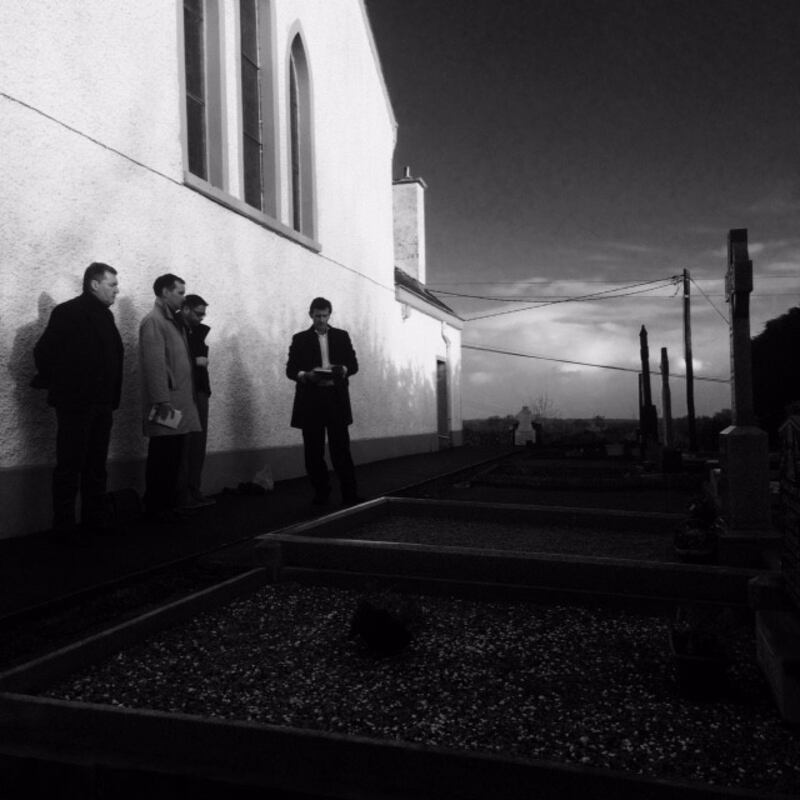
Gathered at the grave in the gloaming, we chatted, caught up with each other’s lives. To meet up had become a rarity, as happens with all friends. Things were moving on. Some of us had recently become parents, others were thinking about it. We were silent for a bit, some blessed themselves, a cigarette was lit. Then we hit on for Carrick-on-Shannon. This visit to the grave on the hill in Aughawillan became a Christmas ritual.
Within two years of that initial graveside visit, I published my first essay on McGahern as part of one of four stylish Yearbooks edited by John Kenny at what was then called NUIG, having taught for a few days in Ballinamore library the previous June at a lively summer school dedicated to honouring the author’s work. Another essay appeared the following year as I became more interested in the oblique presence of WB Yeats across McGahern’s fiction. These essays soon grew into an idea for a book on influence and literary allusion and I passed a year among McGahern’s papers in Galway, spending most of my waking hours in 2013 reading McGahern drafts. The resultant book, Touchstones: John McGahern’s Classical Style, was published in 2016.
In July 2014 I was contacted by Madeline McGahern, the person who would become by far my most important source in assembling a biography. New York-born and two weeks her husband’s senior, she had already lived a fascinating life before ever meeting John in a Manhattan restaurant in 1966. I was happy to agree to lunch in Mohill to discuss a few ideas around her late husband’s work. By the end of that day, I had visited the McGahern home in Foxfield, been shown an impressive range of archive boxes and read a couple of McGahern’s letters. For someone like me, a devotee of the work who had begun to commit my professional life to its elucidation, these hours were a humbling and exciting experience.
On leaving that day, Madeline asked me to consider editing John’s letters. While I felt instinctively that it was a job I wanted to undertake, she was happy for me to think about it for a couple of weeks before getting back with an answer. My hesitancy was about the scale of the job – I knew this would be my life for many years to come and had to be sure. A fortnight later, I said yes.
Editing the letters took seven enjoyable years. There were frustrations: letters that could not be found, letters whose recipients did not wish to share them, glancing references that I never managed to trace. But for the most part the work was extraordinarily enriching. As the project grew, I became closer to Madeline and we began to work well together, with me sometimes visiting Foxfield over several days armed with hundreds of questions. This growing closeness and trust led, by 2017, to us tentatively talking about a possible biography, and in February 2018, over a London lunch with Madeline and McGahern’s agent, Bill Hamilton, I signed up to write the book.
For a few years, work on the Letters ran alongside thinking about the biography, occasionally drafting parts of a possible chapter and thinking hard about structure. I was fortunate to win a British Academy/Leverhulme Senior Research Fellowship for the academic year 2018-19 that allowed me to all but finish editing the Letters, which were published by Faber in 2021.
I was now ready to work full-time on the biography and had a lot of the hard lifting done. I had gone through the entirety of the McGahern papers (about 50,000 pages) in Galway courtesy of funding from the Leverhulme Trust and from the University of Galway’s Moore Institute. I had transcribed and annotated some 1,200 letters, interviewing dozens of figures known to McGahern over the course of his life, leading to an 850-page book. A subsequent visiting fellowship at the National Humanities Center in North Carolina gave me enough peace and solitude to bring the biography to completion over the 2024-25 academic year. It would be hard to overstate the importance of these various funding bodies who still believe in the humanities and in the need for long, silent contemplation.
I was acutely conscious that time was running out: most of those I wished to interview had been born in the 1930s and 1940s and that generation was rapidly disappearing. I never got to speak to Seamus Heaney, Edna O’Brien, Brian Friel. I cold called Richard Murphy in Sri Lanka on a Friday from my Liverpool office. He died the following Monday.
I did not expect many surprises about my quiet, private subject over the course of my research, and that supposition proved correct. I had learned about the existence of John McGahern’s son, Joseph, while editing the Letters, discovering that after McGahern’s decision to have no part in this boy’s life, the pair subsequently met on several occasions beginning in 1979 and running through to the 1990s. I was able to isolate the precise moment when McGahern and his son’s mother, Joan Kelly, first met, when she interviewed him for the Irish Press on the publication of his debut novel, The Barracks, in 1963. I did not find Joseph, despite being given several leads – all of them dead ends. And, frankly, I was torn about this whole aspect of the research, not wishing to impose on the privacy of people who had never asked to be discovered, whether that be McGahern’s son or his first wife, Annikki Laaksi, who I also failed to find despite a number of Finnish searches.
I had better luck with unveiling other aspects of the life: one especially moving moment came when McGahern’s cousin, Liam Kelly, put me in touch with Fr Peter Dolan, a Leitrim priest in his 90s, who had spent much of his life ministering in Florida. Amazingly, he had been taught by McGahern’s mother, Sue, in Lisacarn national school and shared with me his vivid memories of her kindly teaching style.
A former student of McGahern’s, Shep Ranbom, who had been taught by the writer in Colgate University, New York, in the late 1970s and is now living in Washington, was another terrifically useful find, with a photographic recall of the writer’s preoccupations and classroom habits. Similarly, my correspondence over several years with Bob White, a former teaching colleague of McGahern’s at Newcastle University, and now a retired professor in Western Australia, allowed me to form a much clearer picture of the otherwise largely undocumented mid-1970s.
So what is it about McGahern that makes him such a worthwhile subject for biography? He lived an undramatic life after all: he never fought in a war, he didn’t win the Nobel Prize, nor score the winning goal in an All-Ireland final. He never broke the bank at Monte Carlo. But he worked hard, he thought carefully about who we are and why we’re here. He told the truth about things others would have preferred to stay hidden.
But it is, of course, for the unparalleled quality of his prose that he will be remembered. Hilary Mantel recognised him as “one of the greatest writers of our era”. Deirdre Madden has written about the fact that “there is almost something eerie about the way that McGahern’s language works. The words seem to disappear and you see the thing itself, as if unmediated.” Andrew O’Hagan comments of him: “McGahern is, in some way, in some priceless way, out on his own: his prose is richly odd, and has none of the mannered simplicity much-loved by the world’s Creative Writers. He is a writer with nerve.”
Over the course of my work on McGahern over this past 20 years I had cause to visit Paris on a number of occasions. John and Madeline spent many happy times there and it was where he wrote large sections of Nightlines and The Leavetaking in particular. When the beautiful old Irish College on rue des Irlandais was converted into the Centre Culturel Irlandais in 2002 it was to McGahern that the authorities turned for the opening. Around the corner is the magnificent Panthéon, celebrating the great figures of French civilisation, above its pillars as it peers down over rue Soufflot the words: “Aux Grands Hommes La Patrie Reconnaissante”.
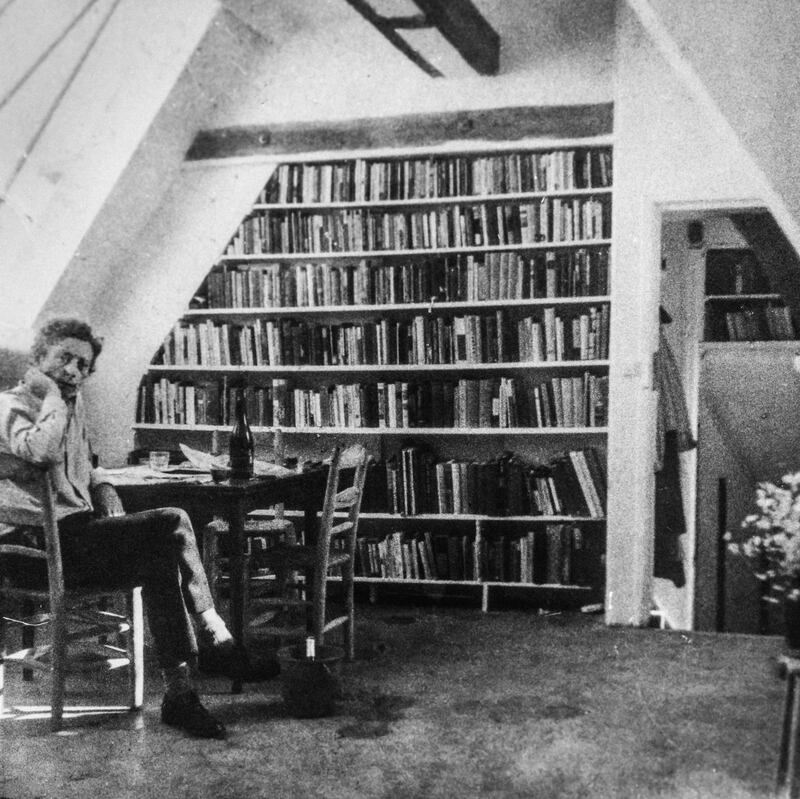
McGahern thought the categorisation of writers under national tags an idle endeavour, but nonetheless he was Irish and his work can make us feel rightly proud. We have no Panthéon to honour him – he lies with his mother in the still beauty of an Aughawillan churchyard. But we have his books to which we can return alone and in silence. “For all art,” McGahern reminds us, “approaches prayer”.
John McGahern: A Writing Life by Frank Shovlin is published by Faber. Shovlin is Professor of Irish Literature in English at the University of Liverpool