

I was away from Beirut for one week and in that time full-blown war began. The reality has once again shifted in a city accustomed to pain. I came back to a new set of circumstances, where the boundaries of modern warfare are being stretched and pushed anew; where people often question if there are any boundaries at all.
My WhatsApp groups have morphed and multiplied: the chat for my Arabic-language school and a “Friday night drinks” group have become places where people share volunteering opportunities and safety warnings or request donations.
Someone messages saying they bought blankets to distribute but need a vehicle to deliver them; another purchased groceries but needs a stove for displaced people to cook them on; they share requests for particular blood types needed urgently at particular hospitals, or a specific medicine required for someone with a chronic illness who is now cut off from their regular treatment providers.
My apartment, like the homes of so many others, appears to be inside the evacuation area. Like hundreds of thousands of Lebanon’s inhabitants, I studied a low-quality map posted online by Israeli forces on March 5th only to realise that I was seemingly being ordered to leave, with no instructions as to when I can go back. I am lucky I am not fleeing with children, elderly parents or relatives with disabilities, as so many other people are. I am lucky I have friends who have offered to let me stay.
READ MORE


The full area ordered evacuated is about 23km sq, according to Lebanese newspaper L’Orient-Le Jour. In southern Lebanon, another 832km sq is already under evacuation orders, it notes.
My neighbourhood is not in the area known as Dahiyeh, or Beirut’s southern suburbs, though it is very close to it. My apartment is in a Christian area, which is much less likely to be targeted by Israeli strikes. Why was it included in the stretch of territory now deemed a no-go zone? I have no idea.
[ Sally Hayden in Beirut: Church shelters families fleeing waves of air strikesOpens in new window ]
After I landed on Saturday, I went back there anyway, to gather some belongings and see the situation for myself. A neighbour had kindly come in to open the windows while I was gone – to prevent them from shattering from pressure if there is a blast nearby. This is the type of practical action that Beirut’s residents have become used to.
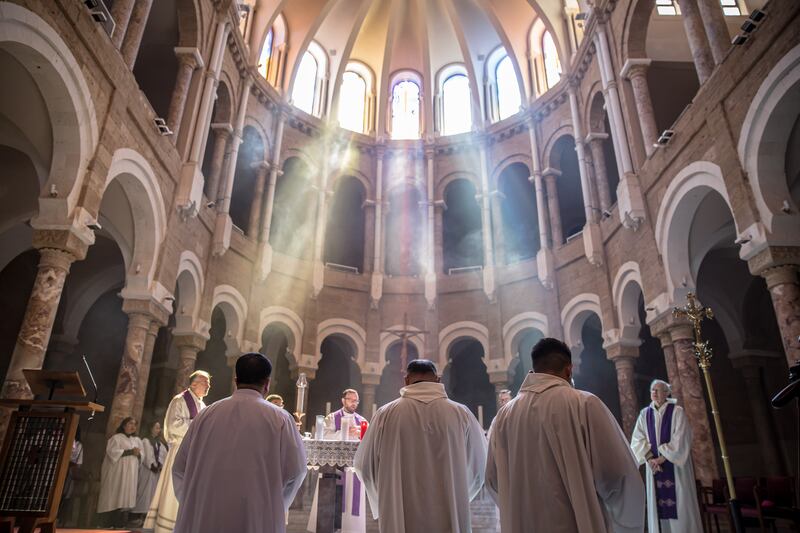
I stayed there for a few hours, organising things, until a loud drone became audible in the sky. Dusk was falling when I heard gunshots: a warning that a new evacuation warning had been posted online. I checked X, and saw that the Israeli forces’ Arabic-language spokesman had reiterated his order to leave this area, reposting the map that still included my street and my apartment. I picked up my bag of clothes and walked up the road, in the direction of safety. Straight in front of me was a church, its doors partially open, a service in progress. The priest was wishing for peace from the altar.
Somewhere between 500,000 and 700,000 people are thought to be displaced in Lebanon now, depending on which estimates you go by. People are sleeping on the streets or in shelters; staying with friends or family; renting new properties in areas considered safer, though there are not enough to meet the demand. Others have stayed put, saying they have nowhere to go and no resources to leave with.
Many in Lebanon believe – apart from this being a form of psychological warfare and collective punishment against civilians (illegal under international law) – that Israeli are trying to rile up sectarian tensions, potentially with the goal of provoking a civil war (Israel says its goals are to guarantee the safety of its own citizens, by stopping attacks from Hizbullah).
People elsewhere become afraid to rent or give shelter to displaced Shia Muslims, frightened that air strikes could follow them. Human rights organisations denounce vague and broad evacuation warnings as a violation of international humanitarian law, which prohibits the forced transfer of civilian populations, unless it is temporary and under specific conditions related to safety and military need.
As I left my neighbourhood, I stopped in front of the church to listen for a while, until the drone’s buzzing reminded me I should keep walking.
The roads were largely empty except for a vehicle with flashing lights which passed me at speed. Once outside the evacuation zone, I called a taxi through an app and got a lift to my friend’s house. The taxi driver told me that he, too, was displaced by evacuation orders: he was sleeping in the streets with his family. He, too, could not believe there was another war happening. “We are so tired,” he said.