
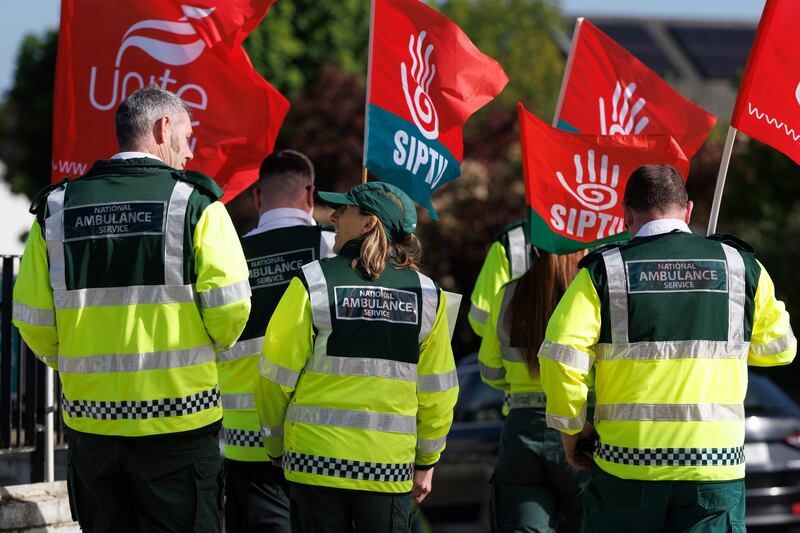
The two unions representing striking ambulance staff have been urged by the Minister for Health to re-enter talks to resolve the pay and grading dispute that prompted a 24-hour stoppage on Tuesday.
However, organisers said they have yet to be approached for talks without preconditions.
The HSE said the strike, involving about 2,000 frontline staff at the National Ambulance Service (NAS) had had “a significant impact” on services and waiting times over the course of Tuesday.
Jennifer Carroll MacNeill described the decision by members of Siptu and Unite to take industrial action as “regrettable” given the previous offer of pay increases of up to 14 per cent but said “the only way to resolve this issue is through dialogue and I strongly urge the unions to re‑engage with HSE management, which remains available to engage, to find a resolution”.
READ MORE


Taoiseach Micheál Martin also told the Dáil the only way to resolve the dispute would be “through dialogue, and through exhausting the well-established industrial relations machinery of the State”.
Siptu sector organiser John McCamley said the unions would be happy to re-enter talks without preconditions but had had no direct indication from the HSE that it wishes to re-engage.
“I keep hearing politicians say that the door is open but it would be nice if they told us where the door is because nobody has come to us.”
He said that during previous meetings HSE and NAS management had imposed preconditions on any new talks when it suggested they would have to address new crewing arrangements which staff claim compromise safety and overtime payments and which the unions say would disadvantage members who have to do overtime because of staff shortages. “But we are happy to enter discussions,” he said.
With a 48-hour strike due to take place from next Tuesday and a 72-hour one scheduled for the week after, the Irish Patients’ Association urged both sides to work to find a speedy resolution as it said patient safety is “clearly at risk” while the stoppages continue.
Speaking as Tuesday’s 24 hour-hour strike was under way, Stephen McMahon, director of the association, said: “Historically, there have been interventions when public safety and public health is at risk – and it couldn’t be more clearly at risk than today.”
Earlier, the Irish Association for Emergency Medicine warned the strike posed “a significant risk” to lives. However, trade union Siptu disputed this.
The Irish Times spoke to a number of patients and visitors outside the Mater hospital in Dublin on Tuesday. They were largely in support of the workers and believed the industrial action was a last resort.
Joe Power, from Kells, in Co Meath, said paramedics and ambulance drivers “have been waiting a long time for this, and they just seem to be ignored”.
“It’s sad to say that it has to come down to this in this day and age, and all the money that’s being wasted in the country on bicycle sheds.”
Power needed to be transferred from Navan to Drogheda via ambulance about 18 months ago and said the paramedics were “absolutely brilliant” and “couldn’t have been nicer or more helpful”.
[ Ambulance strike under way as group warns move poses ‘significant risk’ to livesOpens in new window ]
Power’s wife was undergoing a routine procedure at the Mater. The couple left Kells at 6am on Tuesday to be at the appointment on time. He was able to drive his wife to the hospital but said some patients do not have access to a lift or public transport.
Colm, who did not want to give his surname, said ambulance workers should get a pay increase.
“They’re brilliant workers; they’re the next best thing to a nurse. The work they do in the ambulance to help patients is unbelievable, and they’re not recognised properly for it. The politicians are very well recognised for what they do, which is nothing for the public,” he said.


