Trade union Siptu has denied that lives will be put at risk because of its 24-hour ambulance strike.
The Irish Association for Emergency Medicine had earlier warned the strike by 2,000 workers at the National Ambulance Service, which began at 8am, posed “a significant risk” to lives.
Pickets have been placed at ambulance bases around the country as part of the action by crews, who are members of Siptu and Unite and engaged in a dispute over pay.
Taoiseach Micheál Martin told the Dáil the only way to resolve the dispute would be “through dialogue, and through exhausting the well-established industrial relations machinery of the State”.
READ MORE


Siptu health division organiser Ciarán Sheridan called on the Minister for Health and the Health Service Executive to “come to the table” for talks.
Sheridan told Newstalk his members were disappointed they had to take such action but they were “absolutely resolute in ensuring that the additional responsibilities and roles they’ve taken on, in the interest of enhanced patient care, will be recognised”.
Despite the strike, emergency cover is still in place and patients in need of urgent medical assistance can still contact 999 or 112.
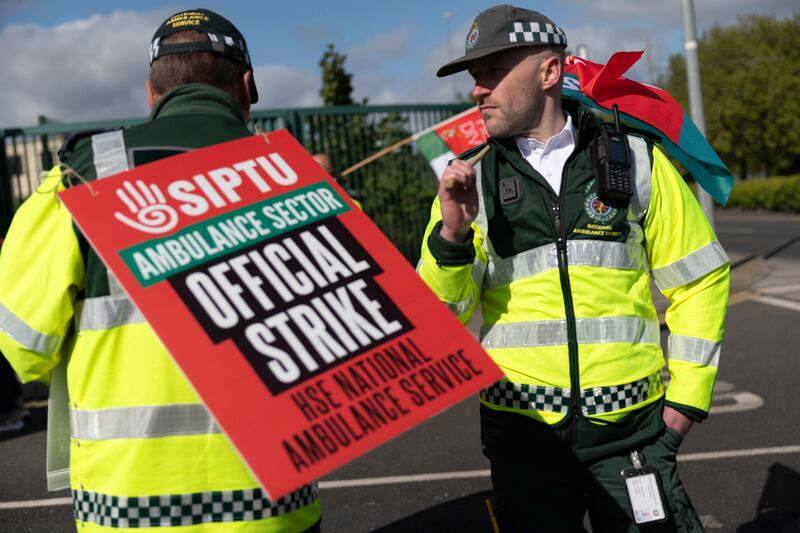
Sheridan said although some of union members were on the picket line, others were providing emergency care for the most “time-critical, high-acuity calls”.
The HSE’s clinical lead for emergency medicine, Dr Rosa McNamara, told RTÉ’s Morning Ireland emergency departments were open and urged people who need to attend, and can make their own way, to do so.
However, she said if anyone felt they needed an ambulance, they should call 999 – which would be fully staffed. She acknowledged the “reality” of the strike was the number of ambulances was severely curtailed, with 46 per cent staffing, which meant ambulances would have to travel long distances to reach sick and injured people.
The Taoiseach described as “very dishonest” claims by Sinn Féin leader Mary Lou McDonald that “this strike could have been avoided but you let the situation fester for six years”.
She accused the Government of leaving the ambulance service “stretched to breaking point” when staff started to provide full pre-hospital care.
“You have left them understaffed, overworked and underpaid,” she said, adding that the Government had forced paramedics to “fight for respect for recognition and for fair pay”.
Martin said the State had offered pay increases of between 3 per cent and 14 per cent linked to service reforms, which was “on top of the 9.25 per cent increase under the current Public Service agreement”.
He noted that “union leadership recommended this proposal to their members” and the HSE remains available to meet the unions “and there will have to be discussions on this”.
Social Democrats leader Holly Cairns said it was “outrageous” the service is operating on “fumes and workers’ good will”.
She said the services paramedics are providing mean “they have the same responsibility as other medical professionals”, but are being paid less.
Earlier, Prof Conor Deasy of the Irish Association for Emergency Medicine said the dispute needed to be resolved “very quickly”.
“It should never have gotten to this point. It’s dangerous for patients. There’s no question.”
The Irish Times spoke to a number of patients and visitors outside the Mater hospital in Dublin on Tuesday.
Joe Power, from Kells in Co Meath, said he “absolutely” supported the striking workers and believed their industrial action was a last resort.
“They’ve been waiting a long time for this, and they just seem to be ignored,” he said. “It’s sad to say that it has to come down to this in this day and age, and all the money that’s being wasted in the country on bicycle sheds.”
Colm, who was also visiting the Mater on Tuesday, said ambulance workers should get a pay increase.
“They’re brilliant workers, they’re the next best thing to a nurse. The work they do in the ambulance to help patients is unbelievable, and they’re not recognised properly for it,” he said.
“The politicians are very well recognised for what they do, which is nothing for the public.”
A female patient who wanted to remain anonymous said she also agreed with the strike. Her husband had a heart attack earlier this year and was rushed to the Mater via ambulance. Emergency personnel carried out an electrocardiogram (ECG) on him in the ambulance and did their best to revive him, but he did not survive.
“They were brilliant,” she said, adding that the workers “deserve to be looked after”.
The long-running dispute involving about 2,000 members of Siptu and Unite, is over grading and pay related to a programme of modernisation within the service.
It was the subject of a report in 2020. Two sets of proposals brokered by the Workplace Relations Commission (WRC) were rejected by more than 70 per cent of those who participated in a ballot.
The HSE said the proposals included provision for pay increases of between 3 and 14 per cent, in addition to those due under national public sector pay deals.
The unions, however, said the action was tied to future changes in work practices, when changes already in place had not been adequately addressed.
The HSE has called for a return to talks under the auspices of the WRC or Labour Court. However, John McCamley, Siptu sector organiser, said there was a precondition that they would discuss future changes.
“We’re not averse to that but we need the historic issues to be dealt with first.”
People Before Profit TD Richard Boyd Barrett said ambulance workers provided paramedic care and saved lives and there had been “a failure” by the HSE and Government “to recognise the demands of ambulance workers for their pay to acknowledge the level of skill, the level of training, the level of professionalisation of ambulance drivers”.
The strike is to continue until 8am on Wednesday. If the dispute is not resolved, a 48-hour strike is scheduled to start next Tuesday, with a 72-hour one the week after that.


