
What were the key themes at the Cop31 climate summit in Antalya, Turkey, over the past few weeks? And what, if anything, was achieved?
The science
“Global warming is accelerating. We are inevitably exceeding the 1.5 degree limit and entering, at best, overshoot.” So began Johan Rockstrom’s address at the United Nations summit’s science plenary earlier this week.
The renowned Swedish scientist had worse news. The rate of emissions growth has declined slightly, so emissions alone can’t explain why temperature is rising so fast.
“This is very concerning as it cannot be explained only by forcing,” he said. “It is a combination of forcing but also feedbacks in the resilience of the Earth’s system.”
READ MORE


That means the planet is losing the ability to absorb and/or repel the extra heat human habits keeping loading on to it.
Remarkably, the summit was divided on this state of affairs, arguing over how to acknowledge it and whether to support the Intergovernmental Panel on Climate Change (IPPC) to complete its next global assessment.
The panel is the world’s climate science body and its next report is due in 2028.
The approach favoured by largely petrostate delegations was to obstruct the IPCC by starving it of funds, delay the assessment and dodge responsibility.
“It’s unfathomable how we’ve got to it but in a sense we’ve seen the denigration of the science taking place over the past few years,” said John Sweeney, professor emeritus of climatology at Maynooth University. “Denial has become almost default in some areas.”

The money
Money makes and breaks Cop – short for Conference of the Parties – summits and the discussions around it this year were particularly fractious.
Previous Cops acknowledged a need to increase climate finance for poor countries to $1.3 trillion annually (€1.17 trillion). But progress has been slow, with the EU taking an unusually firm stance on not increasing amounts this year.
Sinéad Walsh of independent think tank ODI Global believes there was some justification for this position. “There’s a lot more money going into security,” she says. “The need to support Ukraine is probably not disputed by too many people at this Cop. There are domestic pressures like in France.”
In arguments that can expect to be repeated at future Cops, the EU wants to broaden the contributor base, still confined to countries categorised as “developed” when the Cop process began in 1992.
“The world has changed since 1992. The list of countries that are known as ‘developing’ – some of them are so wealthy and some of them from fossil fuels as well,” Walsh says.
“There are also things that can be done that are not going to cost the exchequer money,” she adds. Easier access to existing finance and debt reform are just two. “The EU also wants more private-sector finance.”
Bríd McGrath from Oxfam Ireland proposes a more direct approach.
“We keep hearing there’s no more money,” she says. “There is money. But there isn’t the appetite to go after where the money is.”
Oxfam has calculated a minimum of €1 billion could be raised in Ireland through a tax of 1 per cent on the 1 per cent – the richest in society. “Imagine that on a global scale,” McGrath says.
Tax on private jets would raise another €45 billion globally, and a windfall tax on energy profits a further €45 million.

The geopolitics
Stereotypes tend to prevail at Cop with the EU the good(ish) guys, petrostates bad, China and India with a foot in each camp, the US a ghost and least developed counties (LDCs) and small island developing stats (SIDs) the moral compass for all.
Some odd coalitions crop up too, such as Saudi Arabia, Russia and the Holy See – dubbed the “unholy alliance” – which joined forces to object to enshrining gender rights in various texts.
Meanwhile, Russia, China and the US met outside the summit, jointly pledging to pump more oil.
But there could be changes in future, McGrath said, with Africa calling more of the shots. “If Africa understood its power in the way that Opec [oil-producing] countries did in the 1970s, the balance of power would shift,” she says.
“Africa has rare earth minerals, a growing population and a growing economy. By 2050, a quarter of the world’s population will be African.”
Walsh spots other changes.
“The thing that people are talking about at this Cop is that India [the world’s third largest emitter] is very absent,” she said.
Very few heads of state turned up to Cop31 but it may be too soon to tell if that is a blip.
“A Cop in Turkey shouldn’t be that badly attended by heads of states,” Walsh said. “But the timing [it coincided with EU events in Dublin ] was unfortunate.”

The personalities
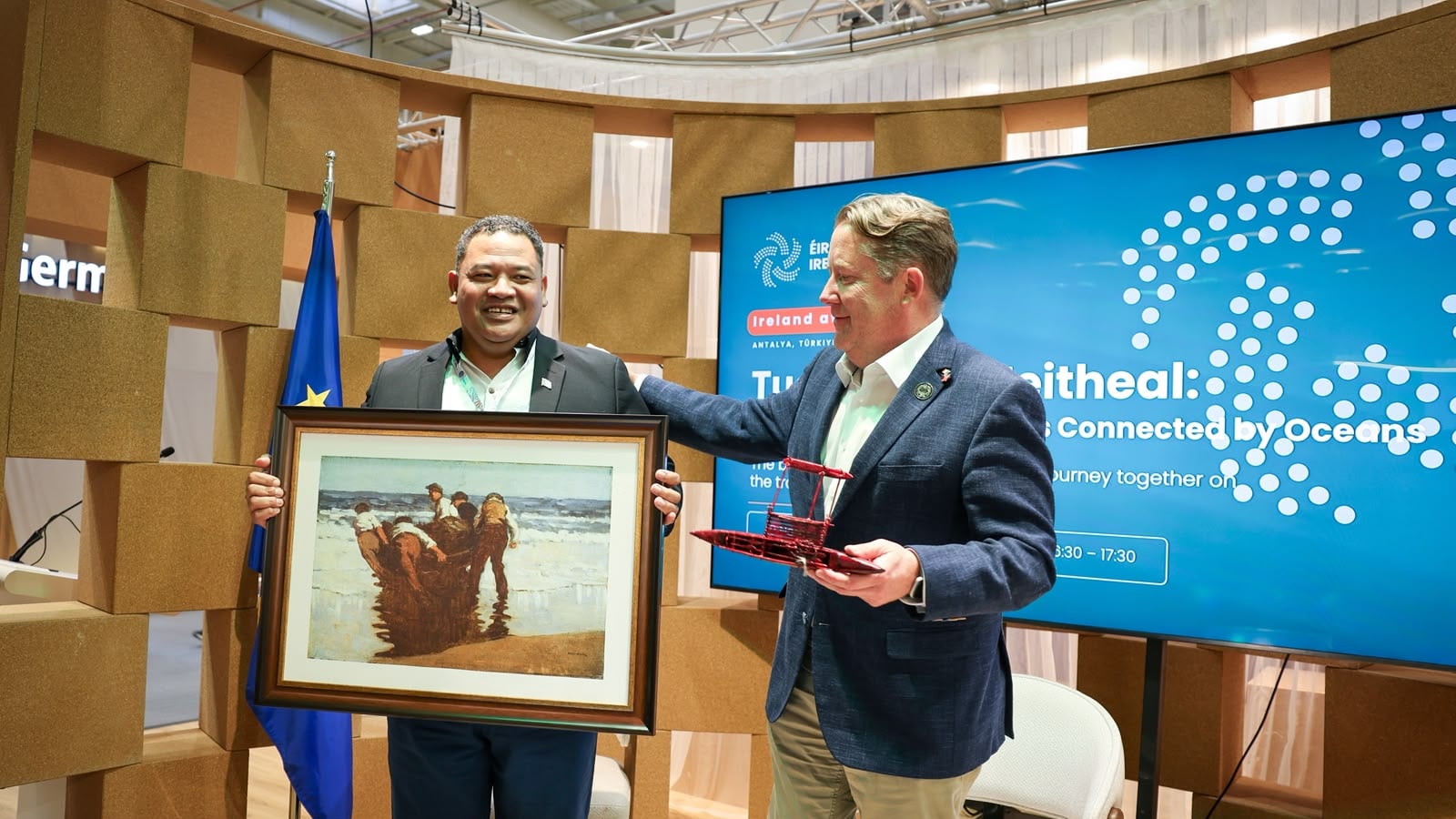
Maina Talia, climate, environment and home affairs minister for the Pacific island nation of Tuvalu, is a direct speaking politician and smooth in international diplomacy despite only being in politics a few years.
He’s also a theologian and philosopher.
His PhD examined the threat posed by climate change to Tuvalu “through a lens of what it means to be a neighbour”.
In Tuvalu, the word for neighbour is “tuakoi” but the meaning is broader.
“Tuakoi is the moral responsibility of being a good neighbour, which is beyond geographical proximity and across oceans,” he said at the event to launch Ireland and Tuvalu’s co-hosting of the Transition Away From Fossil Fuels conference next year. “It asks us to care for one another because of our shared humanity.”
Expect to hear more from him in the year ahead.
Gita Chaudhary, Nepal’s minister for agriculture, gripped one of the summit’s largest events by recounting the deadly flooding in her country last August. An articulate writer, quiet speaker, powerful communicator, she also likely to become familiar in future years.
Mary Robinson was yet again a huge draw and her schedule a source of some awe.
An average day saw the former president of Ireland give an address, do a TV interview, convene a media huddle, moderate a panel discussion, join talks in official delegation rooms and then slip into unofficial meetings to try to coax obdurate nations to soften their stance. But then, as one observer quipped, she is only 82.
Greta Thunberg popped in for her first Cop in a while and, although she has taken up other causes – she was en route to Albania to support antigovernment protests – her influence on proceedings is undoubted.
Few of the young people at Cop31 now studying or working on sustainability issues – inside or outside of governments – would say Thunberg was anything other than an early inspiration to them.

The questions
Can industry lobbyists ever be kept away? Not only big oil had representatives at Cop31 but big gas, big tech, big agriculture and – that new, much-hyped enterprise – big carbon capture.
The Kick Big Polluters Out coalition counted more than 100 corporate giants that sent delegations. There is an argument that the climate crisis can’t be solved without them but they’re clearly not all here for the good of the planet. Sometimes they have roles in governments too, so they get to lobby themselves.
Will the United States ever come back? This year more than any, the absence of US voices was striking.
The America Is All In delegation of climate-conscious governors and mayors was exuberant – especially after Democrat gains in the US midterm elections – but the media rooms were devoid of US representatives.
If the American people aren’t reading and hearing about the climate crisis, will they vote with it in mind? Will the next US president, sympathetic to the cause or not, feel it worthwhile to return to the fold?
Is the “action agenda” the way forward? While Cop agreements are the ultimate aim, the consensus rule means it only takes one country to object and the proposal falls.
Hence the usually weak wording of the final “cover decision”. But alongside formal negotiations, groups and alliances of countries work on initiatives that can make a difference.
The Transition away from Fossil Fuels (Taff) movement is one, composed of countries fed up with waiting for all nations to act on the Cop28 pledge to starting breaking the link with coal, oil and gas.
Are Cops still worth it?
John Sweeney has been to more than most and has reasons to be cynical, but takes a measured view.
“A hundred thousand people at Cop is a new record. It does indicate that there is a groundswell coming from somewhere,” he says.
“It may be not coming from the governments, it may be not coming from politicians but it does indicate that maybe we’re seeing a turnaround, especially in the grassroots concerns for climate.”