
Tapalpa’s tranquil, scenic charm belies its reality. Its pine-covered hills in western Mexico are the heartland of the country’s most ruthless criminal group, the Jalisco New Generation Cartel.
Wealthy families and tourists visit for long weekends to ride horses, hike the highlands and race motorcycles on the winding roads.
That peace was shattered on Sunday morning.
Mexican military forces were sweeping into a nearby residential compound after learning that the country’s most-wanted cartel boss was meeting his lover there.
READ MORE


Residents barricaded themselves inside their homes while helicopters thundered overhead and explosions cracked in the distance.
Details are emerging about the military assault to capture Nemesio Oseguera Cervantes, known as El Mencho, leader of the Jalisco New Generation Cartel. The raid triggered hours of gun battles between cartel gunmen and federal forces, leaving at least 58 people dead in Jalisco state, including Oseguera.

For Tapalpa residents who bolted their doors as special forces fanned out in the hills, it still feels surreal. On Tuesday, many said they were still struggling to absorb that one of the world’s most wanted fugitives had hidden nearby, and that their quiet town had become the stage for his final hours.
“It was like something out of a movie,” said Paulina Silvestre, who spent the morning listening to circling helicopters. “It’s just hard to believe it really happened here.”
The gated neighbourhood where El Mencho had camped out was closed to all but residents. Surprisingly, there were no police or military around, but a security guard stood at the gate turning cars away.
About a mile away is Cabañas La Loma, a residential compound and cabin rental business on the outskirts of Tapalpa that had sanctions imposed on it by the US treasury department as far back as 2015 for its Jalisco cartel ties.
[ ‘Mexico is losing everything’: Expats in Ireland react to violence at homeOpens in new window ]
From a distance, the development looks like a picture-perfect mountain sanctuary. Inside, a single cobblestone road snakes up the hillside between 10 large wood and stone cabins. Children’s playhouses dotted the yards and a tennis court stood to the side.
But up close, it was a crime scene frozen in time.
The streets, driveways and doorsteps were littered with dozens of spent shell casings, including jackets of .50-calibre rounds used for military weapons. Fires burned just beyond the homes.
The neighbourhood bore signs of a panicked exodus: front doors left open and windows shattered. Inside some of the homes, clothes were thrown across unmade beds, drawers ripped out and closets half emptied.
One livingroom was cluttered with an oxygen tank, syringes and a spread of pharmaceuticals: antidepressants and specialised medications for kidney failure.


The walls of several homes were pocked with the jagged craters of bullet impacts.
Yet, despite the markings of extreme violence, the scene was surprisingly unsecured. No law enforcement officials guarded the compound or the roads leading to it.
Such a lack of oversight is common among Mexican law enforcement, who have a long history of leaving high-stakes crime scenes unpoliced and allowing critical evidence to be tampered with – or lost entirely.

The killing of 'El Mencho': Why Mexico decided to take on the cartels
“Since it was a federal operation, the agency responsible for securing the scene is the attorney general’s office,” said the state government of Jalisco, adding it had no other information about the site.
The attorney general’s office did not respond to a request for comment.


Some Tapalpa residents said they struggled with accepting that a powerful figure such as El Mencho could be caught, much less killed. After all, he had eluded Mexican and US authorities for more than a decade, building in under 15 years a vast criminal network that moved drugs across continents.
“We never saw a picture of the body. I can’t actually believe he’s dead,” said José Luis López, a jewellery store manager near the main town plaza. “He was too powerful. He had too much money. And the government needed to prove something.”
[ ‘El Mencho’: His cartel, his death, and what happens nextOpens in new window ]
Unlike other notorious drug lords such as Joaquín Guzmán Loera, known to the world as El Chapo and whose prison escapes and carefully crafted legend made him an outlaw folk hero to some, Oseguera inspired no such romanticism.
In Tapalpa, El Mencho was less a celebrated myth than a powerful presence to endure. Residents said they did not know Oseguera was hiding out in Tapalpa, but it was widely understood that his cartel controlled the region.
Oseguera, colloquially known as Señor de los Gallos, Spanish for “Lord of the Roosters” for his passion for cockfighting, kept close to his rural origins. He was known to frequent local arenas where cockfights are held amid blaring music, while men in cowboy hats crowd the rails.


There is a complicated consensus that Oseguera’s command brought a chilling brand of stability, an order, however brutal, imposed by the cartel.
“We know they’re here. They control everything and everyone with violence, with money, with influence,” said Gilberto Peregrina, an employee at the local grocery store in Tapalpa. “But they don’t bother the population.”
This brittle stability came not just from the cartel’s influence, but from the state’s tactical withdrawal.
A state police transit officer speaking on the condition of anonymity for fear of reprisals from both her superiors and the cartel described a state police force that turned a blind eye. There were standing orders not to intercept or question suspected cartel members, she said, and a tacit understanding that state police units avoided certain sectors without explicit clearance from criminal bosses.
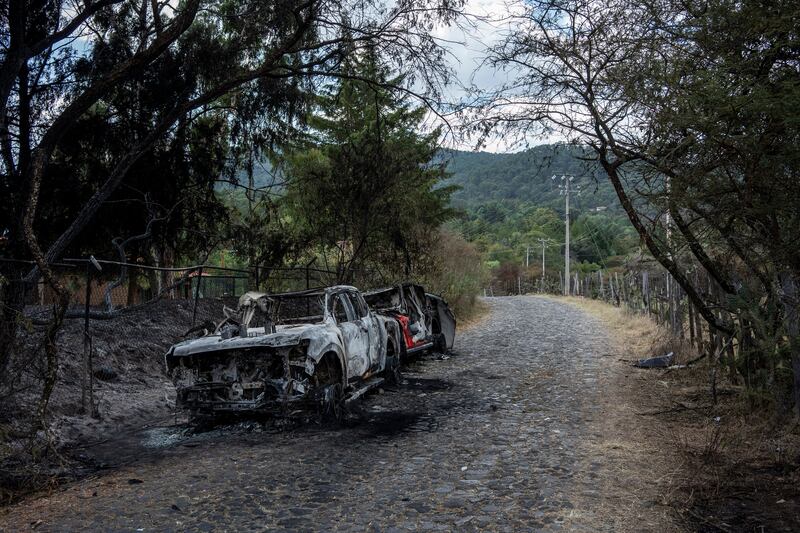
The cartel can corrupt every level of authority, she said as she looked toward the highway that was blocked by a charred bus just a few miles from the town.
They are the real authority in the area, she said.
The state police’s office did not respond to a request for comment on the accusations.
Along the highway that winds roughly 82 miles north from Tapalpa to Guadalajara, the capital of Jalisco state, the aftermath of Sunday’s violence was hard to miss.
At least a dozen vehicles laid incinerated along the road: blackened frames of tractor-trailers, compact cars and public buses, several still smelling of acrid smoke. The transit police officer said that they had found more than 50 burned vehicles and had already removed most of them from that stretch of highway.
At one point, as the photographer and I stopped to document a cluster of four incinerated cars, a man in a white SUV slowed as he passed. He leant out of his window, frantically shouting.
“This is terrorism!” he yelled over the engine. He paused, then added a defiant statement. “But we are okay!”
This article originally appeared in The New York Times.
2026 The New York Times Company


