
Yves St Laurent fell in love with Marrakesh. The fashion designer first visited the Moroccan city in 1966; before he left, he’d bought a house in the medina. But the attraction wasn’t instant.
For the initial four days, ferocious rain prevented St Laurent from leaving his hotel. When the sun eventually appeared, the city’s palette profoundly affected him. Until the fashion trailblazer’s death in 2008, he visited the city twice a year to design his collections.
“Marrakesh,” St Laurent said, “has opened me to colour.”
I’m standing in the museum that attests to the deep relationship between the city and the couturier. Opened in 2017, it displays collections ranging across 40 years of St Laurent’s haute couture designs.
READ MORE


Stepping in from the blazing Marrakesh sunshine, the first thing that hits me is the darkness. Black was an essential element in St Laurent’s oeuvre. The pronounced emphasis on this colour in the hall housing the permanent exhibition of his fashions, presented simply on mannequins, creates a hushed atmosphere – it feels like being inside a spacious, air-conditioned capsule.
The exterior of the Musée Yves St Laurent is equally arresting. The building’s striking curves reflect the designer’s inimitable style, and the latticework of protruding bricks evokes the weaves of fabric.
Underlining the fashion giant’s connection with the city, the museum’s terracotta brickwork echoes the ochre-coloured sandstone that gives Marrakesh its moniker: Red City.
This hue is expressed most elegantly in Koutoubia Mosque, the meeting point for my walking tour of the city with Mustapha. He is a Berber, the indigenous people of Morocco who inhabited the region before the arrival of the Arabs. “In the Berber language,” Mustapha tells me, “Marrakesh means ‘Land of God’.”
The former capital city is an indisputable protagonist in the national narrative: until the start of the 20th century, Morocco was known as the Kingdom of Marrakesh. Today, it’s a wide-awake, polyphonic city, the most-visited in Morocco and typically tourists’ first taste of the country. Koutoubia Mosque is the symbol of Marrakesh.

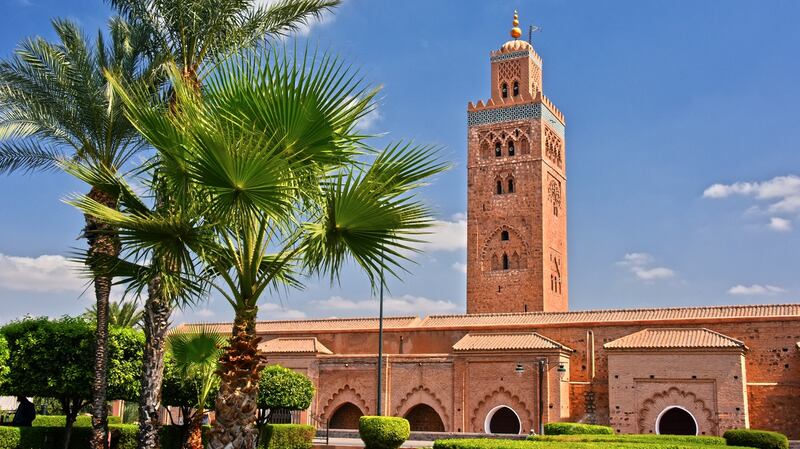
Its 77m minaret tower – emblazoned with arches and crenellations – is the highest building in the city. The minaret was built in the 12th century, but the extensive scaffolding on one side reflects more recent history: it sustained major cracks during the earthquake that struck Morocco in 2023.
Pale green tiles decorate the neck of the spire. Mustapha explains that the colour is intentional for its strong connotations with Islam and peace. In a frenzied city, there are overtures of calm in the adjacent, palm-tree studded Koutoubia Gardens.
We follow Mustapha through this public park, past rose bushes and clusters of fig and orange trees, on our way to the kasbah. Inside the coral-coloured walls of this fortress, we smell the pungency of tanneries and hear loudspeakers broadcasting, in the words of Colum McCann in his novel Twist, the “haunting praise” of the call to prayer.
Mustapha shows us to a street that was the shooting location for a Pepsi ad promoting the 2022 Fifa World Cup in Qatar. The soft-drink brand used Marrakesh’s kasbah as it resembles Doha’s “old town” – but it sparked controversy among Moroccans who accused Pepsi of cultural appropriation.
But the quarrel was eclipsed during the tournament when Morocco became the first African country to reach the semi-finals in the history of the World Cup. Football is the country’s favourite sport and lots of is played in Morocco: the Africa Cup of Nations took place here recently and in 2030 the country will co-host the World Cup with Spain and Portugal, the inaugural time the competition will be held across two continents.
These set pieces are part of Morocco’s attempts to become one of the world’s top 15 tourist destinations. In 2024, Morocco welcomed more than 17 million international visitors, pushing it past Egypt to the rank of the most-visited country in Africa. By 2030, Morocco wants to attract 26 million tourists annually.


In the contentious Pepsi ad shot in the kasbah, body doubles were used for Ronaldinho, Paul Pogba and Lionel Messi. Those star players have accumulated vast fortunes in their careers, but the cross-legged musician that Mustapha brings us to on a nearby street is asking for a humble payment for his toil.
In front of him is a simple board with a thumbtacked, laminated white page that reads: “We are artists. This does not mean we work for free. We have bills to pay just like you”.
Dressed in a flowing, chestnut-brown kaftan and wearing an embroidered, baby blue fez, he plays Gnawa music – a tradition that originated in sub-Saharan Africa. With Mustapha joining him on iron cymbals called qraqeb, the musician plays the guembri – a guitar-like instrument but with three strings, which are made from goat gut.
The penultimate stop on our tour is a Berber pharmacy. Cement-sized bags of hibiscus, rosemary and other dried plants flank the entrance, and the place is infused with a Willy Wonka sensibility. On display stands in the middle of the shop are huge bowls of kaleidoscopic spices: cumin, nutmeg, turmeric and saffron.
On each wall, above the benches where we sit, wooden shelves reaching to the ceiling are crammed with glass jars of pastel-hued natural herbs for a platoon of ailments. Spry, white-coated staff explain what these natural remedies can treat, placing some of the herbs and spices, as well as oils, under our noses so we can inhale their healing fragrances.
Our walking tour culminates in the city’s sprawling, frenetic main square, Djemaa El Fna. Its history stretches back 1,000 years to the very inception of Marrakesh. In this century, Unesco included the square in its List of Intangible Cultural Heritage of Humanity.


It’s around midday when we arrive and it’s hard to reconcile this accolade with what we see here. As we dodge speedy mopeds and delivery vans and decline the entreaties of the pushy hawkers of counterfeit attire (including “Kalvin Klein”-branded underwear), the site’s more unpleasant aspects are evident.
Most blatant are the handlers who try to coax tourists to pose with their chained monkeys dressed in Little Red Riding Hood outfits and Barcelona jerseys. But when I return in the evening, I get a sense of why Djemaa El Fna is a place to watch the cinema of life.
Hundreds of stalls freckle the square – their twinkling lights in the dusk set against the backdrop of the Koutoubia Mosque’s illuminated minaret. Djemaa El Fna morphs into a carnivalesque amphitheatre for acrobats and dancers, henna-tattoo artists and fortune tellers.
Whole rows of stalls sell fruit juices, including smoothies made primarily from dates or avocados. At one stand, three smiling men dressed in identikit Morocco national team soccer jerseys, rosé coloured-aprons and lipstick-red fezzes shout “Hi!-Hey!-Hello!” to grab the attention of passersby.
A Palestinian flag is draped behind them, and the front of their stand presents their fruit – oranges, kiwis, peaches, apricots and more – in fastidious interlocking triangles, the crimson pomegranates resembling a luscious pack of reds on a snooker table.
As the variety of food stalls and the activity in the square can be overwhelming, I join a street-food tour – the lens through which I can browse some local specialities. Led by Abdul, we stop at various vendors in the square, sitting beside Marrakshis on benches arranged in a U-shape around the stall kitchens.
At one, we watch a laser-focused chef preparing explosive “magic bread”: he frantically fills round, sliced flatbread – the ubiquitous khobz – with mashed potato, egg salad, cheese, olive oil and chilli. Later, we try red and green olives marinated in spices, piled high in enormous ceramic bowls, and use toothpicks to extract gluttonous, rubbery snails from their dirty white shells.
The highlight is a bowl of harira, thick orange-brown soup made of tomatoes, chickpeas and lentils, with chebakia – a sweet, crunchy dough that’s deep-fried, smothered in honey and encrusted with toasted sesame seeds.
With a few chebakia still on the table, Abdul tells us his grandmother used to say: “The person who finishes the last bit of food is rewarded by God.” Then he quickly concedes that her motivations might’ve been more prosaic. In a master deadpan, Abdul suggests: “It’s also a way to avoid waste.”
No space is wasted in the Majorelle Garden, a botanical wonderland of more than 300 plant species from five continents. Attracting more than 900,000 visitors each year, it’s Morocco’s most popular tourist sight.
Created by the French painter Jacques Majorelle, the landscape garden is studded with pools and fountains, bamboo and jasmine plants, cypress and palm trees. Its founder trademarked Majorelle Blue – an intense, vivid shade of blue with notes of cobalt and ultramarine.
That and an Easter-chick yellow dominate the garden’s colour wheel, most startlingly in their interplay in the Art Deco-style Berber Museum. Some of the visitors are very considered in their attire: one woman with a floppy sun hat is dressed in a lemon-tinted and Majorelle Blue-printed dress.

After the painter’s demise, St Laurent bought the garden in 1980 to ensure it remained open to the public and to preserve Majorelle’s legacy. The garden is next door to the museum built in honour of the fashion designer, on the street now named Rue Yves St Laurent. “Marrakesh, for me,” he frequently said, “is paradise”.
When St Laurent died in 2008, his ashes were scattered in the Majorelle Garden so that he could forever remain in the city that he loved.
Guide to Marrakesh
Getting there: Aer Lingus flies from Dublin to Marrakesh from September to May. Ryanair flies from Dublin to Marrakesh year-round.
When to go: The high season is March to May and September to October. The shoulder season is November to February.
Tours: I joined a free Guru half-day walking tour of Marrakesh with Mustapha. Rather than paying a set price, at the end you give the amount you consider appropriate. The suggested minimum is €15.
The street-food tour with a local guide costs €27. Skip the queues for the Musée Yves St Laurent, Jardin Majorelle and Berber Museum by buying your tickets online. You can select a ticket, specifying the date and time of your visit, for one of these sights or for a combination.


