
The French-Irish film-maker Alexander Murphy grew up in Paris but spent his summers and Christmases in Ireland. He became fascinated with the Traveller community, an interest that has coalesced into Tin Castle, his warm and intimate portrait of Traveller life.
“I’ve always been curious about the Traveller community,” he says. “But when I was younger, whenever I asked questions about them, I’d get the same sort of response: ‘Be careful Don’t get too close.’ Or: ‘You shouldn’t go there, because they can be dangerous.’
“It was always the same story, and I never got a proper answer when I asked why. I felt there was a real disconnect. I couldn’t understand why there was so much stigma surrounding a community that is Irish. It seemed strange to hear people in my own environment so openly reject this community.”
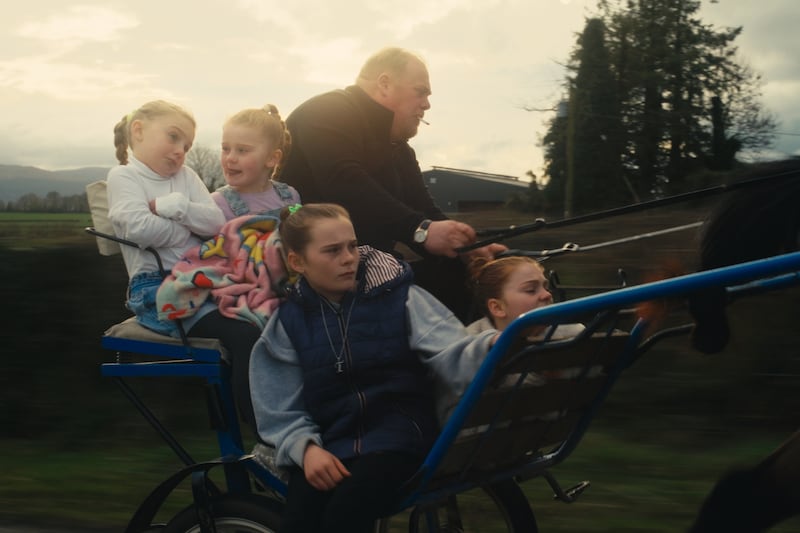
Murphy spent several years meeting different Traveller communities. He felt an immediate connection with the 12-strong O’Reilly household, who live in a mobile home in rural Co Tipperary. They’re outsiders even within the Travelling community, continually facing eviction threats, generator failures and the vagaries of the weather. They equally enjoy horse rides, ice-cream cones and rambling through grassy fields.
READ MORE



“I connected with the children first. There was something very unique about the place where they lived,” Murphy says. “It felt completely isolated from everything, both from wider society and from the surrounding community. The first time I met them was almost like something out of a fairy tale. I was in the middle of nowhere, and I saw this little mobile home.”
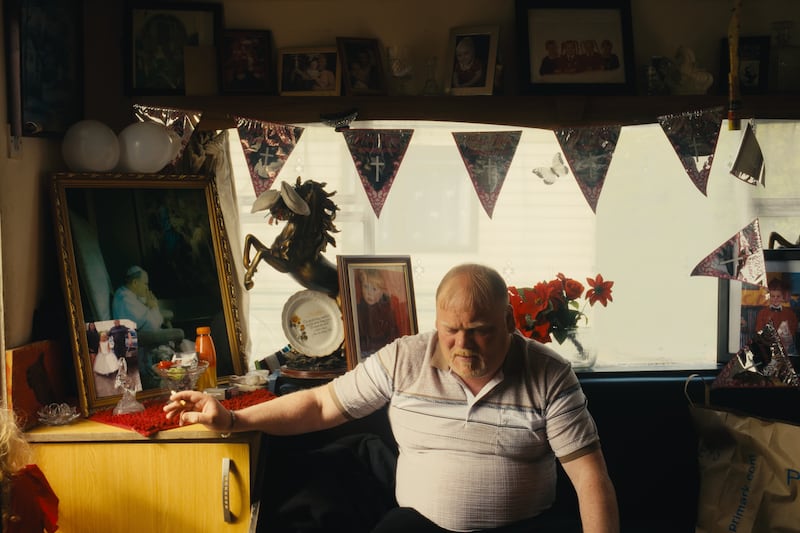
It was the sight of Pat O’Reilly, the family’s imposing father, that really struck Murphy.
“One child came out, then another, then another, and eventually Pat appeared through the door. When I first saw Pat I thought he looked like a work of art, almost like a sculpture. It was such a strange and wonderful thing.”
John Wilson’s upcoming documentary The History of Concrete shows that even the most apparently mundane subject can become an unexpectedly expansive piece of cinema. The sustained fake-out of You Can See Everything has seen Nathan Fielder’s film become a global box-office sensation.
Murphy’s methodology is more painstaking and old-school than these voguish titles. Shot between the summer of 2020 and the spring of 2026, Tin Castle follows O’Reilly, his wife, Lisa, and their 10 children as the youngsters dress up for weddings or count cars as they pass on the road.

In common with The Flats, the Italian film-maker Alessandra Celesia’s arresting 2024 documentary about the residents of a New Lodge estate in Belfast, Murphy’s outsider status was a way in, not a hindrance.
“I do think the fact that I’m not completely Irish also helped,” Murphy says. “I’m half-French, so I was this slightly strange guy with a funny accent, a mixture of Irish and French. I suppose I was a bit of an exotic figure to everyone.
“The fact that I had a very small camera and was working alone at the beginning helped too. They probably thought, ‘Well, you can make your little film or your video, but it’s not really going to go anywhere.’ They didn’t take it particularly seriously.”
The film has been much lauded since its premiere at Cannes, during Critics’ Week – a rare documentary entry in that competition. The French culture site aVoir-aLire remarked that it’s a “long time since we have seen a documentary of such power, where every scene, every patch of light, every musical tremor breathes beauty”.
French audiences have flocked to see the film since it went on general release there last month. “We’ve reached 34,000 admissions, which is very high for a documentary.”
It remains a tricky task, Murphy says, to explain Irish prejudices against the Travelling community to the French.
“It’s quite shocking how normalised this attitude still is. It’s almost as though this is the one community towards whom it’s still socially acceptable to be racist.
“Whenever I talk about this in France or elsewhere, people are surprised. The Irish are so well known for being welcoming, warm and kind – and they are. But that warmth doesn’t always extend to the Traveller community.”
Travellers have occupied an uneasy space on screen. Early films such as Paul Rotha’s No Resting Place, a social drama from 1951 following a Traveller family, established a tradition of depicting their lives through the lens of poverty, exclusion and conflict with settled society.
Later Irish films, including Joe Comerford’s Traveller, Mike Newell’s Into the West and Gillies MacKinnon’s Trojan Eddie, often presented Travellers as swashbuckling, romantic outsiders, emblems of an older, disappearing Ireland.
Pavee Lackeen, Perry Ogden’s carefully observed 2005 film, switched the narrative, its intimate docudrama pivoting around 11-year-old Winnie Maughan and her family. Blurring the boundaries between fiction and documentary, it offered a careful, close, unsentimental portrait of contemporary Traveller life, with the family playing versions of themselves.
More recent films, such as Float Like a Butterfly, Carmel Winters’s 2018 drama about a young Traveller girl determined to become a boxer, have sought to provide more nuanced, sympathetic portraits.
Television and social-media platforms offer a very different perspective. The Channel 4 series My Big Fat Gypsy Weddings remains a ratings winner, but its emphasis on ostentatious nuptials and teenage relationships has attracted fierce criticism for doubling down on stereotypes – and for conflating distinct Traveller and Romany communities.
Murphy, who wanted to correct some of the less-flattering portrayals, ensured the O’Reilly family had a say in the final cut of Tin Castle.
There’s a moment in the film when Patrick, one of the older sons, simply turns off the camera. As invisible as Murphy’s presence became over the long shoot, there was always a stop button.
“I kept showing the kids little edits whenever I came back,” Murphy says. “I’d bring my computer and show them some of the footage I’d put together, and they loved it. They really enjoyed seeing themselves, and the parents did too.
“As for Patrick turning off the camera, that was part of the way we worked. It wasn’t a conventional professional shoot, with someone constantly shouting ‘Action’ and ‘Cut’. It was very free. The children could do whatever they wanted with the microphone or the camera. In a way, the camera became part of the family, almost an extension of it.
“When Patrick turned the camera off I was initially quite surprised. But when I watched the footage again during the edit, I realised how extraordinary that moment was. Suddenly, he became the director of the film.”
Murphy was keen to show the O’Reilly family a rough cut of the film ahead of its Cannes premiere.
“It was a wonderful moment, because it was the first time the children had ever been to the cinema,” he says. “When they saw the film, I think they felt a sense of relief. They realised it wasn’t just another documentary about Travellers. I think they were very proud to see themselves on screen and to see themselves portrayed in a different light.
“They actually told me that the only thing they wanted to change was Pat’s snoring. That was incredible for me, because I had expected a huge list of things they wanted me to alter. Instead, they accepted the film exactly as I wanted to make it.”
At Tin Castle’s recent Irish premiere at Cork International Film Festival, the boys were signing autographs. Murphy has received emails from fans “from Brazil to Korea”. He’ll stop in with the O’Reilly family again at Christmas. They are old friends now.
“I certainly miss them,” the director says. “At the same time it’s strange, because I can see them growing up. The girls are now becoming young women, and naturally my relationship with them is changing. I don’t have quite the same connection with them as I did when they were children.
“I’m still in contact with the two oldest boys, and we’ll definitely stay in touch. And who knows, maybe I’ll make another episode in 15 years’ time.”
Tin Castle is in cinemas now