

Al Hol, an infamous camp in northeast Syria holding tens of thousands of people accused of links to Islamic State, has almost been emptied, according to multiple sources.
Roughly 20,000 Syrians and Iraqis were previously being held in a larger section of Al Hol, while about 6,000 women from 42 countries were being held in a separated area, known as the Annex. Many are the wives or children of people accused of being members of Islamic State (also known as Isis). They were detained for years without charge or trial, raising human rights and legal concerns.
In late January, a United Nations official said refugee agency UNHCR was taking over the management of the camp. This followed the withdrawal of Kurdish-led Syrian Democratic Forces (SDF) in reaction to a military offensive by the Syrian government, which took control of the camp on January 21st.
On Sunday, Gonzalo Vargas Llosa, the UNHCR representative in Syria, posted on X that the agency “has observed a significant decrease in the number of residents in Al Hol camp in recent weeks”.
READ MORE


He said Syrian authorities had informed UNHCR of a plan to relocate the remaining families to a camp called Akhtarin in Aleppo Governorate, and had requested UNHCR’s support, “which we stand ready to provide”.
In January, a lightning offensive by government forces against the SDF led to the Kurdish-led forces losing almost all of their territory, largely ending their hopes of an autonomous administration. Journalists who visited Al Hol in the following days described a chaotic situation, where residents were constantly trying to escape and soldiers seemed to have little capacity or interest in keeping them inside.
Syria officially joined the global coalition to fight Islamic State last November. However, many Syrians felt the camps were an injustice and a breeding ground for extremist views, and that maintaining Al Hol as a detention camp would have been highly damaging for Syrian president Ahmed al-Sharaa when it comes to maintaining domestic support. Detainees were also completely dependent on aid, leading to panic and a temporary halt in services when the US aid budget was drastically cut last year, for example.
Jihan Hanan, the former co-director of the camp, said her reports indicated that Al Hol was empty. “All the residents have managed to escape,” she said in a WhatsApp message. “According to information, the majority of the foreign women have arrived in Idlib and the Syrians have returned to their areas of origin. The situation is very chaotic, unfortunately.”

The exact circumstances of the departures are not completely clear. The Irish Times requested access to the camp, but was told that it is not possible due to the security situation and because a census is taking place.
The Syrian government – which has been approached for comment – initially blamed escapes on the SDF, saying it withdrew without a proper handover, prompting chaos in the camp and the suspension of humanitarian services. The disorganised nature of the escapes or releases since then have led to concerns about people-trafficking.
[ ‘The only way is up’: Meet Syria’s self-appointed minister of tourismOpens in new window ]
At the same time, about 5,700 male detainees accused of Islamic State links have been moved to Iraq.
On Sunday, US secretary of state Marco Rubio said US president Donald Trump had engaged personally with al-Sharaa to tell him to “stop the fighting so that we can move the Isis prisoners that are there – thousands of Isis prisoners, who by the way could have broken out and created havoc and chaos ... and you know what? Al-Sharaa did it. He’s kept his word up to this point”.
He said the prisoners were “moved to Iraq and out of harm’s way so that we don’t have a massive jailbreak and 4,000 or 5,000 Isis killers running crazy all over the place and threatening us in the future”.
In February last year, The Irish Times visited Panorama Prison, where thousands of detainees were being held incommunicado with the outside world, including their families. One of the conditions of being allowed speak to them was that journalists could not tell them that Bashar al-Assad’s regime had fallen in December 2024 and that al-Sharaa had come to power.

European countries were repeatedly criticised by the Kurdish-led authorities in the semi-autonomous region for not repatriating their nationals, which would have enabled them to go through a legal process. But Syrians frequently accused the Kurds of using the Isis detainees to get international support to maintain their control in the region.
Fionnuala Ní Aoláin, a law professor at Queen’s University Belfast and the former UN special rapporteur for counter-terrorism and human rights, said she has many concerns about the situation.
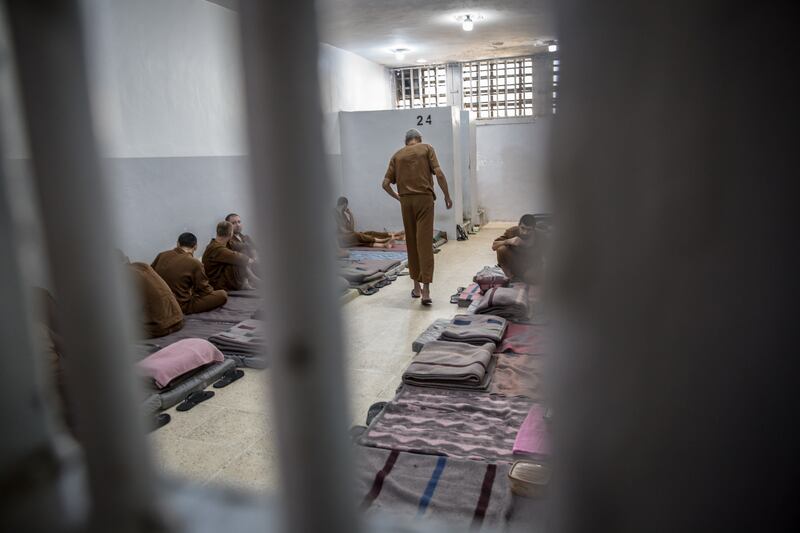
She said the transfers to Iraq were “unprecedented in terms of scale and legal issues”. These include concerns about non-refoulement, the principle of international law that prohibits states from transferring individuals to a country where they face a real risk of torture, inhuman treatment, persecution or irreparable harm. She said there was also “the profound concern that Iraqi prisons do not have the capacity to cope with the scale of transfers”.
Regarding Al Hol, she said that for more than seven years, tens of thousands of people were held because the view of the global coalition against Islamic State was that they could not be released. That they are now leaving so quickly “essentially makes a mockery of both the security rationale for their detention and underscores the profound illegality of the scale of detention in Al Hol,” she said.
“It’s imperative that persons who leave the detention facility are subject to humane treatment consistent with the international law obligations of the government,” she said. “The international community [also] has an obligation. Countries whose nationals remain in Syria have an obligation to repatriate them.”
[ Syrian president pulls off another stunning advance with Kurdish agreementOpens in new window ]
More than 2,000 people accused of Islamic State links are believed to remain in the Al Roj camp, which is still under the control of SDF. Most of them are women and children. There are also questions about the fate of teenage boys, taken from their families and held in centres in Syria’s northeast, who may have also been transferred to Iraq.


