

There’s an incongruity to tomorrow’s Dubai World Cup programme in Meydan that only underlines the improvisational qualities that have made it one of the most high-profile events in global racing.
It is the 30th running of the World Cup itself. The mile-and-a-quarter dirt race is the $12 million (€10.4 million) feature of an eight-race card worth over $30 million in all.
All of it is the brainchild of Dubai’s leader, Sheikh Mohammed, who no doubt will be guest of honour despite the pressing business of trying to navigate his country through the conflict between the US, Israel and Iran.
The frivolity of sport effectively taking place in a war zone generates an inevitable dissonance. When people are dying, and the world’s economic outlook is so uncertain, the spectacle of so much effort and money going into something so comparatively trivial can be unsettling.
READ MORE


Those who were at Meydan four weeks ago when racing took place in a context of explosions overhead from Iranian missiles and drones being intercepted have spoken of the eerie unreality of such a situation.
On that occasion, Sheikh Mohammed’s appearance was treated as a reassurance that things couldn’t be too bad. But Meydan is 12km from downtown Dubai where Iranian attacks have struck. Since then, another Meydan fixture was disrupted by a nearby missile strike. The novelty of a single figure heartening racegoer morale with his presence has a limited shelf life.
Missiles and drone damage in the UAE includes at Dubai airport, which is about 10km from the track. Just 55km separates the UAE from Iran across the Strait of Hormuz, which is shaping up as the focal point of a potential battle upon which much of the world’s economy will depend.
It’s little wonder some foreign connections have opted for prudence and not travelled to Dubai. More than 10 intended Japanese runners have stayed at home. Runners from the US and UK have done the same. Aidan O’Brien had been training two hopefuls for the day but opted not to travel.
His son, Joseph, however, runs both Sons And Lovers and Al Riffa in the $750,000 Dubai Gold Cup. Fresh from his Cheltenham festival fireworks, Willie Mullins will take on the world’s top-rated racehorse, Calandagan, with his Breeders’ Cup hero Ethical Diamond in the $6 million Sheema Classic on turf. The Irish trio arrived in the Gulf at the weekend.
It has been repeatedly pointed out recently how the gulf’s current political context has burst the balloon of normality that tiny oil-rich countries like Dubai have projected to the world.
American moves to potentially destroy Iran’s power systems drew a retaliatory threat to do the same to Dubai and other neighbours. That’s a prospect that could have an impact almost immediately, since no desalination capacity would affect drinking water supplies.
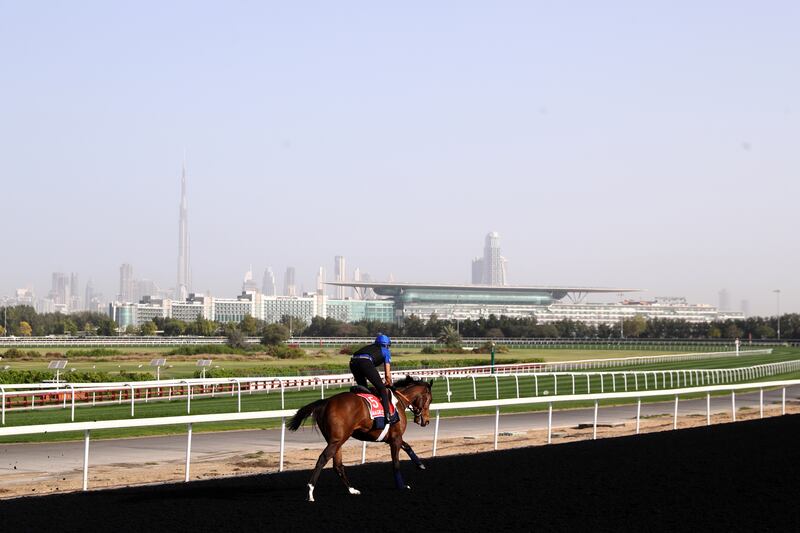
That’s a stark elemental reality capable of concentrating the minds of those dazzled by Dubai’s futuristic architectural skyline. It certainly puts the outcome of eight horse races on the edge of town into perspective.
That it is going ahead, however, reflects an element of defiance that has always been at the heart of this event.
Thirty years ago, the idea of a big international race in the desert seemed almost ludicrous. The old Nad-Al-Sheba track was literally developed from the desert and surrounded by sand when opened. But driven by the Maktoum family’s bottomless resources, not only was the race run, but it was won by the world’s top dirt performer at the time, Cigar.
A year later, the meeting was run five days late due to unlikely rainstorm conditions. The track was made raceable partially through using helicopters, and their rotor blades, to dry it out. Only the Covid-19 pandemic in 2020 has proved an insurmountable barrier to racing going ahead.
That global health emergency highlighted how racing can strike a defiant note in the most horrible state of affairs. Behind closed doors, as much of it was then, racing was still an expression of a widespread underlying desire to keep calm and carry on.
Although many sports in Europe were cancelled during the second World War, racing of some form continued in most countries. It provoked no little controversy in Britain in particular, where some decried it as little more than a tasteless frippery during an existential threat.
Nevertheless, although jump racing was banned between 1942 and 1945, the flat continued. Newmarket was a central hub where the classic races still took place. The benefits in terms of public morale were intangible but nonetheless real.
The Dubai World Cup’s legacy is how it has laid the foundation for a new dimension to global flat racing’s ecosystem in the Middle East.
Saturday’s action comes after last month’s Saudi Cup, an event dubiously rooted in the Riyadh regime’s attempts at sportswashing but one that has added to a sense of world racing on the move.
Even in a war zone, the World Cup programme has still attracted the world’s top-rated dirt horse in Japan’s Forever Young and the best turf horse, Calandagan, from France.
Even allowing for how money is no object, any unease about the optics, and lingering fears of the real world intruding, getting such an array of talent to Dubai in the current climate is a defiant feat.
Something for the Weekend
Forever Young and Calandagan will be very short favourites tomorrow. Pryomancer (1.30) is a likely favourite too for the UAE Derby but at current available odds of 9-4, he could prove a bet. The unbeaten winner of Japan’s only Group One race for juveniles on dirt, the Godolphin-bred colt won that despite running notably keen. With that experience under his belt, he could prove a different level to this opposition.
Electric Beauty (4.15) sprang a 20-1 surprise on the opening day of the flat season a fortnight ago and can defy a 6lb penalty over the same course and distance at the Curragh tomorrow. Top apprentice Wesley Joyce takes off a valuable 3lbs on a filly who will relish conditions.