Donie Smith believes the provision of a 12-week ban as the minimum punishment available for the infraction leading to Ger Brennan’s suspension is too severe and should be reassessed.
Two of the highest profile disciplinary actions taken this season have been Brennan’s 12-week ban and the one-match suspension handed down to Roscommon forward Daire Cregg.
Cregg was shown a red card for an off-the-ball incident, in which he appeared to raise his arm at a New York player, late in the first half of Roscommon’s Connacht quarter-final win at Gaelic Park in April.
The ban had the potential to undermine Roscommon’s Connacht campaign as it meant Cregg would be unavailable for their semi-final against Mayo in Castlebar.
READ MORE


David Clifford avoided retrospective disciplinary action following his raised elbow during last Saturday’s All-Ireland SFC clash between Kerry and Donegal in Killarney.
“For David, he is our best ever player – I have no problem saying that – I want to see him play every game,” says former Roscommon player Smith.
“As a supporter and as a spectator, I’m delighted because obviously you want to have your big names available.
“Obviously his arm, his elbow, was high. I think Caolan McGonagle did make the most of it. And I think two things there can be true.
“Daire was just very unlucky and it has kind of disrupted his season in a small way because obviously he didn’t play the Mayo game. It’s kind of disjointed him a small bit after the excellent league he had.”

But it is the regulation around a Category IV infraction (misconduct at games by team officials) that Smith would like to see addressed.
The minimum punishment in the GAA’s Official Guide for any type of physical interference with an opposing player or team official is a “12 weeks suspension in all codes and at all levels”.
Jim McGuinness was facing the prospect of that penalty for his clash with Kerry’s Diarmuid O’Connor, but the Donegal manager has avoided any punishment.
If referee Sean Hurson had reported McGuinness, the infraction would have fallen in the above category, leaving GAA disciplinary officials with no other available option but to propose the minimum 12-week suspension.
Smith believes the GAA should revisit the rule, perhaps to provide officials with a wider range of possible sanctions rather than just having one severe minimum penalty to cover all relevant cases.
“Whatever happened with Ger, 12 weeks is far too long,” says Smith. “Maybe a one-game ban might have sufficed, or maybe a two-game ban.
“The 12-week thing, I think that’s where all the talk has come from [this week]. If Ger had got a one-game ban, there was probably a likelihood Jim might have got a one-game ban as well.
“So I think that the 12-week thing has to be looked at. It’s far too much for what Ger did, or what Jim did. I think 12 weeks is crazy. So from that point of view, I’m obviously delighted Jim didn’t get a 12-week ban.
“But on the same side then, you have to feel bad for Ger because Ger has obviously had to sit in the stands while the Leinster championship has been going on. So I think it’s a tough one for him.
“The 12-week ban, regardless of what happened in Salthill or regardless of what happened in Killarney, is far too much.”
Closer to home, Smith does not believe Roscommon’s defeat to Tyrone last Sunday will derail their season. Mark Dowd’s side entered the fixture on the back of a hugely positive Connacht campaign but Tyrone halted their gallop in the Hyde.
A regular criticism levelled at Roscommon over the years is their tendency to blow hot and cold, in particular a failure to build on strong provincial campaigns when they enter the All-Ireland series.
But Smith does not believe the one-point loss to Tyrone will prove fatal to their All-Ireland charge.
“Leaving the ground last Sunday I was kind of like, ‘this is typical us’. But to be honest, I’ve kind of slept on it for a couple of days now,” he says.
“No, I’m happy enough, obviously I’d prefer to have won but I don’t think the balloon has completely popped in terms of momentum, because I think they played well and they were still in with a chance at the end.
“If Tyrone had beaten Roscommon by seven or eight points we might be having a different conversation, but I think when the draw is out next week they’ll be ready to go.
“And to be honest with you, I don’t think anybody would want to play Roscommon. That just shows how far they’ve come in six months, because from January right up until now I think they’ve been playing at a really consistent level.”
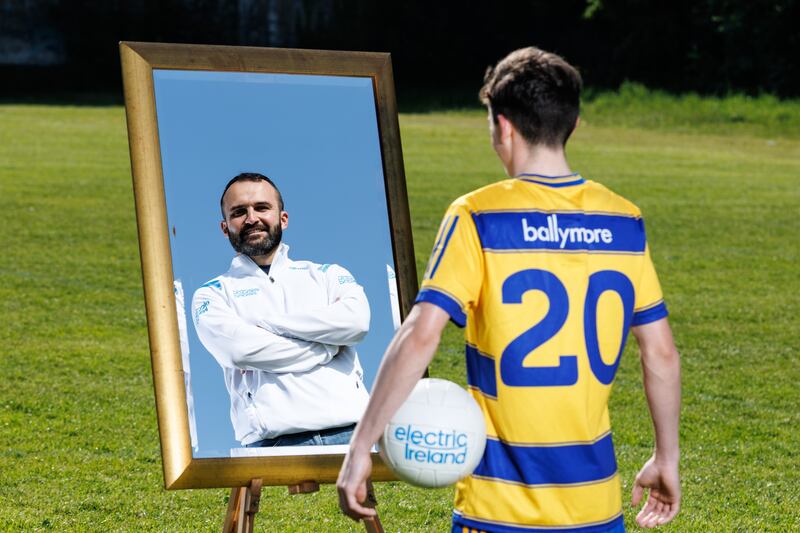
– Smith was speaking at the launch of the 2026 Electric Ireland GAA All-Ireland minor championships.