Main points
- Taoiseach Micheál Martin said the Government is ‘open for negotiations’ with trade unions following Wednesday’s public sector industrial action
- An estimated 300,000 workers were set to take part in the strikes across the country, seeking a new pay deal and arguing terms must be agreed before negotiations begin
- Minister of State John Cummins said there is a ‘window’ for talks in advance of a second day of strike action planned for October 21st
- Hundreds of health workers demonstrated at University Hospital Galway and the Mater hospital as most colleges, schools and universities closed
- It is understood more 150 schools in the Dublin and Kildare regions received emails warning them of potential bomb attacks on the same day as the strikes
- The HSE said hospitals ‘remain very busy’ with thousands of medical appointments cancelled
- Sinn Féin leader Mary Lou McDonald claimed the Government has ‘played a really disrespectful game of chicken with 300,000 workers’
Key reads
- Q&A: What services are affected by the public sector strike and what is closed?
- Health service workers claim no choice but to strike
- Rubbish and broken glass line capital’s streets with no one to clean up
- John McManus: Why we must have this performative strike by public sector workers
- Podcast: What is the strike about and why hasn’t it been averted?
Estimated 300,000 take part in protests
That’s a wrap from us this evening after 300,000 people took part in nationwide protests seeking a new public sector pay deal.
The Government has indicated they are willing to negotiate with trade unions, but it remains to be seen if another strike next week will go ahead with no talks currently planned.
More than 150 schools receive bomb threat email on same day as strike
A number of schools received threatening emails warning them of potential attacks on Wednesday, Education Correspondent Niamh Towey reports.
It is understood over 150 schools in the Dublin and Kildare regions received the bomb scare email.
The schools are understood to be operating as normal while taking the advice of gardaí.
This comes on the same day as widespread industrial action over public sector pay, where the majority of schools across the country were closed and pickets placed outside.
Gardaí said they are “aware of a communication” that was sent to a number of schools on Wednesday.
A spokesperson said gardaí are assessing the “contents and credibility” of the emails.
Gardaí are engaging with the schools involved, they said, adding that no further information is currently available.
‘People who are working never seem to gain’: Public sector workers in Westmeath
On the eastern outskirts of Athlone on Wednesday, three groups of public sector workers were striking for better pay and to show solidarity to their fellow workers, reports Stephen Farrell.
Sheltering from the blustery conditions at Cornamaddy Community National Sschool were special needs assistants (SNAs) and teaching staff, including Lauren Holmes (28).
“It’s frustrating that it had to come to this, they[the ] knew it was coming in June. We’d prefer to be teaching inside,” she said.
The public service Agreement 2024-2026 expired in June and there has been no agreement on any new deal.
Holmes, like most of the teachers in the school, she says, began teaching after 2011, when austerity pay cuts and lower entry salary scales were introduced for newly appointed teachers.
Holmes adds that many teachers in rural areas are on sub-maternity contracts due to the lack of fixed-term contracts and for them “it is even more difficult”.
Holmes said that “the backbone of the school” is the SNA staff, one of whom is Caroline McManus, who said she is looking for “equality and fair play” for all public sector workers.
McManus was particularly mindful of young people already working in the public sector or who may enter the sector in the future: “I would like young SNAs to be treated and respected in their job, fair play for the work they do. So many are leaving the country.”
Another teacher at Cornamaddy is Kate O’Connor who remarked on the public backing throughout the day.
“It’s all been very supportive, people passing by [beeping their horns], there hasn’t been anything negative,” she said.
She too was frustrated at the ’s approach and that she and her colleagues did not want to be “standing here” on October 21st, the next planned strike date, if the unions demands are not met.
A two-minute walk from the school, to the junction of Woodville Road and the Blyry Industrial Estate, which is the home of the Athlone Ambulance station, a number of ambulance service personnel were on strike including Paul McCabe (63) and Darren Mulledy (56).
Ambulance personnel provided reduced cover, said Mulledy.
“We are out here in solidarity with our colleagues in the public service,” said McCabe.
The cost of living was a big motivating factor for both McCabe and Mulledy in taking part in the strike.
“A number of people are living on the bread line,” said Mulledy, with McCabe imploring the to “just sit down and talk to the unions”.
“If reasonable people sit down and talk, they will come to a reasonable conclusion. It’s like the old saying, ‘if you put your head in the sand’,” he said.
The cost of home heating oil was a particular concern for both men.
“It costs €2,000 to fill a tank, I can’t afford that,” said Mulledy, who has had to supplement his fuel with bags of turf.
Less than half a kilometre West, about 40 Department of Education civil servants were also on strike outside their place of employment.
Dearbhla Sargent works as a Higher Executive Officer in the pensions section and is hoping that workers will get some sort of remedy to the cost of living.
“The cost of diesel has increased, the price of food is extortionate, we need some sort of compensation,” she said.
“I don’t have anything for saving out of my weekly take-home pay – and I’m close to retirement.”
She also pointed to a recent increase in her PRSI which has cancelled out any additional money she received as a result of Budget 2027.
“Obviously I’m hoping that they [the ] will call us back in to talks and offer us something substantial. People who are working never seem to gain,” she added.
Smallest protester ... loudest voice!

‘I had a medical appointment cancelled but I support the strikers 100%’
“I am a pensioner and my medical appointment was cancelled today but I support the strikers 100 per cent,” Johnny Cloono, from Co Waterford, told The Irish Times.
“They are right to strike for better pay, we are all suffering from the cost-of-living crisis and public service workers deserve wage increases that address it.”
He said the level of public support for the strikers was “heartening to see”.
“I hope that they continue to take action until their demands are met.”
Martina Callanan, an education administrator from Co Galway, said she is angry that “my husband and I, both in full-time employment, have a lower standard of living and worse pensions than our parents”.
“I’m angry that the Taoiseach and senior ministers have spoken disparagingly about me and my public sector colleagues. I’m beyond angry that the Government refuses to nationalise a fully public childcare and creche system, or hire healthcare workers on decent contracts to provide necessary support to children and people with disabilities.
“And I’m furious that blockaders with big trucks got cash in a week ... yet trade unions are held at arms length by Government.”
Ger Moane, a retired lecturer, said: “When over 90 per cent of public employees vote for strike, there is something seriously wrong. It’s not just about pay ... it’s about squeezing more work with less resources.”
Salters Sterling from Co Offaly is nearly 90. He feels the strikes reflect “inequality in our society”.
“The contrasts between mansions and homelessness, between professional and pensioner; between abundance of food and not enough to go round ... are blatant to the point where obvious injustice motivates protest and conscience demands the implementation of a vision of fairer, more equal ways of allocating resources and sharing wealth.”
Government ‘open for dialogue,’ says Taoiseach
Speaking in Brussels on Wednesday evening, Taoiseach Micheál Martin said the Government was “open for negotiations and open for dialogue” with the trade unions, Europe Correspondent Jack Power reports.
There was “substantial funding” set aside in the budget for a pay deal. “I believe there’s a platform there for negotiations ... We want to get into a negotiating process,” Martin said.
“So we will engage and see can we find a basis and a process that would be satisfactory for all sides to enable negotiations to take place and avoid any action next week,” Martin said.
He was speaking at an EU press conference in Brussels, where he will attend a two-day summit of EU leaders starting on Thursday.
Met Éireann website and forecast reports affected by industrial action
The strike is having an impact on weather forecast reports and there were disruptions to updates on met.ie on Wednesday.
The last update was posted on Met Éireann’s site at 10pm on Tuesday evening. Meanwhile, there is a yellow weather warning in place for five counties overnight.
Hospitals ‘remain very busy’, emergency and critical care prioritised
The HSE has said hospitals “remain very busy” amid today’s strike action.
“Engagements with unions during the day have been positive and helped us to make sure that emergency and critical care services are being prioritised.
“Rescheduling of impacted appointments and procedures will be prioritised and rescheduled as soon as possible. We ask patients to bear with us as there may be further delays until there is greater certainty regarding future industrial action.”
‘Window’ for talks before second day of strike action
Minister of State John Cummins has said there is a window of opportunity for talks in advance of a second day of strike action planned for next week.
He told Newstalk: “I do welcome the fact that union leaders have said today that they do see a pathway to talks. I would encourage that to happen.
“I’m a former teacher myself, I’m a former union rep for the school myself, all disputes are resolved by discussing things around the table.
“There’s a window ahead of next Wednesday for those intensive talks to take place.”
‘Nobody wants to be out striking ... We love our jobs’
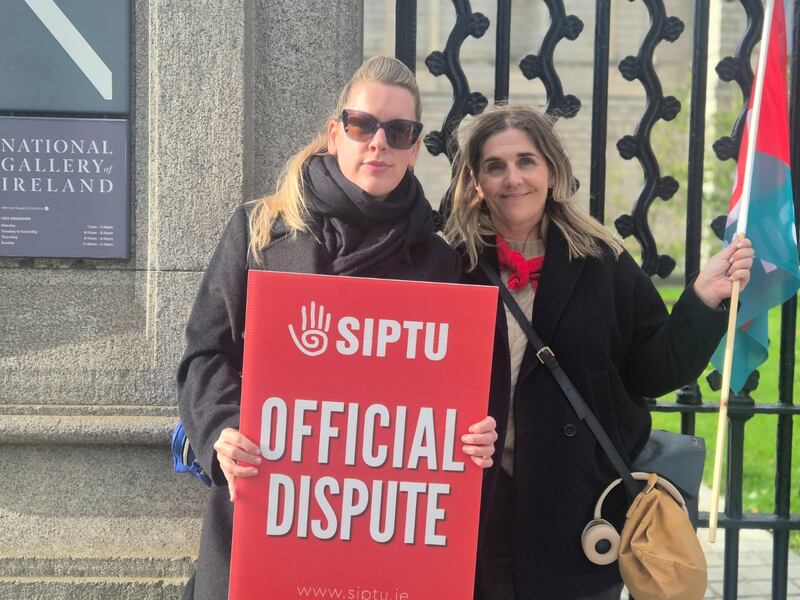
Aoife Brady, curator of Italian and Spanish art at the National Gallery, said the strike “could have been avoided” and was “a real last resort for us as union members,” Órla Ryan reports.
“We’re not being paid for our day today. We would rather be in work, getting on with the various responsibilities, which are only going to pile up and be there tomorrow morning, but it’s a necessary evil in our eyes. Unfortunately, in order to get the Government’s attention and to ask them to negotiate fairly as they should have earlier in the summer, this is what we’ve been brought to.”
Brady, a Siptu member, said many public sector workers are “paid under the national average”.
“The cost of living has gone out of control ... We’re looking for a pay raise in line with inflation. So I think it’s only reasonable at this stage.”
Brady said it would be “ideal” if a pay agreement was reached in the coming days so a further strike was avoided next week.
“We have no desire to disrupt the public any more than it has been, but we are prepared to strike next Wednesday, as planned, if the Government don’t sit down at the table and engage fairly in negotiation as we’ve been requesting.”
Catherine Ryan, who works in communications at the National Gallery, said employees are “just looking for fairness of pay, the increments that should be paid to keep us in line with the rising cost of living”.
“Nobody wants to be out striking ... We love our jobs. We’re very proud of the work we do here at the National Gallery, as is everybody here on this picket line ... but our hands are being forced. Basically, we have to do this.”
Ryan said cultural institutions like galleries and theatres “mightn’t be life and death, but it really is a thing that makes your life worth living and enriches your life in all these ways”.
She added: “Ideally, we won’t be here next week, but we’re very willing to be here again and out in great numbers.”
‘I’d like to see them committing to pay rises’

Catherine Boothman, traditional arts officer at the Arts Council, said she and fellow Siptu members were striking “because we really want qualitative engagement with the Government about pay and investment in the public services,” reports Órla Ryan.
“We’ve known forever that the previous [pay] agreement was going to come to an end in June. Public servants are very used to long-term planning, we’re always looking ahead ... So it’s incredible that the Government wouldn’t be coming at the start of this year with substantive engagement - not only about pay, but also about the vision for the public service.”
Boothman was critical of the fact Minister for Public Expenditure Jack Chambers this week told RTÉ News that “strike action should be a last resort, not a first resort for trade union leaders”.
She said: “When Chambers says strike shouldn’t be the first option, actually there were hundreds of first options many months ago. We knew the end date of the previous agreement, and it’s incredible that [the Government] wouldn’t be coming with an actual quality proposal...
“I’d like to see them committing to pay rises, immediately working on an agreement that is going to go from July 2026. We shouldn’t be working outside an agreement.”
Boothman said she hoped the issue would be resolved soon, but added: “I think we’ll be out next Wednesday.”
David Parnell, a manager with the Arts Council, agreed that a new pay deal should have been finalised before the Public Service Agreement 2024–2026 expired in June.
“I suppose the feeling among workers is, ‘Why has it taken this long?’ I think it is a shame that it’s come to this point,” he said.
“No one wants to be inconveniencing people. No one wants to be on strike if they don’t have to be, but it got to the point where there was a feeling that we have to show that we’re serious about this.”
Parnell said he hoped the 24-hour strike planned for next Wednesday could be averted.
“This can’t go on indefinitely. There has to be some agreement at some point. So one would hope that that would happen sooner rather than later.”
Leaders of main teaching unions call on Taoiseach to intervene

Leaders of Ireland’s main teaching unions have called for Taoiseach Micheál Martin to intervene in order to prevent further strike action on the first day of industrial action over pay, reports Education Correspondent Niamh Towey.
Speaking on a picket line outside Hartstown Community College in Dublin 15 on Wednesday, the General Secretaries of the Irish National Teachers’ Organisation (INTO), the Association of Secondary Teachers Ireland (ASTI) and the Teachers Union of Ireland (TUI) all indicated a lack of trust between their members and the Department of Public Expenditure and Reform.
Almost all schools, colleges and universities across the country were closed on Wednesday in the biggest public sector strike seen here for almost two decades.
Approximately 100,000 teachers and lecturers who are members of the INTO, ASTI, TUI and the Irish Federation of University Teachers (IFUT) went on strike over what they called a lack of meaningful engagement from Government on a new public sector pay deal.
In total there were over 300,000 public sector workers including teachers, doctors, nurses and civil servants taking part in the strike today.
“I think it’s fairly evident there’s been a breakdown of trust, and I think really we’re going to need somebody to bring the parties together,” Linda Kelly, general secretary of the ASTI, said.
“I think it was too little, too late from the Minister [Jack Chambers] last night to have his epiphany around pay being a central part of a pay deal, and I think that needs to be addressed. I do think there is a role here for the Taoiseach,” Kelly said.
Minister for Public Expenditure Jack Chambers told RTÉ’s Prime Time on Tuesday night that pay could be dealt with first in any negotiations.
“The question is, can we trust that now?,” general secretary of the INTO John Boyle said.
“This is the same Minister who told the general public only three weeks before the budget that there will be €2 billion available for public service pay, and yet on budget day, he only made available €1 billion, plus point two of a billion for pensions. And within the 1 billion, a lot of that money is already spent on carryover costs.
“So we are going to have to get assurances from the Taoiseach who needs to step in here that whatever negotiations are going to commence, and I am confident that they will commence after last night’s change of heart from the Minister, but the Taoiseach is going to have to convince us that if pay is going to be spoken about at the beginning of the talks, that it’s all aspects of pay,” Boyle said.
Government ‘squeezing us so hard with the cost of living’

Stephen who works as a library attendant in Cabra says at 46, he’d like to be able to move out of his mother’s house in Ballymun, reports Dublin Editor Olivia Kelly.
“At my age I don’t think I should be still living at home, but there’s no way I could afford not to. I’ve worked all my life and I can’t afford to house myself. I’d probably need two jobs that pay the same amount of money that I’m on to move out.”
He says he is on the picket line to highlight the impact of rising costs, not only on library staff but across the public sector.
“I think it’s important to say this is for everyone. The Government are just squeezing us so hard with the cost of living and yeah, we need more money just to survive.”
Courts and public counter service only available under certain derogations
Courts and court public offices nationwide, were cancelled with very limited exceptions on Wednesday due to the public sector strike, reports Legal Affairs Correspondent Mary Carolan.
Given the level of involvement in the strike, the Courts Service said earlier this week it had decided, after consultation with trade unions and staff, it would be unable to support courts and open public counters on Wednesday.
It said that meant courts and public counter service would not be available on Wednesday except for emergency domestic violence and childcare applications; Garda applications to remand an accused person in custody where station bail was not granted; and injunctions to dela with the protection of life, health, safety or welfare.
In granting these derogations, the trade unions recognised “the particular importance and sensitive nature of the work carried out by the Courts Service, as well as the potential severe consequences for the community and vulnerable individuals should urgent, critical matters arise”, the Courts Service said in a statement.
Those looking for emergency domestic violence or childcare supports on Wednesday were advised to contact An Garda Síochána who have access to the local courthouse/ court office emergency on-call number.
Acknowledging there would be “significant disruption” to court users who may have had a court date on Wednesday, the Courts Service said it would notify all parties when rescheduled court dates are available.
Have your say: What is your view on the public-sector strike?
A one-day strike by more than 300,000 public and civil servants got under way countrywide overnight.
Employees are seeking a new public sector deal, with trade unions arguing that pay terms must be agreed before other issues are addressed.
Schools, colleges, libraries, council offices and many parks are among the publicly run facilities that are closed on Wednesday because of the action. Health services are disrupted, with all elective procedures and thousands of appointments postponed.
The Irish Times would like to hear your views on the strike. Do you support the striking workers, and what is your view of the dispute? Are you striking today, and if so, what has your experience been like? If you are not striking today, have you been impacted by any public services being unavailable?
Click here to have your say.

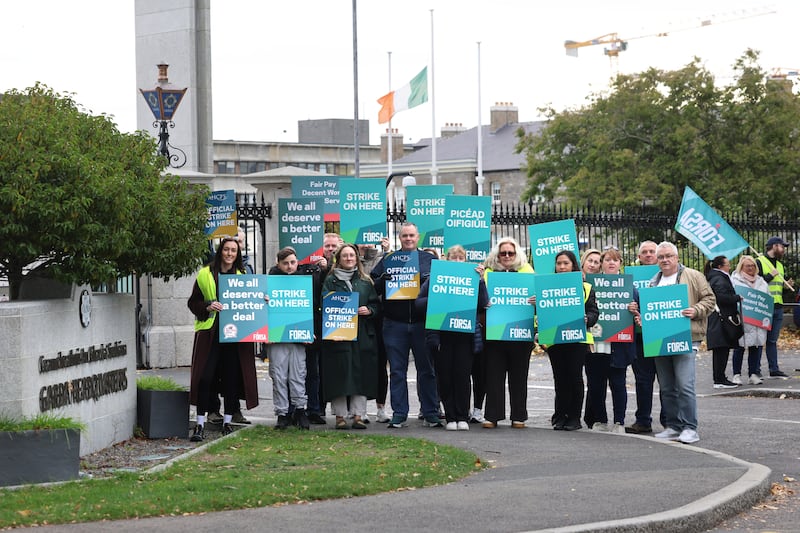
Josh Graves (31), is one of the more than 150 civilian members of An Garda Síochána striking outside Garda Headquarters in the Phoenix Park and feels the action is the only way to get their point across, reports Hugh Dooley.
From north Dublin, Graves and his partner both work in the civil service; “We’ve just had enough, to be honest. We’re both in our early 30s and we are struggling through life. We can’t afford a house and can barely afford to put the petrol in the car at this stage, never mind groceries and bills.”
He said that the people who work on the ground and keep the country running deserve better.
“We’ve played ball long enough with the Government at this stage in terms of past agreements,” he said, but feels the attitude from Leinster House has been different this time around, “not positive”.
“This is our last option. None of us want to be here. I’d much rather be in work today. We’re not getting paid for today. We don’t want to cause the disruption to the rest of the community, but, unfortunately, we’ve got to the stage where we feel this is the only way we can get our point across.”
The Garda civilian staff work behind the scene, performing administrative labour, consoling the victims of crime, vetting people working with children and working as dispatchers in the control room.
“We take the administrative burden off Garda members so that they can concentrate more on their frontline duties; protecting communities and responding to emergency calls.”
The action is popular among staff, with more than 99 per cent of those who responded to Fórsa’s poll supporting the decision, the trade union said.
Graves said these staff are not looking to be “wealthy or rich” and just want their pay to “meet the requirements of the cost of living and inflation”.
He encouraged Government figures to come out to Garda stations to speak with staff and see how they are struggling.
“We just want to get by. We just want to [be able to] afford a house. I want to get married. I want to have children. But at the moment, none of those are feasible for me.”
Jamie Carroll (32) also works for An Garda Síochána and is in a similar position. He still lives in his parents’ home and “can’t afford to rent or move out”.
He feels the cost of living crisis “doesn’t look like it’s getting better anytime soon”.
“We want better pay that helps to deal with the cost of living crisis, but the Government aren’t sitting down to negotiate and cross their hands,” Carroll said, noting he feels taken for granted by the Government.
“We’ve tried, they haven’t, so we’re trying to force their hand onto the table.”
‘I don’t know anyone who wants to be on strike today’

Teachers do not want to be on strike today and are anxious to see negotiations on a new pay deal begin, one secondary school teacher has said, reports Education Correspondent Niamh Towey.
Anthony Keane is an English teacher and counsellor at Hartstown Community School in Dublin 15.
“I don’t want to be on strike. I don’t know anyone who wants to be on strike today, and it’s unfortunate that it has come to this,” he said on the picket line outside his school on Wednesday morning.
“I think it’s unfortunate that we’re outside the school building rather than inside where we want to be today, inside it, and so I just hope it’s an encouragement for the government to engage in meaningful dialogue,” Keane said.
The cost of accommodation has put huge pressure on teachers in his school, particularly younger staff, and people are “really feeling the pinch on multiple levels,” he said.
Many of the staff at Hartstown are commuting very long distances, some from Kilkenny, Cavan, Westmeath and Offaly, Keane said.
Many are “not able to afford accommodation, not able to get on the property ladder,” he said, meaning “massive commutes are the only option for a lot of people, and all the expense and reduction in quality of life that that entails”.
Part of his reason for being on the picket line today is to show a sense of solidarity with these younger staff members who are “really struggling” on the current wages they receive.
“Let’s appreciate what makes life better for people in this country and they are the basic services, so that people can live and be educated and have basic needs looked after,” Keane said.
He urged those on both sides to sit down and find a resolution through dialogue, sooner rather than later.
“Those of us that are around a long time know that ultimately resolution is the only way through. So why delay? Let’s just get involved in meaningful negotiations.
“It’s unfortunate that taxpayers are being affected today. That taxpayers are on strike today. That people who are providing public services have to be on strike outside their places of work, rather than inside doing what they want to do,” Keane said.
‘We want fair pay and also decent public funding’
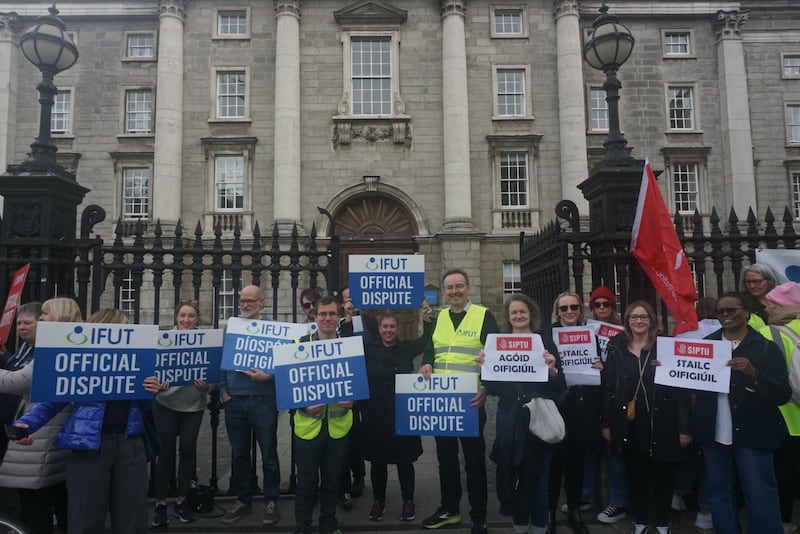
“There is a sort of stereotype around university staff and university lecturers, in particular, being well paid, but it’s oversimplified,” says Trinity academic and Irish Federation of University Teachers activist John Walsh, reports Work Correspondent Emmet Malone.
“The perception really fails to capture the large number of precarious staff in universities. More than 30 per cent of all university staff are on fixed-term or precarious contracts. And even a lot of people who would come in on the assistant professor scale wouldn’t be particularly well paid.
“So a lot of our members would have insecure contracts and poor terms and conditions, much of which is a legacy of the economic crash and of government underfunding of higher education since the crash.
“We want fair pay and also decent public funding.”
Most of the people filing past the pickets at College Green barely give the various unions’ protests a glance as they try to get to somewhere else but those who had been intending to visit the university grounds have generally taken the realisation they have picked the wrong day well.
“We’re very pleased with the level of support we’ve got from members of the public. There’s a lot of people dropping by to express support and even tourists who couldn’t get into see the Book of Kells were saying they support the strike,” Walsh says with a smile.
“They’re a bit surprised, they didn’t seem to have heard about it but it’s all been good. We’ve had a really positive experience.”
Teachers feel ‘disregarded’ by Government

Teachers feel “disregarded” by a Government which does not “have our best interests at heart,” one protester said on Wednesday morning, reports Education Correspondent Niamh Towey.
Kai Monahan (25) is a Spanish teacher at Hartstown Community School in Dublin 15.
“There’s a shortage of teachers and they know what they need to do, but it just doesn’t feel like they’re actually doing the best for us,” Monahan said on the picket line outside his school on Wednesday morning.
“If you look at different aspects in life, if you’re looking at the cost of rent, the cost of living in Dublin, it’s increasing every year and we’re not seeing that being reflected in our pay by the government,” he said.
Buying a house feels very far from his grasp on his current salary, but also at any point in the near future.
“I would definitely struggle to buy a house at this point, it just doesn’t seem like something that’s feasible, even in the long term. It’s not something that I’m really considering right now,” Monahan said.
He wants to see a “fair public sector pay agreement” that “reflects the work we do and also the rise in inflation and the cost of living”.
‘I feel like I’m going to be forced to move country’

Patrick Burke, a physiotherapist at the Mater hospital, said staff “don’t want to be here today,” reports Health Correspondent Shauna Bowers.
“The cost of food in your food shop is increasing regularly. Even transport to work as well and ability to buy houses. It’s a big pressure on everyone here working,” the 29-year-old Sligo man said.
“A lot of my friends went abroad to Australia. I decided to stay. Now that we’re here now, we’re trying to get better working conditions and pay to encourage more people to stay in Ireland.
Ciara Loftus, who works with the frailty team in the Mater hospital’s emergency department said, “I’m still living at home. I should be saving for a mortgage by now but I’m living with my mam.
“I’m 25 and I feel like I’m going to be forced to move country by the end of the year or next year,” she said.
“It’s not sustainable anymore. I don’t want to leave but I might have to because if something is not done about the cost of living crisis, about our pay, our future, I’m just going to suffer here.”
Emer Kearney, a nurse in the Mater hospital, said protesters are asking the government to “help us”.
“We’re looking to equate to the cost of living. We want our salaries to reflect that. We don’t want to be out in the picket here today, we want to be in looking after our patients,” she said.
“It’s a very real struggle and we have very real costs. We are asking the Government to meet us at the table. We want to be able to do our work and we want to be able to come to work.”
‘There’s an underlying seriousness to what’s going on’

“It’s going very well,” says Maurice Sweeney, a chief technical officer for hazardous materials at Trinity College as he stands with colleagues from Unite at the Leinster Street entrance to the university on Wednesday, reports Work Correspondent Emmet Malone.
“Support for it from the staff has been very strong. I represent Unite, and I think all our members are out today, regardless of childcare issues or whatever. People have made it happen. In some instances, people have brought their children to the picket lines so that (they) could be here.
“There’s unbelievable public support and you can see that the mood of the people here is very boisterous,” he says as large group of mainly young female members of Fórsa and Siptu sing and dance a few feet away and enthusiastically acknowledge each toot of support from passing motorists.
“Everyone’s having fun,” says Sweeney, “but there’s an underlying seriousness to what’s going on.”
There’s people in here and across the public sector, that are on not much more than the minimum wage, he said, adding that he is “struggling”.
“I’m just a family man with a wife and one daughter and a home and a mortgage to pay for. But your weekly shop is putting you under pressure. I would be considered to have a good wage for the type of work that I do. Some days we are coming in here for 5am, so we are the people that Simon Harris says get up early in the morning.
“But we didn’t see much of the benefit from that budget there last week at all. Not that I could see. It’s a couple of pence here and there, a couple of cents. They give it to you on one hand, but on the other hand, they might be taking it away with other bits of taxation or whatever.”
Michael Collins warns of possible renewed fuel protests
Independent Ireland leader Michael Collins blamed the Government for the public sector strikes and also warned renewed fuel protests are possible, reports Political Correspondent Cormac McQuinn.
Speaking outside Leinster House he referred to last April’s fuel protests and said: “This is the second time in less than 12 months that this country has ground to a halt by a Government inside in that building that are no longer in touch with the ordinary man and woman in this country, especially the working people in this country.”
He said of the strike: “yes services are being lost and put off which is a huge difficulty for many, many people.
“But these people have no choice. At the end of the week there’s little or nothing left in the pay packet to pay the bills that need to be paid.”
He argued that measures to support people with fuel costs in last week’s Budget did not go far enough.
“We have a major cost of living crisis. We have been pleading with the Government for months and months to make changes and unfortunately they haven’t listened,” the Cork South-West TD said.
Collins said the unions “saw how effective” April’s fuel protests were and “they’ve now got to sit up and start fighting for their people because their people aren’t going to survive the way things are”.
Asked by reporters if the farmers and contractors who protested earlier this year should talk to the unions about coming together for a larger protest Collins replied: “Absolutely. I think that’s very, very important.
“Because they’re hungry here and I know by talking to them that they’d love to be involved in this as well – not to disrupt anything – just to make sure they have a voice and people are listening to them.”
He said the fuel protesters are “watching this protest today” and he has been talking to them.
Collins said he was at a pre-budget meeting with the fuel protesters in Moate and he was “pleading with them to try to negotiate, to see can we bring the Government with us.”
However, he added: “The budget last week proved that that’s not possible, so it’s quite possible there could be further protests.”
‘There’s no need for us to be out here today’

Jane Culligan, a medical scientist at the Mater hospital, said there was “no need for us to be out here today,” reports Health Correspondent Shauna Bowers.
Protesting alongside her two colleagues Laura Dempsey and Grainne O’Grady, the trio said they are there to support all public sector workers.
“We are annoyed with the Government that the public pay talks have fallen through. There’s no need for us to be out here today, it could have been sorted beforehand,” Culligan said.
“Inflation is going up and our pay hasn’t gone up in line with that. I think the unions involved in negotiations have made efforts to avoid this and I don’t think the Government has listened.
“We feel the pinch and we will remember this when it comes to election time.”
Strike action held at universities across Ireland
The Irish Federation of University Teachers (Ifut), the only dedicated trade union and professional association in Ireland for third-level academic and research staff, posted photos and videos on X from picket lines outside universities and third-level institutions across Ireland.
They shared photos from Dublin City University, University of Galway, Maynooth University, Trinity College Dublin, University College Cork and others.
‘Nobody can survive on the wages we’re getting’

Mark Prouse, head groundsman at the Iveagh Gardens in Dublin, described the provision of €1.2 billion for public sector pay in the budget as “an insult”, reports Órla Ryan.
“Micheál Martin comes along and brags about this €1.2 billion that he’s giving us over the next three years – when you break it down, it’s actually only €3.50, €3.40, a day or something. It’s crazy. You couldn’t get a cup of coffee with what he’s offering us, so it’s not a genuine offer. He thinks we’re all stupid when we’re not,” Prouse said.
“When you mention those types of figures, people automatically think, ‘Oh my God, these guys are going to get a massive money’. But when you break it down between 300,000 people over a couple of years, it’s actually nothing. It’s only pennies that they’re offering us.”
Prouse, who is also a Siptu shop steward, said today’s strike could have been averted if the Government engaged in negotiations with trade unions months ago.
“It got to this point because the Government wouldn’t sit down and talk to us ... We should have sat down in January because our last [pay] agreement ended in June, so we should have been sitting around the table last January to discuss the new agreement for the next three years, and they didn’t. And here we are in October and they still haven’t sat down.”
Prouse, who was striking outside St Stephen’s Green in Dublin, said workers are really struggling amid the cost-of-living crisis.
“My gas bill has doubled, my electricity bill has doubled, my diesel has doubled. I mean, what do they expect us to live on? ... Nobody can survive on the wages we’re getting.”
Prouse thinks the dispute can be resolved in the coming days – in order to avoid another 24-hour strike next Wednesday – if the Government “stop insulting us, sit down and give us a proper [offer]”.
“They give themselves these big wage rises. You don’t see us complaining about how much they’re giving themselves ... We’re not asking for the money that they’re giving themselves every week. We’re just looking for a bit of respect ...“It’s always the unions, it’s always the working class, that have to go to them with our hand out begging, and we’re tired of it.”
The Iveagh Gardens and St Stephen’s Green are among the many parks closed today due to the strike.
Mary Lou McDonald calls on Government to act
Sinn Féin leader Mary Lou McDonald claimed the Government has “played a really terrible and disrespectful game of chicken with 300,000 workers that we all rely on”, reports Political Correspondent Cormac McQuinn.
She made the remarks outside the gates of Leinster House where there was about 150 workers from the Houses of the Oireachtas, the National Museum and the National Library on picket lines.
McDonald argued that the industrial action is “a reflection of the failure of Government”.
She added: “It beggars belief that they have known now for months that they needed to engage and negotiate a new pay agreement and they have failed to do that.”
The Dublin Central TD said there is a “really strong sense of public support for all of the workers” and “these are pay negotiations that need to happen”.
“The very idea that the Government is playing a game of semantics or a game of chicken or brinksmanship with workers and refusing to acknowledge that pay will in fact be the core item and the first item for discussion is absolutely incomprehensible to me.
“So we are calling on the Government to act. I think at this stage the Taoiseach needs to intervene. The phone needs to be lifted.”
She said there must be “clarity” given to workers that “they have been heard, that the cost-of-living crisis that they face is real, that their need for a pay settlement is honourable and deserved and that the talks will happen with pay at their core” and as “the first item for discussion”.
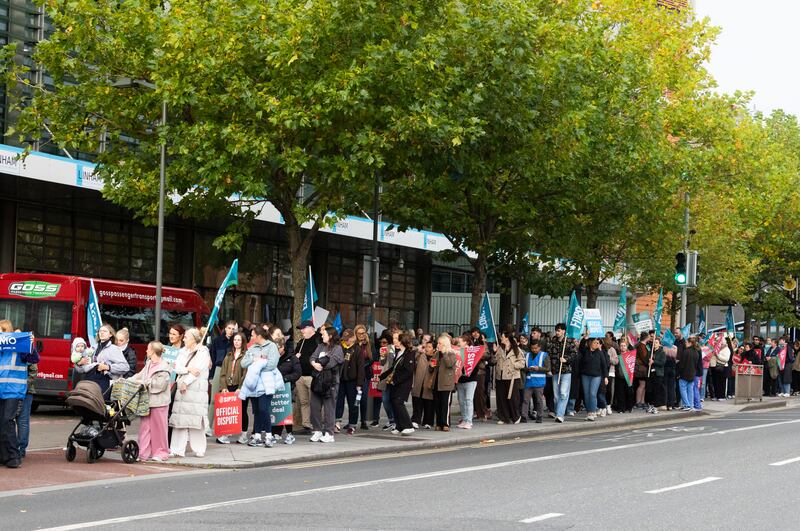
Some photographs from across the picket lines


‘Inflation is rising, so should our wages’
“The bottom line is pay,” said Emma Tyrrell, a District Court clerk on the picket line at the Criminal Courts of Justice, reports Legal Affairs Correspondent Mary Carolan.
“The cost of living is rising and our wages are not. I’m just back from maternity leave, I’ve two young kids, I’ve a mortgage to pay. I’ve childcare costs, petrol, all them things. Inflation is rising, so should our wages.”
Pay, housing and the cost of living are huge concerns for Ian Temple, who was recently promoted to the rank of executive officer, having been a clerical officer for four years. He works in the Phoenix House courts complex.
Housing and energy costs are up 10 per cent, transport 7.5 per cent and it is to go up again, diesel is up 22 per cent, home-heating oil is up 60 per cent, said Temple as he stood on the picket line. “I think it’s very disingenuous to say to people with a straight face that things are okay. Come out to the north inner city.”
He and his wife are renting in a rent pressure zone, paying €1,500 monthly. “That’s 50 per cent of my wages gone, there’s no chance of any mortgage because of the systemic rules laid down after the banking crisis 20 years ago.”
Housing costs are a huge burden for him and many others, he says. “That’s where all my money is going, it’s also going to Electric Ireland. And there’s no grants for renters, there’s more than half a million of us.
“I absolutely love helping people every day, I deal with claims in the accountants’ office, every day I answer that call and help people I know I’m helping citizens. I ask citizens today to support us to get that extra bit of money. We’re looking for what we deserve.”
Ciarán Lyons, an executive officer in the Phoenix House courts complex, said because of the housing crisis, he, at the age of 38, is living at home with his parents.
His pay is around the level of the medium industrial wage, meaning buying or renting a house would be very difficult, said Lyons.
“The pay deal for the public service expired at the start of June and the Government had not meaningfully engaged with the union leadership for us and the other unions involved since then,” said Lyons.
Pay should be the first item discussed and agreed on the agenda, but it has not been in the past two pay deals, he said.
“Even including the 1 per cent from the last pay deal, workers are worse off than we were at the same time in 2023.”
Lyons, a Forsa local workplace representative, said clerical officers had approached him coming up to the strike saying their pay is so low they could not afford to lose a day’s pay.
“One of the most common queries I’ve had is clerical officers saying we want this better deal, we want to be out with our colleagues, but they are scared and anxious of even losing a day’s pay.”
Emma Courtney and Gillian Teehan, both members of the Association of Higher Civil Public Servants, said they were on the picket line at the Four Courts primarily in solidarity with colleagues on lower grades struggling with housing and cost-of-living issues.
“I was an EO [executive officer] and a CO [clerical officer] and I know how tough it is for them, and the nurses, the guards, the younger people” said Courtney. “We’d love a few more quid but if it came to the lower paid workers, getting it, that’s fine.”
“Twenty, 30 years ago, you wouldn’t have younger people living at home with their parents, they would have left, but they have no choice now,” she added.
“There is an inequity in the system,” said Teehan, citing teachers on lower pay grades as an example.
Protest is not just about pay, say community nurses

Community nurses were protesting outside the Summerhill primary care centre in Dublin 1 on Wednesday morning, reports Health Correspondent Shauna Bowers.
The nurses said they provide a cradle-to-grave service, often visiting patients in their homes, while using their own cars.
Anita Ennis said the protest was not just about pay, but also about the impact the cost-of-living crisis was having on staff.
Health workers ‘feel like we have no choice’ but to strike

Andrea Kelleher, a member of trade union Fórsa who works in BreastCheck Western Unit to the rear of University Hospital Galway campus, said health workers “feel like we have no choice” but to strike, reports Dara Bradley.
“With the cost of living, we are all just struggling to manage on a day-to-day basis. We need hope that we are going to get some pay increases.
“Over 5,000 people have joined Fórsa in the last few days. The next scheduled strike is the 21st of this month. We all hope we won’t have to stand out here again but if we have to we will,” said Kelleher.
‘Nobody wants to be on strike,’ say Garda civilian staff

More than 150 staff are gathered on strike outside Garda Headquarters in the Phoenix Park on Wednesday morning, reports Hugh Dooley.
“Nobody wants to be on strike. Nobody wants to lose a day’s pay. We just want proper negotiations to start,” Garda control room operator Sinéad Mason (33) told The Irish Times.
“We’re all struggling. The cost of living is rising drastically. It’s very simple.”
Mason was joined on the picket by her daughter Megan (12) and her one-year old Maltese-Shih Tzu, Felix – the cost of food for dogs and teenagers is rising too, she said.
“I didn’t think we would get to this point, but here we all are,” Mason said, gesturing at the assembled protesters buoyed by a passing car blaring its horn to the crowd.
“Civil and public sector workers keep the country going. I myself work in the control room answering emergency calls from the public day in, day out.”
Much like doctors, nurses, midwives and the uniformed gardaí, Mason said the staff assembled with their placards are “essential” and “should be protected” from the rising pressures of the cost of living.
The sight of protesters outside Garda HQ is not new, but as civilian staff strike, the frontline gardaí are legally compelled to continue working.
Both Garda unions have come out in support of the strike, and that solidarity manifested in Garda members activating their sirens momentarily while leaving HQ.
Government to do ‘everything we possibly can’ to reach agreement

The Government will do “everything we possibly can” to reach agreement with public sector unions, the Taoiseach has said.
Micheál Martin said Public Expenditure Minister Jack Chambers and his officials are “working very hard” to enter dialogue and negotiations.
He said: “I think we can move this into a better space in terms of getting a resolution to all of the outstanding issues.
“I understand fully the pressures public servants are on and workers are on so our focus is on trying to get a process going that can lead to a satisfactory outcome in terms of a new national pay agreement, which is what we want to put in place.”
Martin said budgetary decisions provided “a very strong foundation and platform” for public service pay talks, adding that he detects “good will all round”.
Speaking at the Government’s AI summit, he said: “I think the foundations are there for a very substantive engagement between unions and Government, and we certainly will be doing everything we possibly can.” – PA
Taoiseach open to idea of ‘honest broker’
Taoiseach Micheál Martin has said he is open to the idea of an “honest broker” to resolve the public sector pay strikes, reports Ronan McGreevy.
The suggestion was made by Forsá general secretary Kevin Callinan on RTÉ Radio 1’s Morning Ireland programme.
Martin responded that the Government “is open to negotiation, we want dialogue”.
He said he detected a “spirit of goodwill all round” to get the public pay issues resolved.
“I know the Minister for Public Expenditure Jack Chambers is working hard on this and his officials in the department are well-practised in relation to public service pay negotiations,” he said
Martin said he noted a change of tone among trade union leaders towards further engagement and a process that could lead to a resolution.
“With goodwill on all sides, I think we can move into a better space in terms of getting a resolution to this dispute,” he told reporters at an AI summit in the RDS.
When asked if he thought a second day of strikes could be avoided, he responded: “I would hope so. That’s a matter for the trade union movement. We will spare no effort to get talks going. We will continue to try and open a process of dialogue.”
“I would like to think that without overstating it. I understand fully the pressures public servants are on and workers are on.
“Our focus is on trying to get a process going that could lead to a satisfactory outcome and a new national pay agreement.”
Bacik: ‘Nobody wanted to be out today’ but ‘no choice’
Labour Party leader Ivana Bacik said she has been visiting picket lines in her Dublin Bay South constituency and she has been “struck by the high levels of support from members of the public from cars honking as they go by” to people bringing the striking workers doughnuts and coffee, reports Political Correspondent Cormac McQuinn.
She said: “People understand that many public sector workers are very lowly paid and that in particular there’s a real concern with the rising cost of living, with rising inflation that public sector pay is not protected against inflation and that’s why the Government need to engage on national pay talks.”
She accused Minister for Public Expenditure Jack Chambers of “recklessly” letting the last public pay deal lapse “for several months before making any sort of positive signs that he’s willing to engage and put pay squarely on the table”.
Speaking to reporters outside the gates of Leinster House – where there is also a picket taking place – Bacik said: “Pay talks must do what they say on the tin. Pay must be first and foremost in the negotiations and we really hope that last night’s glimmer of hope from Government will move things on.”
This was a reference to Chambers telling RTÉ’s Prime Time that pay can “absolutely” be the starting point for negotiations.
Bacik said she had spoken to Fórsa union boss Kevin Callinan and “he’s also said publicly that he believes there is now a pathway to resolving this”.
“Nobody wants to go on strike for a second day. Nobody wanted to be out today but they were left with no choice.”
She said the Labour Party will table a motion in the Dáil on Thursday “calling for Government again to engage meaningfully in talks ... to put pay first and foremost and we really hope we see things moving over the next two days before the weekend”.
Bacik said: “The ball is in Jack Chambers’ court and the Taoiseach’s court.”
‘Taoiseach needs to intervene,’ says Fórsa leader
Wednesday’s protest is about a “breach in trust” and a “lack of confidence” in the industrial relations system, union leaders have said, reports Health Correspondent Shauna Bowers.
Fòrsa’s Kevin Callinan, Phil Ní Sheaghdha from the Irish Nurses and Midwives Organisation (INMO), Adrian Kane from Siptu, and John Boyle from the Irish National Teachers’ Organisation (INTO) attended the picket line at the Mater hospital in Dublin on Wednesday morning.
“It’s over to the Government now to try and address those things if this dispute is going to be resolved,” Callinan said.
He added that if Minister for Public Expenditure Jack Chambers is “sincere” in his comments to discuss pay first then “it’s possible that there may be a way in which a framework can be built on that”.
“I’ve indicated that the Taoiseach needs to intervene. Consider that. Obviously, if that’s possible, we’ll work with it. If it doesn’t happen, we’re gonna have another strike next week and so on,” he said.
Asked if they are open to an independent mediator, Callinan said they will consider “anything that is reasonable”.
About 200 Dublin City Council workers gather outside Civic offices
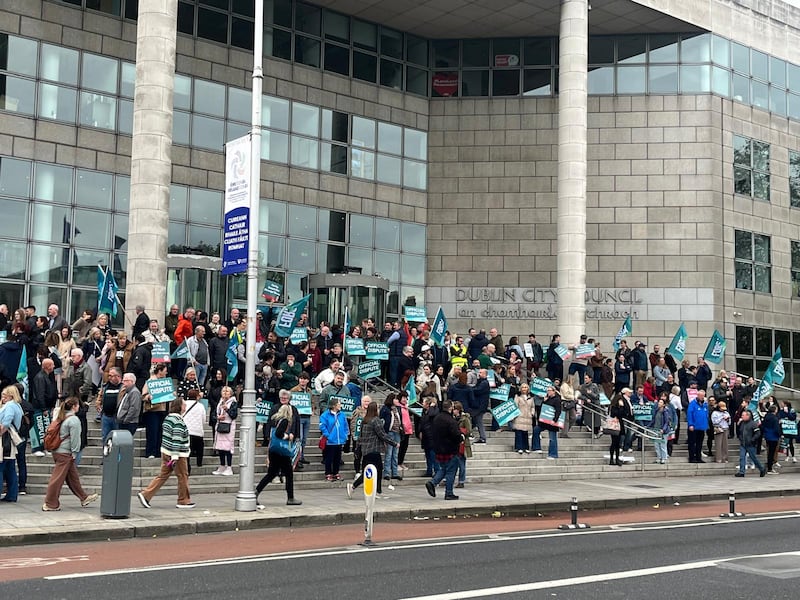
About 200 Dublin City Council workers gathered on the steps of the Civic offices, reports Dublin Editor Olivia Kelly.
“I think we need to be heard at this stage. We provide such a vital services for the public. We keep the city going and we deserve to have a pay rise going with inflation rates,” said Audrey Lambert, secretary of the Fórsa Dublin city branch.
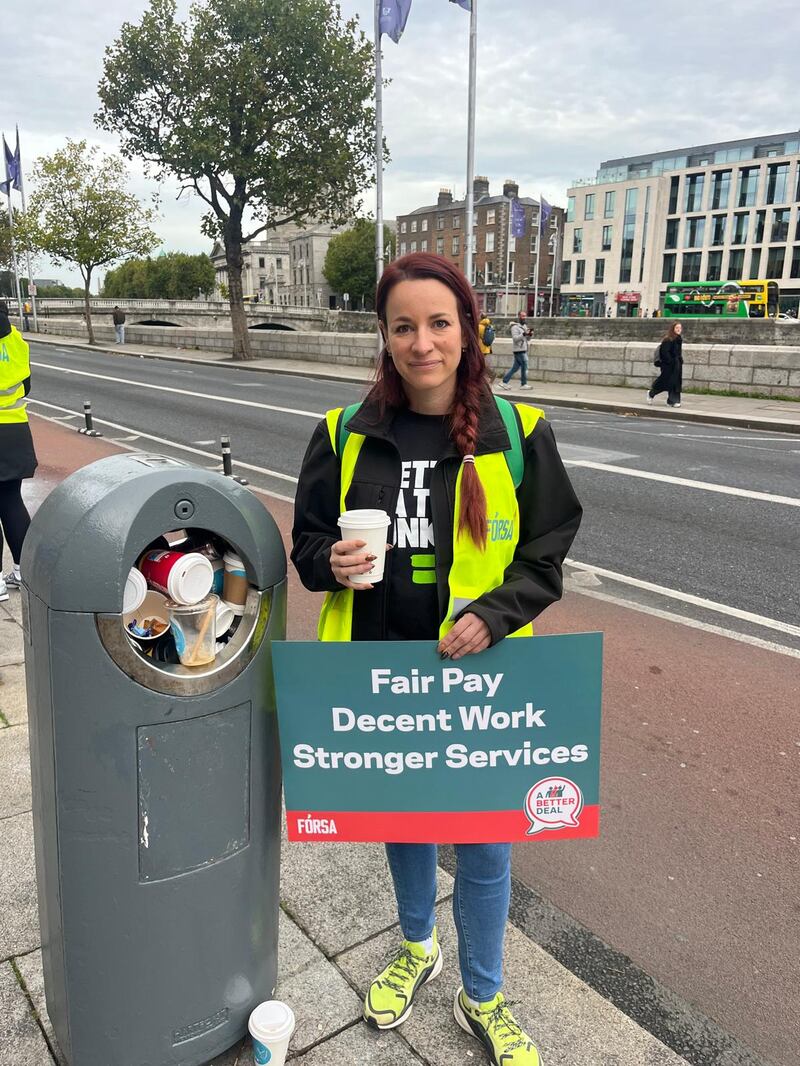
“We have young people that come in and join us and they cannot stay because the pay is not enough. They can’t get housing. They can’t support themselves.
“We have people, mothers, that are struggling to go to work, to pay childcare and it’s essential that we have a fair pay for everyone here.”
Richard Boyd Barrett joins Fórsa picket line in Dún Laoghaire

At the Fórsa picket outside the Irish Lights building at Dún Laoghaire harbour, civil engineering technician Colin Ball sounds slightly exasperated that the public service pay dispute has come to him and his colleagues picketing from early morning, reports Work Correspondent Emmet Malone.
Workers from admin, procurement, facilities management and diverse array of other roles stand close by and nod in agreement as he suggests “they [the Government] have had a long time to sort this”.
“They’ve had months but they haven’t really done anything so we’re just standing here, supporting each other, trying to get a better deal,” he says as drivers of buses and cars beep their horns in support of the strikers while passing by.
Asked about the suggestion by James Lawless earlier on Wednesday morning that public servants tend to be better paid than their private sector counterparts, Ball seems surprised.
“I don’t think that’s fair to be honest. But the issue is that the agreement expired in June, and they’ve had plenty of time to sort a new one out. The rate of inflation’s gone up so much but our pay hasn’t gone up. That’s why we are here.”
People Before Profit-Solidarity TD Richard Boyd Barrett joined the Fórsa picket outside the Irish Lights building in Dún Laoghaire and said he hopes there will be talks to end the public sector pay dispute over the coming days as he visited various pickets in his constituency on Wednesday morning.
“I think the Government has been playing a game of chicken with the unions but what they are seeing this morning is an enormous show of strength and I hope that leads to talks now,” he said.
“People are telling me they don’t want to be out on strike but they say they will do it again if they have to and it’s very obvious as you travel around just how strong public support is for the action,” he continued.
“There’s a lot of anger with Jack Chambers, that it has come to this.
“People of all ages, but a lot of young people have been talking about how they are struggling with cost of living issues, things like the cost of accommodation.
“It’s all very inspiring, I’m hearing a lot of people have been joining unions in the last few weeks and it’s inspiring to see how many people are out this morning, how high their morale seems to be.
“Hopefully other people will be inspired too because it’s not just public sector workers who are struggling with the cost-of-living crisis.”
‘The work isn’t the problem, it’s the pay – we want fair pay’

Martina Burke, a healthcare assistant at one of the country’s busiest emergency departments at University Hospital Galway, has a 40km commute to work in Galway city from her home in Kilmaine, Co Mayo, reports Dara Bradley.
A mother of adult children, like hundreds of workers on the picket line at UHG, she’s feeling the pinch of higher fuel prices and the cost-of-living crisis.
“I work three long days. I’m up in the morning at half five; not home ‘til quarter past nine. It’s a long day. It’s busy in the ED. It’s hard work. But the work isn’t the problem, it’s the pay. We want fair pay,” she says.
A rep with trade union Siptu for 20 years, this is Burke’s second strike and she feels the public is backing the industrial action.
“People who filter through the hospital see the hard work we do. The public are very supportive of us,” says Burke, who adds that workers agreed cover in the wards and emergency department to “make it safe” for patients during the strike.
“Our message to the Government is sit down, talk and listen to the unions. We don’t want to be here today, no one does. We had a 95 per cent vote to strike, which was overwhelming – it means everyone wants the same thing.
“If they don’t sit down with us, we will 100 per cent be back here again next week,” says Burke.
Irish Dental Association strike for first time since 1922

Fintan Hourihan, chief executive of the Irish Dental Association (IDA), said the protest was about more than just pay but also about supporting the service to meet the needs of its special care patients as a group of public dentists picket outside the Roselawn health centre in Blanchardstown, Dublin.
Wednesday marked the first ever strike action by members of the IDA since it was founded in 1922, reports Health Correspondent Shauna Bowers.
‘Whatever you’re earning doesn’t feel like enough these days’
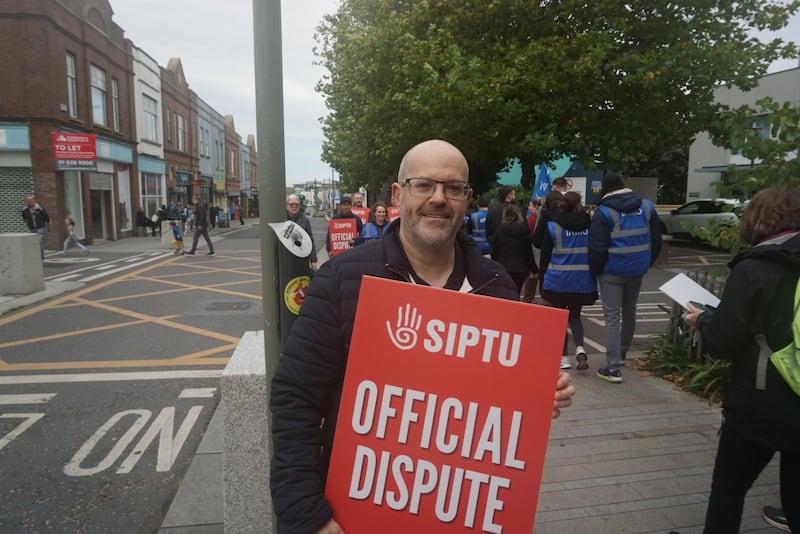
Conor Carroll, a porter at St Michael’s Hospital in Dún Laoghaire, says Wednesday’s strike is all about wages and the increased cost of getting by, reports Work Correspondent Emmet Malone.
“We’re just out looking for fair play,” he says, as he pickets alongside colleagues from Fórsa, the Medical Laboratory Scientists Association and the Irish Nurses and Midwives Organisation at the hospital gates on the town’s main street this morning.
“It’s just about the cost of living. Every time you go to the supermarket you feel it,” he says, gesturing towards the Tesco shopping centre across the road.
“Everything’s gone up, even the cost of eating, and whatever you’re earning doesn’t feel like enough these days.
The hospital, he says, is a good place work, a community operation where “everyone gets on”. And it has good to him since he switched from bar work eight years ago to be around more for his then young children.
“Management are good, they are always helpful with rosters when you need it,” he says, explaining that he commutes from Lucan and tries to work shifts that allow him do a school run.
“I have no complaints, really, except that my pay hasn’t gone up,” he says, “and everything else has.”
‘Everyone is feeling’ the impact of inflation

Jason Dee, a visitor service officer at Dublin Castle, described the strike as “very necessary,” reports Órla Ryan.
“There should be a natural transition from when a pay deal expires into the next deal,” he said, referring to the fact the Public Service Agreement 2024–2026 expired in June and a new deal has not yet been reached.
Dee said “everyone is feeling” the impact of inflation, especially lower paid workers.
He said the strike is “an inconvenience to people and to tourists and to everybody, so I think it’s in everyone’s interest that it’s resolved”.
Strikers in Dún Laoghaire hope second day of action will not be necessary
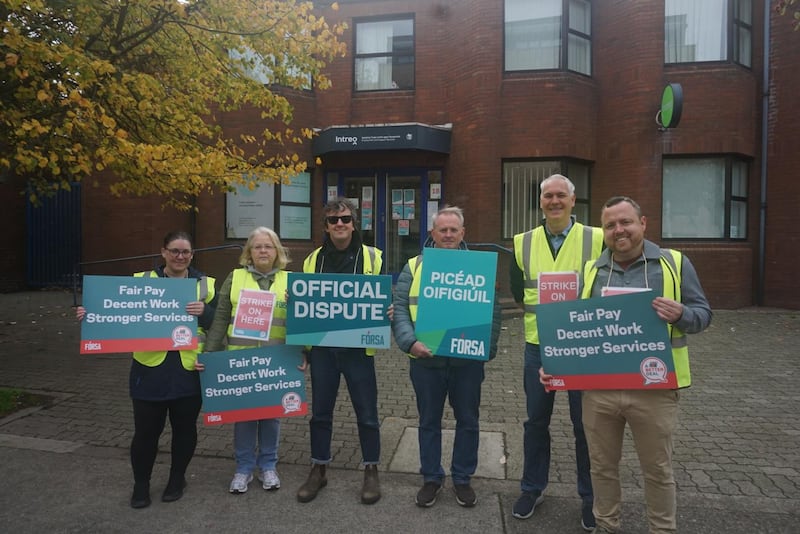
At Dún Laoghaire’s Intreo Office on Cumberland Street, staff who are used to dealing with other people’s employment issues were outside having to explain to the occasional service user that they are having some of their own, reports Emmet Malone.
“We’ve had a few people along this morning, and when they’ve seen us and they’ve asked a couple of questions about why we are striking,” said Lyndsay McGlynn, the centres manager, as she stands with a handful of her co-workers. “But we’ve had no negative feedback. It’s been very understanding and supportive.”
She said she wants to see talks between the unions and hopes the industrial action can be sorted out before the second scheduled one-day stoppage next Wednesday.
Asked if it should have been sorted out before today, with Minister for Public Expenditure Jack Chambers having effectively said last night pay could be dealt with up front, she says the comments came too late.
“It’s something that came out the day before the strike, the night before it, I think it should have happened a lot earlier.
“I do hope that in the next little while it will get resolved. Hopefully, we don’t have to do another strike date next Wednesday.
“But people are very united, all of us here and across all the grades, you saw over 90 per cent voting for the strike everywhere.
“Missing two days’ wages would be a big commitment for all of us but we are doing it because the wages need to be increased, particularly for those on the lower pay.
“We are very united and I do think if it continues people will be determined enough to see it through.”
Workers ‘haven’t had a decent pay rise in forever’

Lisa Walsh McAuley, a visitor and security officer at the National Museum, said workers “haven’t had a decent pay rise in forever”, reports Órla Ryan.
“I don’t see anything in my pay packet. I really don’t because they give with one hand and they take with the other.”
Walsh McAuley said she deals with thousands of people every week in her role and, like many workers in the public sector, has been “double jobbing” – ie, doing extra work that does not fall under her role.
“It seems as if this Government wants to push us as far as we can possibly go. We have role creep in our jobs. Some of us are double jobbing, and that’s taking a toll.”
She called on Jack Chambers and other members of the Government to help workers who have been badly impacted by the cost of living.
“Jack seems to be the kind of person – and I can understand where he’s coming from because of his position – that he has to guard the money. But we have a pot there already. How big does he want this pot to be? It has to be spent somewhere ... Either start giving something back or just watch out for the next election because I ain’t happy.”
Walsh McAuley said she hopes the issue is resolved soon, but “we’ll be here next week, if needs be”.
Government ‘should have engaged with workers earlier’
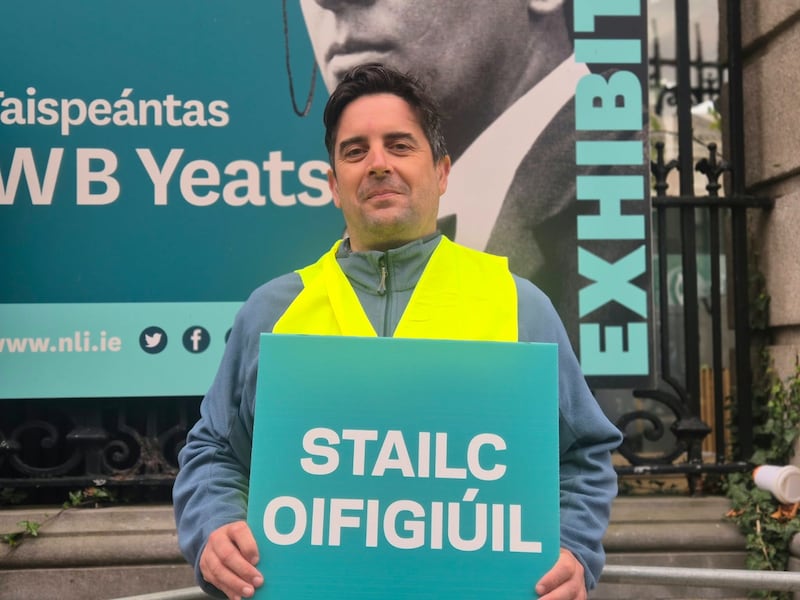
Workers from some of Dublin’s best-known cultural institutions and tourist attractions have called on the Government to engage with trade unions to avoid further strike action, reports Órla Ryan.
Brian Rice, digitisation programme manager at the National Library, said comments by Minister for Public Expenditure Jack Chambers – who on Tuesday night told RTÉ’s Prime Time that pay can “absolutely” be the starting point for negotiations – came too little, too late.
“The Government had the opportunity to engage earlier; they didn’t take it, and now we’re out because of that,” Rice said.
“They should have engaged with workers earlier on this, and I think it’s time to sit down now and it’s time to listen to what workers have to say rather than just arrive at a fait accompli, and to come to some agreement that both parties are happy with.”
Rice said workers are struggling with the cost of inflation and “pay really needs to catch up with where prices have gone”.
“There’s lots of levels of pay in the Library, and I think we’d like to see the lower paid helped more, so they’re proportionally lifted up higher because it is much tougher for them.”
Murphy expects to be back on picket line next Wednesday
Fine Gael TD Barry Ward has warned: “If people are not sitting down around the table, this won’t be resolved,” reports Vivienne Clarke.
There had been “a concerted attempt” by Government in recent weeks to get people around the table to talk about it, he told RTÉ Radio’s Today with David McCullagh show.
“That hasn’t happened because of preconditions that have been laid down. And I don’t really think you can approach a negotiation by saying to people, well, we’ve got to agree this before we even talk.
“If people are not sitting down around the table, this won’t be resolved. And whatever about honest brokers or whether somebody mediates the discussion or somebody else is brought in to do that, that doesn’t matter. If people are not willing to sit around the table, it won’t be resolved. And what’s really important for ordinary people all over this country is that it is resolved and they get their services back,” he said.
However, People Before Profit TD Paul Murphy told the same programme that he expected to be back on the picket line again next Wednesday.
“What we’re hearing so far from the Government is not a commitment to seriously engage on pay. And therefore the workers are left with no choice. And when you talk to workers, they’re clear. Look, I don’t want to be on a picket line, but they voted overwhelmingly to take strike action. They’re doing so because they’re in a desperate situation.
“Because they see their income being eroded year after year. Where from 2021 to now, the total increases they’ve had in pay is just under 16 per cent. And the inflation rate over that period is about 22 per cent.
“So they’re struggling. And I would say, the beeps from people coming by all the picket lines I’ve been on this morning are incredible. The level of public support for this strike should make the government think again.”
Bags of rubbish left outside the closed Grangegorman recycling centre in Dublin 7 as workers at the centre are on strike.

Hundreds of striking health workers at University Hospital Galway

Fórsa members John FitzGerald and psychotherapist Evelyn Newell holding her dog Alfie were among the hundreds of striking health workers on the picket lines at University Hospital Galway this morning, reports Dara Bradley.
Crowds gather outside the Mater hospital in protest over pay

Doctors, nurses, medical laboratory scientists, physiotherapists and other healthcare staff have gathered outside the Mater hospital in Dublin in protest over pay, reports Health Correspondent Shauna Bowers.
The large crowd of healthcare workers is greeted by horns of support by passing cars, trucks and bin lorries as they call for a better pay deal.
“What do we want? Fair pay. When do we want it? Now,” the protesters chanted.
The gathering comes ahead of the four officers of the public services committee of the Irish Congress of Trade Unions uniting outside the healthcare facility to outline their demands to Government.
Kevin Callinan from Fórsa, Phil Ní Sheaghdha from the Irish Nurses and Midwives Organisation (INMO), Adrian Kane from Siptu and John Boyle from the Irish National Teachers’ Organisation (INTO) are in attendance.
Small Fórsa picket set up in Brussels

Strike action is taking place abroad as well, writes Europe Correspondent Jack Power
A small Fórsa picket is set up outside the Republic’s largest diplomatic mission overseas, the Permanent Representation of Ireland to the EU.
About 300 diplomats, civil servants and officials are working in the Brussels office, which has greatly expanded to shoulder the extra workload during Ireland’s six month EU presidency.
Civil servants and temporary staff working in Brussels were unsure to what extent they were covered by the industrial strike action, with conflicting advice and guidance coming from Dublin.
The picket nearly didn’t happen, but for a different reason.
The local council, or commune, of the Belgian capital that hosts the EU’s institutions and embassies, requires 10 days’ notice for a protest or public demonstration.
Fórsa got in the paperwork a week ago and the local Belgian administration isn’t known for its flexibility, but they showed a bit of leeway on this occasion.
Two passersby shouted encouragement for the strike as they walked by, and they didn’t even sound French.
Primary teacher on picket line ‘living pay cheque to pay cheque’

Stephanie Goggins, a primary school teacher at Pelletstown Educate Together primary school in Ashtown, Dublin 15 said, she is “living pay cheque to pay cheque”, reports Education Correspondent Niamh Towey.
“I’m earning the most money I’ve ever earned in my career, and I’m still struggling,” Goggins says.
Goggins, who was among dozens of protesters in Ashtown this morning, says there is “a strong feeling among the staff that we want to fight for this and we deserve a fair wage”.
She feels teachers need a pay increase that is “in line with the cost of living, that we can live comfortably on. You know, many of us are well-educated people. We’re dedicated to our work, and we deserve a wage that reflects that.”
Fórsa calls for appointment of independent mediator
Kevin Callinan, the general secretary of Fórsa and chair of Ictu’s Public Services Committee, has called for the appointment of an independent mediator in the public sector pay dispute, reports Vivienne Clarke.
The Taoiseach needs to take the initiative to try to break the impasse and the appointment of an independent mediator would be a way to do that, he told RTÉ Radio’s Morning Ireland.
It was “disrespectful” to suggest that more than 300,000 people had gone on strike “as a first resort rather than as a last resort”, he said.
“Nobody wants to be on strike, there is a way that we can resolve this but we need a shift in the Government position. I’ve made clear this morning, I think that there is a way in which that can be done.
“I think the Taoiseach needs to take an initiative to try and break the impasse and I’ve suggested how that might be done. If there was an honest broker perhaps assisted by a representative from the employer side and a representative from the union side, it has worked before and I think it’s worth trying.”
Siptu calls for ‘senior political intervention’
Adrian Kane, Siptu deputy general secretary, has called for “senior political intervention” in the public sector strike, reports Vivienne Clarke.
There had been “a rupture in the social contract” between the Government and public sector workers, he told Newstalk Breakfast with Anton Savage.
It would be helpful if the Taoiseach intervened, he responded when asked if Micheál Martin should get involved.
‘Onus’ on unions to take next step to ensure ‘deal is done’

The onus was now on the unions to take the next step to ensure “a deal is done”, said the Minister for Higher Education James Lawless, reports Vivienne Clarke.
The Taoiseach had invited the unions to discuss social partnership, but the unions had “effectively said no thanks, or not right now”.
“I think that’s regrettable, because I think if we did get around the table more often, we’d be in a better place to make progress on these kind of issues,” he told RTÉ Radio’s Morning Ireland.
“And again, my heart goes out to the workers on the ballot today, the parents who had to take children out of school, the hospital appointments being cancelled, the driving test and all the disruption.
“I respect the process, absolutely, but let’s try and not have this again next week and on into the future. The Taoiseach was open to discussion, he had made that position very clear.
“He said pay is always the central issue. He said let’s get on with it. He’s open for discussion.
“No deal was ever done by one side staying outside the room. I think the onus really is on the union now to take the next step.”
Mixed views on public sector unions strike
In letters to the editor, Irish Times readers had mixed opinions on Wednesday’s strike by public sector unions:
Sir, – The public servants taking industrial action are not available for work and consequently have to forego a day’s pay. However, many TDs, who have a salary of just under €120,000, have indicated over the past week that they would not pass the picket at Leinster House and therefore make themselves unavailable for work, writes David Gordan.
Sir, – I believe the public sector unions are making a major strategic error in their approach to the negotiations with Government on the new pay deal, writes Paul Kilcullen.
In an employment environment increasingly dominated by artificial intelligence (AI), the tactics adopted against Government and the public are ill-advised. The next agreement will be dominated by AI productivity and job losses. The public sector, particularly the Civil Service, is full of opportunities for its use.
Read the full letters here.
Fórsa seeks appointment of ‘honest broker’
Fórsa general secretary, Kevin Callinan, said Jack Chambers’s comments on the potential to discuss pay at the start of any negotiations is “promising” but is not in itself enough to call off next Wednesday’s second one-day strike, reports Work Correspondent Emmet Malone.
He told Morning Ireland he would like to see the Taoiseach seek to appoint “an honest broker” with experience of industrial relations to bring the two sides together.
“It’s worked before and I think it would be worth trying,” he said.
Callinan reiterated that one of the issues is the “breakdown in trust” relating to problems over the payment of “local bargaining” aspects of the last pay deal and the Government’s failure to honour a commitment to repeal Financial Emergency Measures in Public Interests (Fempi) legislation. The legislation was introduced after the financial crash to prevent local deals being done in the public service and to tighten the Government’s control of its finances.
Siptu: largest mobilisation of members in a generation
Trade union Siptu said Wednesday’s strike action was its largest mobilisation of its members in a generation.
“More than 60,000 Siptu members will take part in the strike, manning up to 2,000 picket lines across the country alongside tens of thousands of other trade union colleagues in the public sector,” it said in a statement on Wednesday.
Picketing by Siptu members began at midnight at local authority facilities.
Emergency cover will operate under agreed local arrangements to protect life and public safety.
Siptu deputy general secretary, Adrian Kane, said: “This mobilisation demonstrates the determination of our members to secure a better deal for workers struggling under a worsening cost-of-living crisis and a Government which is dismissive of their concerns.
“The €1.2 billion announced in the budget for public sector pay claims is an offer of a pay increase of approximately 2.5 per cent in 2027 once pension costs and previous commitments are included.
“With annual inflation currently running at 4.1 per cent this provides no credible starting point for talks aimed at protecting living standards,” he said.
Strike action with weather warnings in place
If you’re curious about today’s weather, Met.ie might not be the most up-to-date place for information.
“Due to industrial action, there will be disruptions to updates on met.ie on Wednesday 14th October,” a post on Met Éireann’s site reads today.
However, Met Éireann previously published two yellow weather warnings for Wednesday.
A yellow wind warning is in place for counties Donegal, Galway and Mayo from 6am to 6pm on Wednesday.
A yellow rain warning is valid from 6pm on Wednesday to 6am on Thursday in counties Donegal, Galway, Leitrim, Mayo and Sligo.
Strikes should be ‘last resort’
Industrial action should be the last resort, Minister for Enterprise Peter Burke has said as he urged unions to enter talks with the Government. Vivienne Clarke reports.
“A strike should be the last resort. That’s the way the industrial relations architecture has worked because we all know here this morning that this issue will be resolved. All industrial strikes, in my memory, have always been resolved,” he told Newstalk Breakfast with Anton Savage.
“But how they are resolved is by dialogue, by sitting around the negotiating table, trying to get strands of commonality and agreement and getting a sustainable agreement for, first of all, their members.
“And that has been the case, as I pointed out, that over the last pay agreement, we’ve had pay increases of about 9.6 per cent cumulatively, which outpaced inflation of 6.6 per cent. So that’s real wage growth for employees who are in the public service. And the Government wants to be a good employer.

“We want to offer better pay, better conditions, but we also have to get better services for the public,” he said. “We’ve been very clear that we want to improve paying conditions for all members of the public and Civil Service right throughout our country. We want better conditions, but we also need a sustainable agreement for the taxpayer. And that’s Government’s obligation.
“We can’t negotiate an agreement that ultimately will leave our country exposed or that won’t be sustainable. I think that’s only responsible of any government to take that approach.”
Taoiseach’s feathers ruffled in Dáil
Micheál Martin had a tetchy exchange with a metaphor-chucking Mary Lou McDonald in the Dáil chamber on Tuesday.
She accused him of “playing chicken” with the public sector unions. Now, McDonald implied, the chicken games were coming home to roost.
Whatever about the chickens, he remained unflappable throughout. Only his innocence seemed injured. More than once, he spoke of the “enhanced social dialogue” he had offered trade unions in vain.
Frank McNally details the exchange in his Dáil sketch here.

Unions urge Taoiseach to intervene to prevent more strikes
The Taoiseach should intervene to get a talks process started if further public sector strikes and disruption are to be prevented, Fórsa union leader Kevin Callinan has suggested.
As Emmet Malone and Pat Leahy report, he was speaking after the union side rebuffed late efforts by Minister for Public Expenditure Jack Chambers and the Government side to engage and prevent Wednesday’s one-day strike.
Callinan was responding to a suggestion by Chambers that while the Government wanted talks to begin at the Workplace Relations Commission on Tuesday, he would consider other ways to achieve progress if that could not be done.
Asked about what might break the deadlock, Callinan, who also chairs the public services committee of the Irish Congress of Trade Unions, said it would take “an intervention. And I think that intervention has to come from ... the Taoiseach”.
The Government is likely to make a push to bring the unions into a talks process after the stoppage as it seeks to avoid further strikes scheduled for next week.
According to sources familiar with the Government’s position, renewed efforts to start negotiations in the coming days may include seeking an independent mediator or facilitator to bring the two sides together. Coalition sources stopped short of saying they would agree to the unions’ demand to deal with pay first in the negotiations.
It is likely that informal approaches will be made with a view to repairing relations that have become strained in recent days.
Government appeals fall on deaf ears
The Taoiseach urged trade unions yesterday to engage in further dialogue ahead of the strike.
Micheál Martin expressed concern around the disruption that could be caused and said the €1.2 billion the Government set aside in the recent budget for a pay deal provided a strong foundation for talks.
“We did appeal (on Monday) for the unions to come in for talks, and I would say in the recent budget, the Government made a number of efforts, and took a number of initiatives, that were important for workers – significant tax cuts, continued expansion of public service numbers and specific initiatives on reducing the cost of childcare,” the Taoiseach said.
“In my view, there is a strong foundation there laid by the budget and other measures to facilitate productive negotiations on a new national pay agreement. We have negotiated previous pay agreements in good faith, there is no reason why anyone should doubt our bona fides in respect of negotiating a new package.
“My real concern is the disruption that will be caused to many people, particularly patients who were expecting operations and procedures and indeed in terms of school days being lost.”
Minister for Public Expenditure Jack Chambers had called on the unions to postpone the strike and instead enter talks at the Workplace Relations Commission.
However, the Irish Congress of Trade Unions’ Public Service Committee said there was “no basis” for the strike to be postponed.
What’s closed? What services are affected?
Órla Ryan has a comprehensive piece detailing the background to the strike action and the impact it will have on public life today.
Here is what you need to know about the strike and its expected impact.
Now begins a winter of discontent?
Good morning. Hundreds of thousands of public sector staff go on strike today on what could potentially be the first day of a long winter of discontent.
About 300,000 public sector workers, including nurses, doctors, teachers and civil servants, will engage in the national strike following earlier work-to-rule action.
Schools, colleges, universities, libraries, council offices and many parks are among the publicly run facilities that are closed because of the action, which involves some 300,000 workers.
Health services are severely disrupted, with all elective procedures and thousands of appointments postponed. The HSE has warned of “significant and widespread” disruption” to its services.
Members of Fórsa, Ireland’s largest public sector union, as well as Siptu had voted in favour of industrial action including strike.
The major teachers’ unions as well as collective bodies for nurses, midwives and doctors also voted in favour of action.


