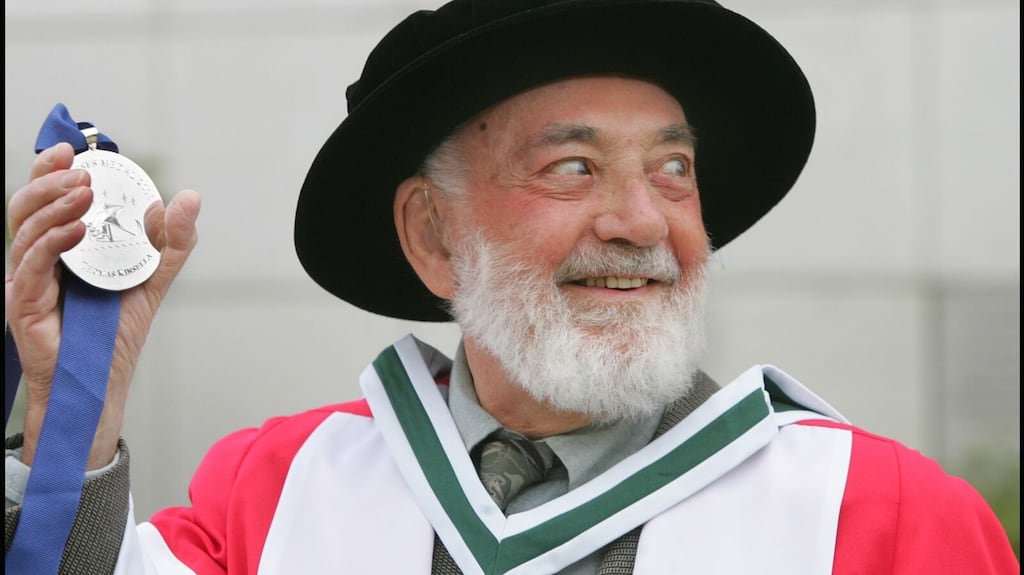

Thomas Kinsella was born in May, but having my own birthday around now often sends me back to re-reading his sombre poem about ageing, Mirror in February. Birthdays aside, its gloomy mood is well suited to the current sodden weather, of which there seems to be no end in sight.
“The day dawns with scent of mist and rain,/Of opened soil, dark trees, dry bedroom air,” it begins, before the narrator is riveted by his own post-shaving reflection, with its “dark exhausted eye” and “dry down-turning mouth”.
Happily, he finds a more upbeat note by the end, viz: “I fold my towel with what grace I can,/Not young, and not renewable, but man.”
And yet this hint of redemptive wisdom is always for me overshadowed by his earlier reference to having just reached “the age of Christ”. As I am reminded every year, gloomily, Kinsella wrote this farewell to youth when he was 33.
READ MORE



Not the poor mouth
I was cheered up for a moment earlier this week by the arrival of an email from reader Pat O’Brien, concerning a dispute 60 years ago between Myles na gCopaleen, comic genius formerly of this parish, and the taxman.
It resulted in a chain of correspondence that, as Pat says, “is now held for posterity among the files of the Revenue Commissioners, in the National Archives”.
He included these in attachments, which I read in hope of comic fireworks. Alas, as Myles lamented once about a play in the Abbey, the row was entertaining enough in its own way “but you couldn’t get a laugh out of it”.
It began in late December 1965, when the Revenue Commissioners returned a cheque he had sent, explaining that they didn’t know what it related to and asking him to attach the original demand.
That was a routine reply and, to most people, would have seemed innocuous. But not to late-period Myles, whose natural tendency to be crankier than a bag of cats was exacerbated by serious ill health (this coming April will mark the 60th anniversary of his death).
He was clearly not lacking in energy, however. So first, in January 1966, he fired off a letter to Revenue finding it “grossly offensive” that he was being required to provide evidence of “my right to make a payment” and commenting:
“That the public service is crawling with workshy [sic] bums is fairly well known but this sort of insult, coolly delivered in writing, is something quite new to me.”
Then he devoted not one but two of his Cruiskeen Lawn columns in this newspaper to the subject, which in turn provoked a series of letters to which, in early February 1966, Myles also contributed.
In the meantime, as the files reveal, his tirade had caused quiet consternation in government circles, attracting the concern of such luminaries as TK Whitaker, then secretary of the Department of Finance, and minister Jack Lynch.
Whitaker conceded that revenue officials could not expect to be popular and were “reasonably familiar with abusive criticism”. Even so, he suggested that in other circumstances, he might have been tempted to take a libel action, although he presumed the minister would share his reluctance to do so on this occasion.
Lynch agreed. Yet even that mild-mannered Corkman admitted to finding the later Myles vexatious. In a sympathetic letter to the chairman of the Revenue Commissioners, he wrote that it was “difficult to contain myself” when faced with certain kinds of newspaper commentary: “For that reason I gave up reading this particular gentleman’s articles years ago.”
Poor Myles. He had himself been a civil servant, until a forced early retirement. And as well as bad health in 1966, the weather may have been getting to him. I note from the archives that, after a cold January, February was a “very wet and dull month”, with rainfall in parts of Ireland “exceeding 350 per cent of the average”.
A very civil servant
I sometimes suspect that the same TK Whitaker, by ushering Ireland into a new, more prosperous era, killed off Myles na gCopaleen’s career as a comic writer.
Certainly, the latter’s best work coincided with the grim, economically straitened De Valera years. Myles’s decline had excuses other than the Lemass-Whitaker reforms, but national prosperity didn’t seem to agree with him either.
On the other hand, I’m reminded that Whitaker’s positive contributions to literature included, accidentally, Thomas Kinsella.
Another who began his career in the civil service, Kinsella served as Whitaker’s private secretary for a time. He could not have been one of the “work-shy bums” referred to by Myles in January 1966, if only because he had resigned in 1965.
But in an interview years later, Kinsella credited the “alertness”, “openness” and “systematic behaviour” he had witnessed in Whitaker and others as a helpful influence on his own work, especially the longer poems. “I made my own of it as best I could,” he said.


