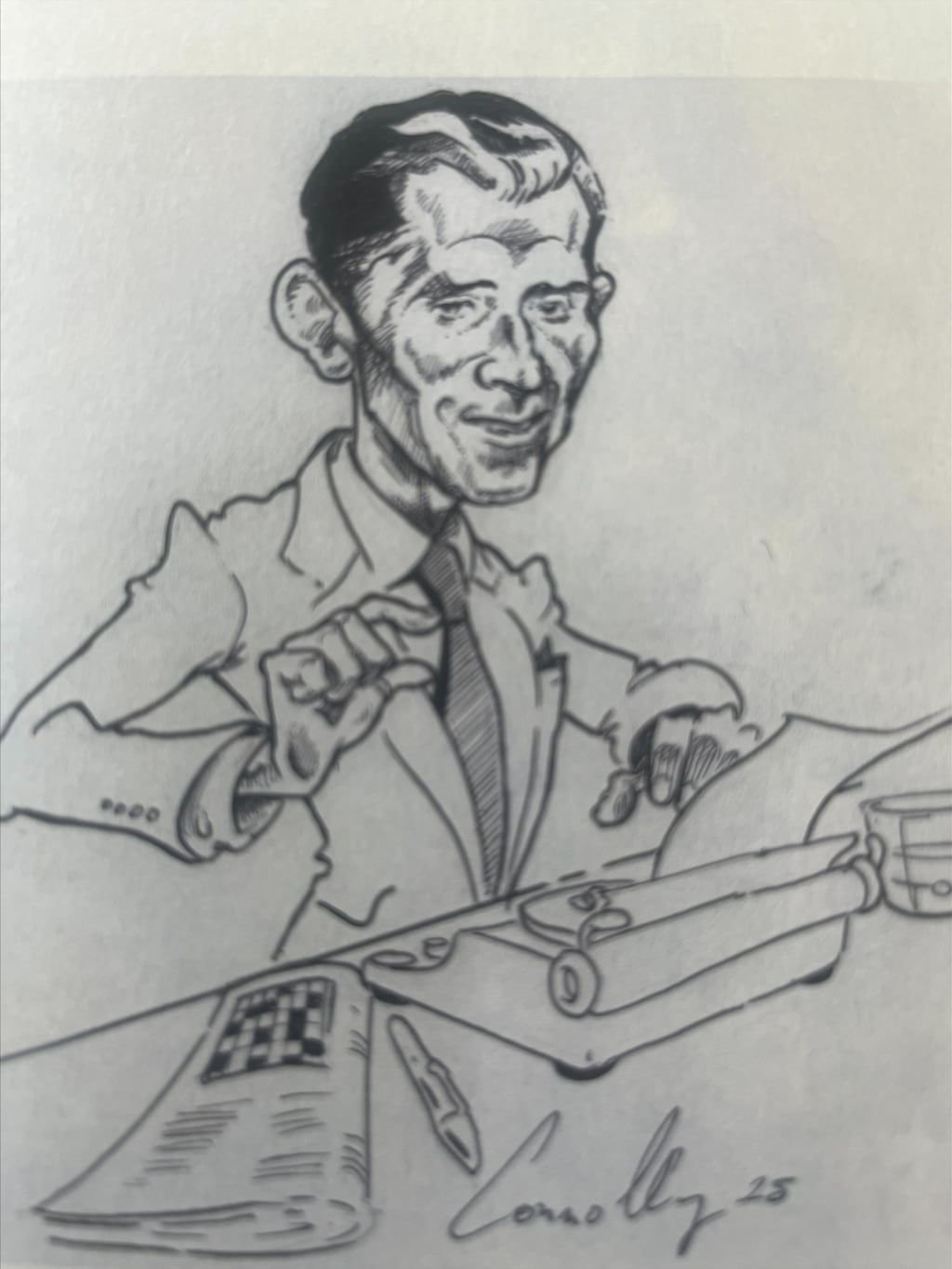

I never knowingly met Frank O’Dowd, “reluctant businessman” and literary wit, late of Rathgar. But on Sunday last it fell to me to launch a posthumous collection of his writings. And when reading up on him, I was gradually overtaken by the certainty that our paths must have crossed at least once.
Older Irish Times readers may remember O’Dowd from his many letters to the editor published in the 1970s and 80s. He was also during that period a regular entrant and frequent winner of the weekly writing competition, for which participants were set a challenge in poetry, prose or drama.
Which reminded me that, as a reluctant civil servant in the late 1980s, I too was in the habit of entering that contest for a period (under – God forgive me – different names). And in one of several coincidences bordering on spooky, I now know that the other Frank made his last entry in October 1989, whereas my debut was in November that year.
Then there was the question of addresses. Born in Galway, O’Dowd moved early in life to Dublin, where along with his wife May, he raised a family of six at Villiers Road, in the triangular enclave between Rathgar Road and Upper Rathmines.
READ MORE


But that was a Bermuda triangle of bourgeois homes and bedsit-land then. And for a time in 1980s, I too lived there, in a bijou apartment at Templemore Avenue, two roads west of Villiers. I must surely have passed the other Frank now and then. Or even more likely, we must have shared vigils for the No 14 bus, a phantom entity for which, I now know, he spent much of his life waiting.
Mind you, if presented with an identity parade of former neighbours, I would struggle to pick him out. According to one of his essays – Did Anyone Ever Tell You That You Were Like Kojak? – he was compared at different times to Bing Crosby, Vincent Van Gogh, James Joyce, Cathal Brugha, Peter Cushing and Danny Kaye, among others.
And yes, despite his fine head of hair, someone also once thought he resembled the famously bald TV character Kojak, albeit that was just a drunk in a pub.
Still, the more I learned of O’Dowd, the more I felt like Samuel Beckett’s detective Jacques Moran investigating the disappearance of Molloy (whom the reader gradually realises is Moran’s – and perhaps Beckett’s – former self.)
Not that either me or the other Frank would be comparing ourselves to Beckett. Which said, one of O’Dowd’s poems, called simply Poem, was an admiring response to Beckett’s play Breath. There is no dialogue in the play, notoriously, so there were no words in the poem. Instead, to assist critical interpretation, O’Dowd was reduced to describing it in a letter to The Irish Times.
Another of his daily routines, I read, was this newspaper’s cryptic crossword, even to the extent of competing against fellow solvers in a short-lived annual competition. This too we had in common.
At peak fitness then, I had a personal best of just under 6½ minutes (wind assisted). So, a couple of times in the late 1980s, I entered one of the regional rounds and then the national final in Jury’s Hotel, Ballsbridge, for which the late Derek Crozier compiled especially fiendish puzzles.
It was like sitting the Leaving Cert again. There were four crosswords, to be solved in two hours. But like showjumpers in the nearby RDS, we were also competing against the clock.
After about 38 minutes, somebody would hand up the papers, looking smug. Then another. Then three or four more. By that point, you could assume at least three of the finishers had all the correct answers and therefore the prizes.
So my vainglorious strategy then was to give up trying to solve the last few clues, fill the blanks with guesses, and hand my papers up too. That way, I could claim a Top 10 finish and (God forgive me again) no one would be any wiser
I don’t think the other Frank ever won a prize either. But lo! I jointly searched for our names in the archives. And now, my detective work has placed us in the same room at least once: at Jury’s Hotel on the afternoon of January 30th,1988.
Most of Frank O’Dowd’s short stories, poems and playlets were unpublished in his lifetime. And no doubt he would have liked to see more in print.
But when not hammering out words on his Remington typewriter, he was busy rearing a fine family, including Anne (herself the author of a book on folk traditions that has been described in this newspaper as “magnificent” with “excellent scholarship”) and Gwen O’Dowd (one of Ireland’s finest painters).
And the extent to which their father succeeded in parenting is evidenced by the publication of Parody Poems and Prose, an anthology of his writings assembled by an admiring family. A literary labour of love, for everyone involved, the collection is available from Books Upstairs or via orpenpress.com.


