
The clash of the old world and the new in the World Cup final between Spain and Argentina on Sunday coincides with the visit of a replica of a ship that made it all happen.
In 1492 Christopher Columbus’s flagship, the Noa Santa Maria, discovered the Americas for the Spanish Crown and set in train the events that would lead to two Spanish-speaking countries, on either side of the Atlantic but bound by a colonial history, competing for sport’s biggest prize.
A replica of the ship is berthed at Fiddle Case Pier in Drogheda, Co Louth, for the next 10 days. It arrived into port on Thursday and will be there until July 26th.
On the other side of the country is a reminder of the historic links between Spain and Ireland. The Galeón Andalucía, a replica of a galleon from the Spanish Armada, is making its way clockwise around the west coast.
READ MORE


It is the first time a Spanish galleon has arrived in Irish waters since three were shipwrecked off the Irish coast and 1,100 men drowned off Streedagh Beach, Co Sligo, in 1588.
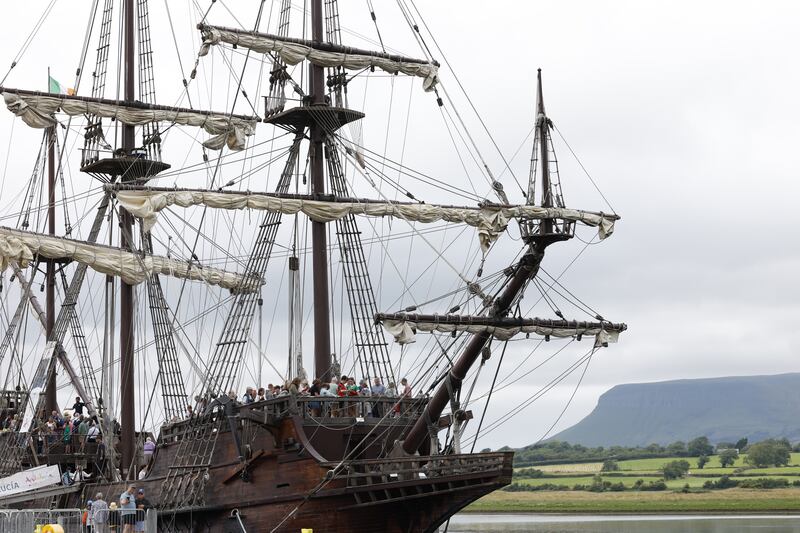
The Spanish sailors who did make it ashore were the luckier ones and would be followed by thousands more after Spain’s intervention during the Nine Years’ War, which ended for them at the Battle of Kinsale in Cork in 1601-1602.
Today tens of thousands of Spanish teenagers arrive in Ireland every summer to learn English. One was Pedro Sánchez, now the prime minister, who studied English in Ireland during the 1990s. Another was Xabi Alonso, who won the World Cup with Spain in 2010 and spent a summer in Co Meath learning English.
The permanent Spanish population in Ireland is growing all the time, from 6,794 in the 2011 census to 17,953 in 2022, fuelled by higher wages and better opportunities for many of them than at home.
Gon Massey, a musician from Barcelona, arrived in Ireland nine-and-a-half-years ago to busk on the streets. He met his musical partner Anxo – pronounced like “anseo” – Silveira from Galicia three years ago and they formed a group, Baliza.
These musical instrumentalists have become popular in their adopted country and featured on Spanish television last week.
[ Ken Early: World Cup final is a confrontation of two opposite ways of seeing the world ]
“We now have a great following from the Spanish community in Ireland. We sold out 10 nights in Whelan’s over the last year,” he said, referring to the Dublin music venue.
The pair organised a show at the Dtwo club in the city’s Harcourt Street around the semi-final against France last Tuesday, which Spain won 2-0.
“We sold 800 tickets in 24 hours, which was crazy,” he said.
Massey said that when he first came to Ireland he didn’t notice that many Spanish people.
“Now they’re everywhere,” he said. “Some people say it is for work. Ireland is a great place to be. You get a good salary, but it is also a nice experience.”
They are going to watch the game in the Dtwo and move on to the Molly Malone pub if Spain win.
Silveira arrived from Galicia three-and-a-half-years ago. “There are great opportunities for music here. There’s more of an underground vibe.”
Spanish people don’t agree on a lot of things and are often divided by politics and regional identity, but they are united in support for a team that reflects the diversity of the country.
A long-term Spanish resident in Ireland, Miren-Maialen McDonald, is originally from San Sebastián, known in Basque as Donostia.
She is proud of the Basque players in the team, especially Mikel Oyarzabal who has scored five goals to date and is captain of her home team of Real Sociedad.
Real Sociedad won the Copa Del Rey tournament in April, leading to much celebration in the city.
“For us Basques, sport is so important for our expression of cultural identity and community,” she said.
“Last Tuesday I watched the match and Baliza music band was playing and it was absolutely amazing.”


