
The front of the barbershop had been blown open, and fragments of shattered glass covered the ground. The dust of pulverised concrete coated the chairs, where clients used to sit, and the mirrors, which they would gaze in as the barber said “Nai’man” – an Arabic phrase to congratulate someone after having a haircut, shaving or taking a shower.
It was to this scene in Beirut that Ali Yassine (28) and Wassim Yassine (24) pulled up on a motorbike, and began rooting through what was left.
One picked up an electric shaver, though he doubted it could work again, and some combs protected by a plastic cover. They would take these tools with them and use them elsewhere, they said.
Both had worked in the barbershop before (“he’s better than me,” trainee Ali said about Wassim).
READ MORE


They were lucky that their skills were transferable: when the all-out war started on March 2nd they began giving haircuts at schools which had been transformed into shelters for some of Lebanon’s more than one million displaced people.
After more than six weeks of war and nearly 2,300 deaths, a fragile 10-day ceasefire came into force last week.
Beirut’s southern suburbs – known in Arabic as Dahiyeh, and normally home to hundreds of thousands of people – was under a mass Israeli evacuation warning from days into the war, but the ceasefire saw many people venture home, at least temporarily, to take stock of their situation and assess what remained.
On Monday, Hizbullah invited journalists to visit an area in Dahiyeh called Haret Hreik, after forbidding almost all journalistic coverage there from March 2nd, saying the information gathered could be used by Israel.

As dozens of journalists walked a long stretch of road, taking photos and videos and interviewing locals, an Israeli surveillance drone – visible in the sky above – flew loudly overhead.
At each turning in the long stretch of road, there seemed to be another toppled building. Locals flashed “victory” signs. Photographs of “martyrs” – locals who died during this war or previous ones – were also a regular sight.
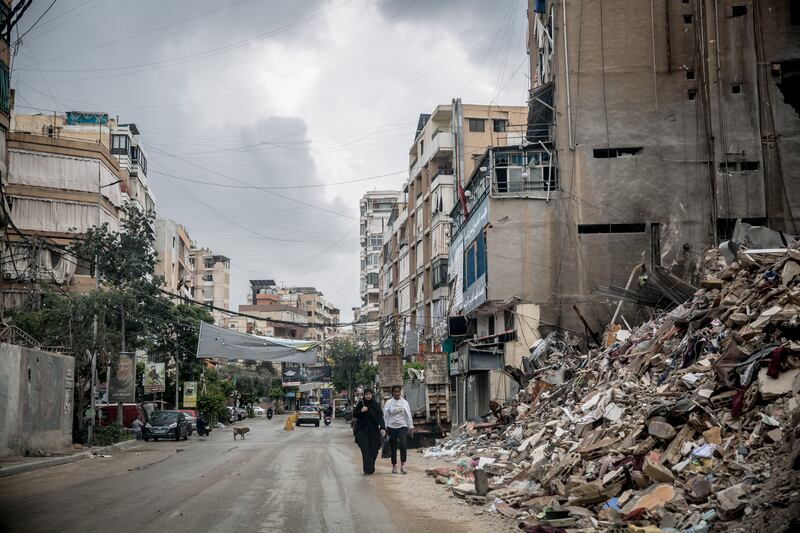
Whether the ceasefire will last is unclear. Israel – which has the stated war goal of making its north safe from Hizbullah attacks for residents – continues to occupy large swathes of Lebanese territory. Hizbullah says any sustained occupation gives the Lebanese people the “right to resist”.
On Monday, a spokesman for UN peacekeeping force Unifil said it has continued to witness Israeli ground activities in southern Lebanon, “including demolitions,” and had recorded “a handful of Israeli drone strikes,” as well as “about 350 launches from south [Israel] to north [Lebanon]. Such launches include mortar and artillery shells.”
Many Lebanese say they do not want a return to 15 months between November 2024 and the latest war, when the Israeli military continued to carry out regular attacks, saying that Hizbullah was rebuilding, but Hizbullah did not retaliate.
“We need dignity, our dignity is a red line,” said a volunteer member of a local “protection” force in Dahiyeh who described himself as a Hizbullah supporter but said the Iranian-backed group does not pay him. He had stayed in Dahiyeh during the war, he said.
[ Day of pain in Lebanon: 'They're doing the same thing they did to Gaza'Opens in new window ]
Sitting beside what locals said was the remains of the headquarters of Al-Manar TV network, two Syrian women said they had returned to the area after the ceasefire because they had nowhere else to go.
Another pile of rubble was a furniture store before, locals said.

“What is the reason to target here?” asked Ali, gesturing at the barbershop he used to work in.
A few premises in the area used to host a branch of the Hizbullah-linked Qard Al-Hassan financial institution.
In both 2024 and 2026, Israel targeted Qard Al-Hassan branches, saying they were funding terrorism. US-based Human Rights Watch has said these are civilian institutions and not lawful military targets, which would make the attacks a war crime.
Even if the branch was the target, Ali said, why carry out an attack so strong that it destroyed an entire row of businesses?
“They want people to leave the place,” suggested Wassim.
“They will rebuild it again, it doesn’t matter how much it costs, life will continue,” Ali said.