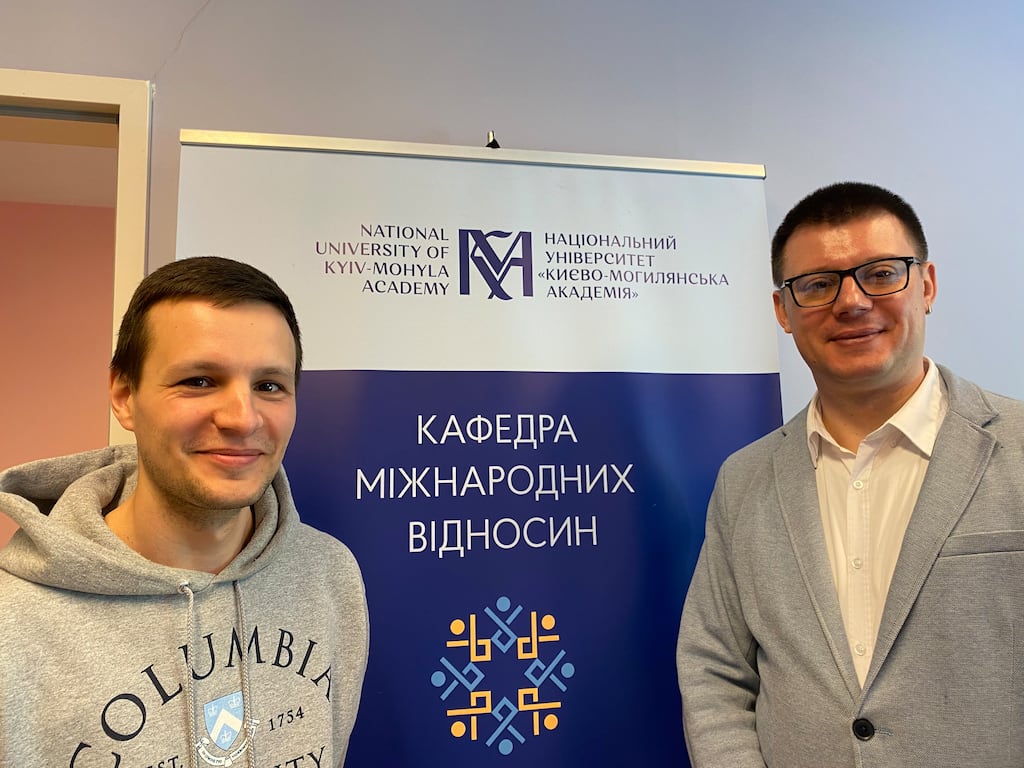

Maksym Yakovlyev heads the international relations department at Kyiv-Mohyla Academy, Ukraine’s oldest and most prestigious university. His former student and colleague, Anton Suslov, is a senior analyst at Kyiv-Mohyla’s school for policy analysis.
Last September, the professors corrected what they saw as a gaping hole in Kyiv-Mohyla’s curriculum by creating a Russian studies programme. “The goal is to know our enemy,” Suslov says. “That is why ours is significantly different from Russian studies programmes in Europe or the US.”
Anything to do with Russia is considered toxic since Russia’s full-scale invasion of Ukraine. The programme proved popular with students, but provoked a backlash from other academics.
In the faculty council “the opposition was so funny”, Yakovlyev says. “For example, we debated if Russia should be written with a small or capital R, or if the title of one class, ‘Anatomy of Russian Elites’ was academic enough.”
READ MORE


Several academics wanted the programme to be entitled “anti-Russian studies”. Academics struggling to establish Ukrainian studies programmes in Europe were outraged. There were objections to Petro Bakumov, a former Russian citizen who was recently naturalised and who teaches a class on Russian soft power. Bakumov holds postgraduate degrees from Milan and Bremen and is a fighter with the Russian Volunteer Corps (RVC), a unit of the Ukrainian armed forces that is comprised of Russians. The RVC has a reputation for right to far-right politics.

“We are being accused of creating a Russophile circle of Russia lovers who pretend to be critical scholars of Russia,” Yakovlyev says. “Of course, impartiality is the first rule of any scholarly undertaking. But you cannot imagine how sensitive our students are to any sort of sympathies towards Russia. A couple of years ago, an older professor dared to quote a line from the great Russian poet Mayakovsky. Students complained right away.”
The professors reached agreement with the Ukrainian military intelligence agency HUR, which provides guest lecturers for Suslov’s course on Russian policy in the occupied territories. “They are interested in hiring our future graduates,” Yakovlyev says. “The presence of HUR is a guarantee that we will not fall in love with ‘the great Russian culture’,” he says with sarcasm.
Yakovlyev says he has learned most from teaching a popular class about treatment of the nearly 30 per cent of citizens of the Russian Federation who are not ethnic Russians.
“[Vladimir] Putin has been careful not to turn Russian middle classes against the war by drafting their sons, so a disproportionate number of soldiers fighting in Ukraine are indigenous peoples,” he says. “The word ‘Buryat’ is almost the same as the word for beetroot, so Ukrainians make dark jokes about Buryats [a Mongolic ethnic group from southeastern Siberia] rotting in the fields like beetroot.” Bashkirs, Chechens and Kets are other minorities dispatched by Moscow to die in Ukraine.
Suslov’s classes on the occupied territories include seminars on youth indoctrination, everyday life under occupation and Russian persecution and suppression of Ukrainian citizens. Russian foreign policy, open source intelligence on Russia and Russian colonialism are a few of the compulsory classes. There are elective classes on, for example, the Russians in Africa, European Union-Russia relations and the Orthodox Church as a tool for soft power.
The professors know of no Ukrainian studies programmes in Russia. “There used to be a library of Ukrainian literature in Moscow,” Yakovlyev says. “It was shut down. The local population petitioned to have Ukrainian as a subject in secondary schools in the occupied part of Zaporizhzhia. The Russians banned it.”
Yakovlyev and Suslov are both from eastern Ukraine: Yakovlyev from Donetsk city, which has been occupied since 2014, and Suslov from the frontline city of Zaporizhzhia. Suslov says the majority of students in his class on the occupied territories are from Crimea and Donbas.
Yakovlyev attended the only Ukrainian-language secondary school in Donetsk. Ukraine had been independent for eight years by the time he graduated, but Donetsk retained the Soviet Union tradition of awarding gold medals to A+ students. A Russian-speaking woman from the city council department for education asked him: “Maksym, you seem like a clever boy. Tell me how is it possible to study physics in Ukrainian?” In her view, Yakovlyev says, “Ukrainian was the language of peasants”.
The professors dispute the idea that people in the occupied territories want to be Russian. All 24 oblasts, or provinces, of Ukraine voted Yes to independence in a referendum. Both Donetsk and Luhansk, which together comprise Donbas, approved by nearly 84 per cent. “In the last all-Ukraine survey conducted across the internationally recognised territory of Ukraine, including Donbas and Crimea, no results showed a significant number of citizens wanted to join Russia,” Suslov says.
The residents of Donbas have sometimes faced suspicion that they harboured divided loyalties between Ukraine and Russia. In a long-censored controversial diary entry in 1993, the Ukrainian writer Oles Honchar wrote: “Donbas is a cancerous tumour – so cut it off, throw it into the jaws of the empire, let it choke on it. Otherwise, the metastases will suffocate all of Ukraine.”

Five writers from Donetsk spoke and read poetry at a recent evening at PEN Ukraine, dedicated to the identity of people from Donetsk.
From the late 19th century, coal mines and industrialisation pulled Ukrainians and Russians seeking economic opportunity to Donetsk. It became a melting pot, comprised of Greeks uprooted from Crimea, Jews, Armenians, Georgians, Azerbaijanis and exiles from other Soviet republics. Following independence in 1991, Donetsk became famous for its melding of business, politics and crime, as personified by Ukraine’s former pro-Russian president Viktor Yanukovych.
The PEN writers recounted stereotypes which I also heard from the professors at Kyiv-Mohyla. People from Donetsk are said to be rude, but punctual and trustworthy; people from western Ukraine are allegedly more polished but less reliable.
The soldier-writer Stanislav Fedorchyk said that even in Soviet times Russians did not trust locals to run the security services in Donetsk, so they brought spies from Russia. “Local people who worked for Russia were looked down on by the Russians, although they served them.”
Not being able to return to the home of one’s parents was perhaps the most painful thing about having fled Donetsk, Fedorchyk said.
In Donetsk, Iya Kiva said, she always felt she stood out as a Ukrainian-speaker. “Attitudes towards people from Donetsk have sometimes been hostile since [the Russian invasion in] 2014. I heard things like, ‘Go back to your Russia’, so I felt foreign in both places,” she said.
After Russia’s initial invasion in 2014, Fedorchyk said he was appalled to hear some Ukrainians say that the people of Crimea and Donbas “deserved this because they were pro-Russian… The new war brought the realisation that was maybe not the case, that invasion will come whether you support the Russians or not”.
The evening of poetry and music had the feel of a group therapy session. “I want the rest of Ukraine to believe in the people of Crimea and Donbas,” Kiva said. “Because they are the most passionate about Ukrainian red lines. People in Lviv might say, ‘Let’s give Donbas to the Russians’. But these people [from the occupied east] will defend Ukrainian territorial integrity to the end.”
The audience burst into applause.


