
Aughinish Alumina will be forced to pay up front for the costs of closing down the Co Limerick plant and repairing environmental damage in the area, under a new deal agreed with the State.
Under various previous arrangements, the Environmental Protection Agency (EPA) relied on a guarantee from the plant’s owners, the Russian metals giant Rusal, to pay €14 million of the expected €31 million clean-up cost when the refinery ceases operation.
Under the new agreement, which was finalised in early June, Aughinish Alumina will be required to set aside nearly all of the €31 million. Rusal will only be relied upon to pay about €220,000.
The new deal was agreed amid increasing uncertainty about the plant’s future. Since the start of Russia’s full-scale invasion of Ukraine in 2022, Government officials have also privately expressed concerns that Rusal, which has close links to the Kremlin, could not be relied on to pay for the closure costs if the European Union sanctioned the plant.
READ MORE


From the Shannon to Siberia: How alumina from a Limerick refinery enters Russia’s weapons supply chain
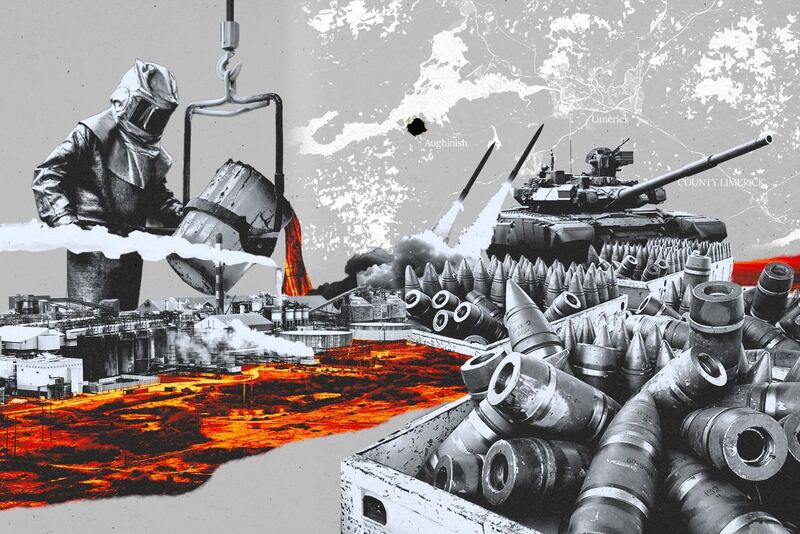
- Aughinish Alumina in Co Limerick supplies vast amounts of raw materials to Russian aluminium smelters, according to an investigation by The Irish Times and the Organised Crime and Corruption Reporting Project (OCCRP).
- Read the full investigation here.
Aughinish Alumina, which is the largest alumina refinery in Europe, sits on 526 hectares (1,300 acres) on the Shannon estuary. Much of the site is made up of the bauxite residue disposal area (BRDA) which contains millions of tonnes of bauxite residue, the main waste product from alumina production.
Environmental campaigners argue the presence of this material, much of which is highly caustic, poses a major danger to the local environment.
The eventual closure of the plant and the resulting clean-up is governed by a “closure, restoration, aftercare management plan” (Cramp) agreed between Aughinish and the EPA as part of the plant’s environmental licence.

Aughinish Alumina; Unsafe vapes; World Cup hydration breaks
Under the plan, the refinery’s owners commit to dismantling the plant entirely and treating the BRDA to neutralise any environmental risks and eventually turn it into a nature reserve. This will take up to 35 years, according to Aughinish’s calculations.
According to official documents, previous versions of the Cramp included a €14 million “secure fund” provided by Aughinish to cover the costs of the BRDA clean-up. The closure of the refinery itself was covered by a “parental guarantee” where Rusal promised to contribute €14 million.
Under EPA guidelines, parent company guarantees are only approved following a financial assessment of the parent company and the likelihood of it honouring the agreement.
As Rusal is technically headquarters in Jersey, the EPA also had an independent legal firm assess the agreement’s enforceability.
EPA documents show this €14 million parent company guarantee was in place as recently as March 2024.
On June 5th, the EPA approved a new agreement with Aughinish which updated the closure costs to €30,795,129, including expected inflation.
This includes a secure AIB account containing €14 million on which the EPA has first charge.
Most of the remainder is met by an “on-demand performance bond” worth €16,575,825 which will operate until 2027.
“The parental company guarantee, while it is still in place, it is no longer a significant aspect of the [financial provision] instruments in place,” said an EPA spokeswoman in response to queries.
The phasing out of the reliance on Rusal to guarantee clean-up costs coincides with growing concerns about the plant’s future, including the impact closure would have on local jobs and alumina supply to Europe.
The Government is currently finalising an inquiry into the plant’s connections with Russia, which was triggered by disclosures in The Irish Times that alumina from Ireland is sent to smelters making aluminium for the Russian military industry.
The Government report will be given to the European Commission which will decide whether alumina should be included in future sanctions targeting Russia.
Such a move would likely make the plant financially unviable as Russia accounts for about half of its exports.
On Saturday, The Irish Times reported that, in the event of sanctions, the Government is likely to request financial assistance from the EU to keep the plant open.


