Any tourist walking through the streets of central Budapest today would rightly realise Hungary is in the middle of an election campaign: wherever you go, flattering posters of beaming politicians take top billing on lamp-posts, advertising hoardings and even balconies.
With airbrushed faces, party logos and carefully co-ordinated colour choices, similar posters are a mainstay in elections in Ireland, the rest of Europe and beyond, so much so you would think all political campaigners are reading from the same publicity manuals these days.
Except, this election in Hungary, due to be held on April 12th, is anything but ordinary: commentators have billed it as the most important in the EU this year and as a referendum on whether Hungary should drift closer to Moscow or to Brussels.
Prime minister Viktor Orban’s ruling Fidesz party is, however, in trouble and, reports say, trailing in multiple opinion polls.
READ MORE


Indeed, visitors to Budapest, never mind Hungarian voters, could be forgiven for wondering where Moscow-sympathising strongman Orban is in all this – you would be hard-pressed to see his picture on any of his party’s posters.
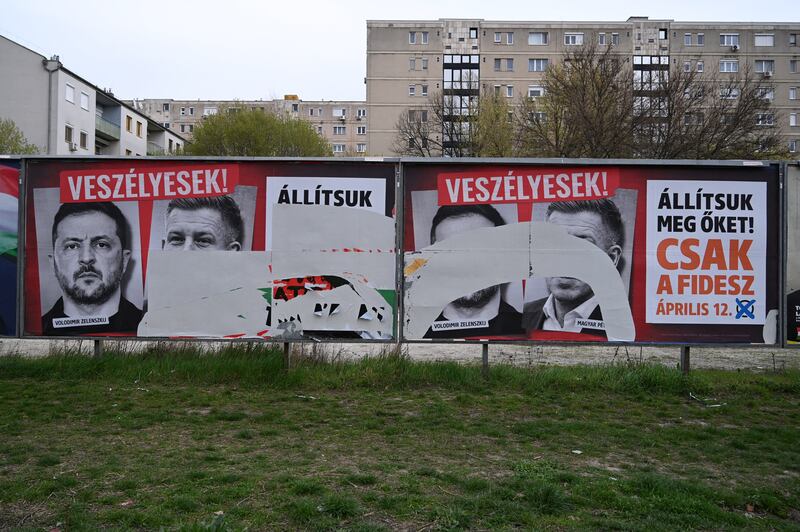
Curiously, what you will see on Fidesz posters are faces of Orban’s “bogeymen”: Ukrainian president Volodymyr Zelenskiy, opposition Tisza party leader Péter Magyar and European Commission president Ursula von der Leyen.
Such posters carry a simple message, loosely translated as “Fidesz, the safe choice” and, underneath, superimposed on the image of Zelenskiy, Magyar and von der Leyen, the warning “they are the risk”.
For their part, though, it does seem voters are seeing through the Fidesz message and are not buying into Orban’s party’s rhetoric.
[ EU leaders are growing tired of the Viktor Orban showOpens in new window ]
Outside Budapest’s elegant, Austro-Hungarian imperial-era Central Grand Café, one Fidesz poster seems to sum up the mood: it has been defaced with the graffiti-style tag “Ruszkik Haza”, two words that pack a lot of meaning and emotion for ordinary Hungarians.
“Ruszkik Haza” translates as “Russians, go home”, a notable slogan from the 1956 revolt in Hungary against Soviet occupation from the second World War onwards. Moscow’s last soldier left these parts in 1991, so such graffiti still carries meaning among middle-aged and older voters today.
If one were still in any doubt about which direction Fidesz might be heading, then the party’s posters also contain another clue for the careful observer: their simple, strong, bold colours and muscular portraits (albeit of opponents) are reminiscent of the statues and public art of that earlier era, the loathed Soviet occupation when communist strongmen leaders were portrayed as the people’s gods while ordinary folks were hailed as every worker’s hero.
Before the collapse of the Soviet Union, dour statues featuring such caricatures were commonplace. Budapest had its fair share, too, and cleverly came up with a solution once Hungary was free of Moscow’s shackles from 1991. About 40 minutes southwest of the capital lies Memento Park, an open-air “theme” park where such artworks were brought to see out their days. All the usual suspects are there: Lenin, Marx and Stalin (but only his boots; the rest of him was toppled in the 1956 revolt).
If nothing else, visitors can marvel at the craft and skill of the sculptors of these behemoths; and then wonder at how such tyranny was so well celebrated in bronze and granite.
Back in central Budapest, there are signs those dark forces are, perhaps, slowly making themselves felt more strongly in a country that has been part of the European Union since 2004 and in the Schengen free-travel area since 2007.
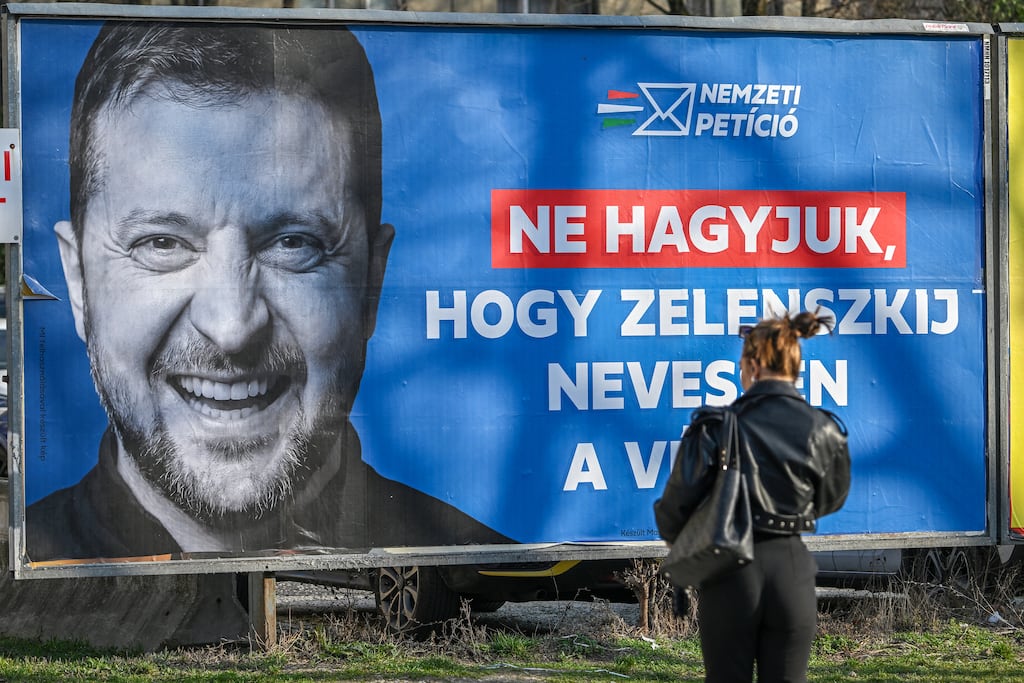
A smiling portrait of Zelenskiy features in posters in the Hungarian capital, but the words underneath are not ones of support. Quite the reverse. The words underneath loosely translate as “don’t let Zelenskiy have the last laugh”.
[ Pipeline row between Ukraine and Hungary escalates into diplomatic crisisOpens in new window ]
Almost in parallel with the parliamentary elections, the Hungarian government is carrying out a “national petition” seeking the public’s endorsement for Orban’s stance against EU support for neighbouring Ukraine.
The posters on this national consultation underline Orban’s position as one of the EU leaders closest to Moscow as he seeks to frustrate the bloc’s attempts to help his beleaguered neighbour.
Orban appears to enjoy support among some Hungarians for his stance on Ukraine, though: Hungary gets oil from Russia via a pipeline that runs through Ukraine. Repairs to this pipeline, badly damaged during Moscow’s “special military operation” in Ukraine, are dragging on. And Orban knows how to make political capital from this, if nothing else.
Whether he can succeed in this “petition” and, days later, in the parliamentary elections is far from certain. A recent documentary, The Price of the Vote, reveals intimidation and bribery to pressure voters into backing Fidesz.
Nothing is as it seems in Budapest. There’s a hugely important election on. But the election posters only tell half the story.


