

Bus users – and the bus-curious – bought into National Transport Authority (NTA) proposals back in 2017 for a complete and thorough restructuring of Dublin’s bus services.
That year, the NTA sought the public’s views on the “general principles” of a new system that involved consolidating routes into high-frequency “spines” that would provide faster services but could involve taking more than one bus to reach destinations previously served directly.
More than 11,000 people, mostly passengers or people who would consider taking the bus if services improved, responded.
Almost 90 per cent were in favour of pursuing the “spine” strategy and 81 per cent agreed it was reasonable to ask people to change buses, if it transported them to their destination sooner.
READ MORE


The first iteration of those plans was published the following year and submissions were substantially more numerous and considerably less enthusiastic.
More than 50,000 submissions were received, with more than 70 per cent objecting to the loss of existing services or having to change buses.
It took another two years of refinement before the final network redesign was published in September 2020. The first new route, the H-Spine from the city centre to Howth and Malahide in north Dublin, was introduced in June 2021.
The network redesign is one half of the BusConnects programme, the other being the construction of 12 bus corridors, largely segregated from general traffic and operating with similar priority to Luas lines.
Eight spines, A to H, were developed with numbers indicating different branches of a spine. For example, all H buses run to Clontarf, then H1 buses branch to Baldoyle, H2s to Malahide and H3s to Howth.
The redesign also introduced orbital routes, a previous deficit in the bus network where almost all buses ran from the suburbs to the city. These routes would provide connections between the suburbs and links to rail and other bus routes. In addition, there were some new city-bound routes, peak-only, express and local services.
The network redesign was supposed be implemented from 2021 to 2023. In fact, the programme is just over halfway through, and isn’t expected to be fully in place until 2027.
Construction of the first of the bus corridors, which required planning permission, is finally due to begin in the new year, with completion of all 12 about six years away.
The pace of introduction of BusConnects has been grindingly slow, largely due to a shortage of drivers and mechanics.
While some of these issues are out of the control of the NTA, delays in introducing a connected coherent network hasn’t helped the public perception of a project that requires significant buy-in from passengers.
Dissatisfaction with the redesign has spiked periodically since the rubber hit the road.
Recently, it has escalated with communities in Chapelizod in west Dublin and Finglas in north Dublin taking to the streets to protest what they see as a diminished service provided by the new routes.
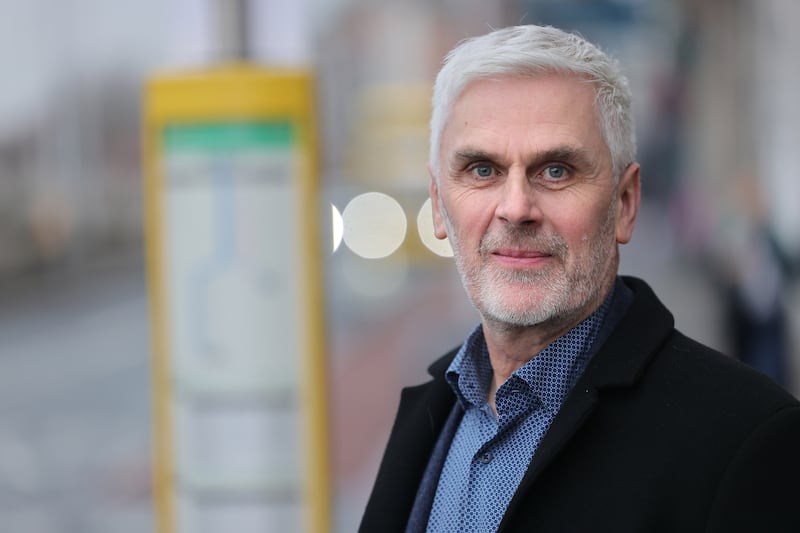
These protests are not reflective of the general reaction to the new routes, says Jeremy Ryan, director of public transport services with the NTA.
“There’s actually been a very positive passenger reaction. In terms of customer satisfaction, we’re seeing a very positive response to the most recent phases implemented,” says Ryan.
The NTA’s statistics do support the assertion that most passengers are happy with routes introduced earlier this year.
According to newly published research, the E-Spine, which replaced long established routes including the 9, 11, and the ostensibly sacrosanct 46a, has an 81 per cent satisfaction rating.
For the survey, Ipsos B&A researchers interviewed 2,559 passengers on board and at bus stops in August and September on the E-Spine and a number of new orbital routes introduced earlier this year.
The strong approval rate is borne out by usage levels, Ryan says.
“We’ve looked at the passenger usage on the network implemented to date. Since 2019, which is before BusConnects, background growth is up by 6 per cent, but on the network where we’ve improved the service through network redesign, it’s up 30 per cent,” he says.
[ Work on Ballymun/Finglas to Dublin city centre bus corrider to begin next yearOpens in new window ]
“You always hear about people who aren’t happy, people don’t generally write in to say ‘it’s great!’ – we do love to get those, of course – but generally people pick up a pen or keyboard when they’re unhappy and that is not necessarily representative of the people using the services.”
The passenger growth analysis and satisfaction surveys precede the most recent controversial Chapelizod and Finglas route changes, and Ryan concedes these new routes weren’t entirely successful.
“There have been issues, particularly due to congestion in the city centre, partly to do with the routing through Bridge Street and High Street to plan ahead for the College Green/Dame Street pedestrianisation,” he says.
The NTA has committed to amending those routes, initially to allow buses back through College Green, which is some years off from being developed as a plaza, with more permanent route revisions to come later in 2026.
“What we’ve always said after each phase is we review how operations have gone, whether the services are working for passengers, and any issues that arise, try to resolve as quickly as we can. We don’t want to be overly rigid, if there’s an issue, we need to resolve it,” he says.
He is aware that some Chapelizod residents still aren’t happy, despite the proposed revisions.
“Look, you’re never going to keep everybody happy. We’re not going to pretend we can. Some people in Chapelizod are lobbying for the return of the old 26, but the redesign has been through three rounds of consultations and thousands of submissions,” he says.
“If significant issues arise we will always see if there’s something to be done to fix that issue, but that’s not the same as saying we’re reopening the whole redesign of the network. Of course we’re not.
“You can’t run a bus direct from A to B for every A and every B, it’s totally uneconomic. If you were to do it, you’d be running very low-frequency services, so you would be totally reliant on one service every half-hour as opposed to a service every five minutes that enables you to change on to another service running every five minutes.”
While the customer surveys indicate approximately 80 per cent are satisfied, that leaves one in five who aren’t. The surveys highlighted dissatisfaction in relation to the punctuality, reliability and capacity of the new routes.
Some of this can be attributed to driver shortage, a “worldwide phenomenon coming out of Covid”, Ryan says, coupled with increasing congestion in the city.
Then, related to both these difficulties, but presenting a whole range of problems of its own, is the technology used to provide “real-time” bus arrival information to passengers.
The phenomenon of “ghost buses” – services that are displayed on screens but never arrive – has been well ventilated.
The information provided to those screens is produced through an automatic vehicle location system, which uses GPS trackers on the bus feeding to a central system that generates a predicted arrival time for a bus.
It’s a convoluted system, now more than 15 years old, involving manual as well as technological inputs. It only works efficiently in the best of circumstances and bus services in Dublin are not operating in the best of circumstances.
“There can be communications issues with the bus tracking system. It can be down to services that are cancelled, but aren’t necessarily notified on time, so the screens don’t know they’re cancelled and show a scheduled arrival time, not knowing there’s no bus coming,” Ryan says.
“It works well when there aren’t a lot of cancellations, but if there are significant traffic issues or the bus is not running at all because of driver availability, it can be difficult for controllers to get on top of that in time to cancel the service.”
The system, dating from 2009, will be replaced in 2026, he says.
“We expect that to make big improvements in terms of communications issues and allow tracking of buses to work more reliably,” he says.
The current lack of reliability harms confidence in a system that requires a high degree of trust from users, particularly those changing buses who need to know they won’t be delayed or stranded.
Ryan is confident the current kinks can be ironed out and, once the network as a whole is in place, people will realise its advantages.
“It does work, and we are seeing that in passenger numbers. We fully expect that to continue for later phases, and once the network is complete, we will get the full benefits,” he says.
“There’s no way you can make the changes that are in the network redesign without some people being unhappy, but our customer satisfaction numbers are really, really good and the passenger response has been really, really positive, so we think we’re doing the right thing, and we think it’s working in terms of getting more people on to buses in Dublin.”


