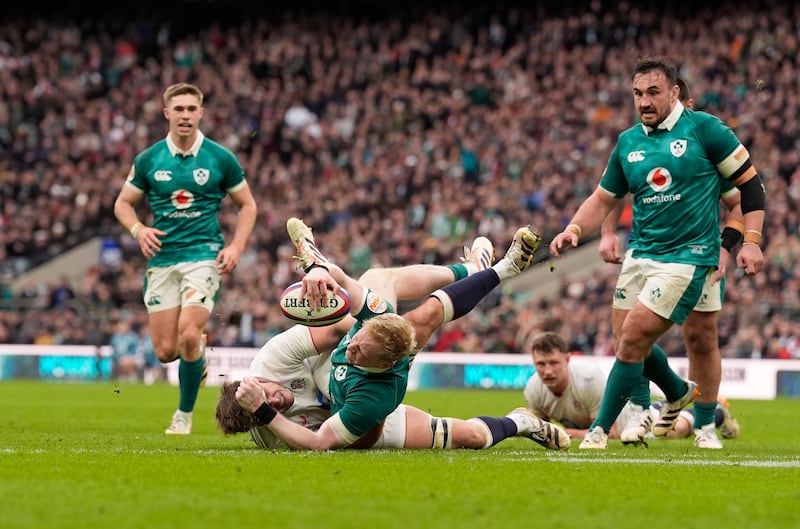

All the trends in this piece come with some degree of a health warning, given three Six Nations games is not a large sample size.
Regardless, we can still learn plenty about how sides are approaching this tournament. Plenty of data points throw up interesting tactical trends. Some were largely predictable, others show how teams are adapting their game plan midway through a World Cup cycle.
Here are the most interesting stats that you may not have known about after three games in this year’s Six Nations.
Is Ireland’s defence sustainable?
Given the importance of 22 efficiency when it comes to winning games, Ireland’s play at both ends of the park warrants mention. We’ve all heard plenty of times at this stage how, in Twickenham, Andy Farrell’s side scored 4.3 points per 22 entry – a very high number.
READ MORE


They’ve also been efficient when defending inside their own 22. According to Opta, Ireland’s red zone denial figure – measuring how often they stop sides from scoring once they cross the 22 – is at 70.6 per cent. That’s the second best number in the tournament, behind France (77.3 per cent) and nearly 10 per cent ahead of Scotland in third.
This at least in part explains how Ireland have outperformed their expected metrics. Again, using Opta’s data, they have been expected to concede 5.5 tries per match, but have only allowed three. Having to defend inside your 22 increases expected points conceded (xP), so repelling attacks close to the line is a good way of outperforming this.
It should be said, though, that five of the six teams have conceded fewer tries than expected – Wales being the outlier. France and Scotland have actually outperformed their xP by a greater margin than Ireland. It’s one to watch as we see if Ireland’s defensive performances are sustainable, or if actual tries conceded start to catch up with expected numbers.
Goal-kicking woes
Another area of concern for Ireland is the goal-kicking. Again, using Opta’s expected metrics, Irish outhalves have been expected to be successful with 83.8 per cent of their shots at goal. Their actual success rate is 73.3 per cent.
The first figure is the highest in the tournament, meaning that, relative to the quality of the relevant kicker, Ireland have had the “easiest” kicks at goal. Yet they still have the competition’s worst success rate.
Both men who have been in the starting 10 shirt have missed kicks in this championship. Sam Prendergast was guilty of a few bad misses against Italy, while Jack Crowley sent a conversion and a penalty wide at Twickenham.
It hasn’t cost Ireland yet but if these trends continue, they could come to rue inaccuracy off the tee in a close, one-score game.
What is Borthwick-ball?
What comes to mind when thinking of Steve Borthwick’s England? Kick. Then kick again. Once more for good measure.
A large part of this perception is undoubtedly England’s game plan at the 2023 World Cup. In that infamous semi-final against the Springboks, a match which almost saw a monumental upset, England kicked 41 times. They kicked once for every 1.9 passes, an astonishing ratio in favour of the boot.
While they haven’t consistently been that dogmatic since, England have still relied on the aerial game. In last year’s Six Nations, they kicked 183 times in play for 4,969 metres. Both figures were the highest in the tournament.
This time around, after three games England are fourth for total kicks (86) and the same place for metres kicked (2,446). Ireland, for reference, are first for kicks (99) and second for metres (2,643 – behind France).
To catch up with the 2025 version of themselves, England would need to kick close to 50 times in each of their next two matches. That won’t happen.
Data in rugby and Ireland’s tactical revolution explained
Part of the explanation lies in a dramatic shift in game plan when losing to Ireland, Borthwick replacing the aerially-minded Freddie Steward with running threat Marcus Smith in a bid to chase the game. Still, these numbers are extensive enough to not be overly swayed by one outing.
England no longer kick as much as they used to. As Ireland moved from possession and phase play to a more balanced approach featuring more kicking, England have gone the other way.
Welsh inefficiency
It’s worth a brief look at some of the Welsh numbers that stand out, given their trip to Dublin on Friday. Despite their three losses, they are second in the tournament for dominant collisions (59) and trail only England for metres made after contact (410).
There are attacking threats within Steve Tandy’s team. They’re just not good at efficiently using them. Their figure of two tries a game is second bottom (ahead of Italy on one) while their expected tries per game is also second worst (4.4 – intriguingly ahead of Ireland). Their total points figure of 42 is also ahead of only Italy (for all the talk of Italian revival, they haven’t been getting over the try line very often in this year’s championship).
[ Six Nations takes on retro feel as Ireland aim to set up Triple Crown deciderOpens in new window ]
Another point of interest is Wales leading all nations for box kicks with 43. They don’t win back that much of their ball, though. Being third in the table for kick metres suggests they go long more than they offer contestables.
Regardless, they will want a figure higher than 11 retained kicks in three games – joint worst alongside Italy (again).

Dominant France
To say France are the best side in this year’s Six Nations is a surprise to no one. Statistically, though, the extent of their dominance is staggering. In the categories they lead, they don’t just come out on top, they dominate. In all the following metrics, they rank first in the tournament.
Their tries scored figure of 18 is six more than next best. The gap between second and third is just two.
Their offload total of 56 is 31 more than second place. The difference between the next two is three offloads.
France have retained nine more kicks than Ireland, who have won back just one more kick than Scotland in third.
They have 60 dominant tackles compared to second place Italy (34) and England (30) in third.
[ How Ireland managed to poach one of the hottest prospects in South African rugbyOpens in new window ]
It’s a staggering statistical victory in most of the categories that matter. Intriguingly, in an era where we are quick to label sides as possession or kick-dominant, France are balanced. They have had the most carries in the tournament and the second most kicks – suggesting a willingness to both run and defend.
A kernel of comfort for Ireland? They are joint top with this dominant French side for the number of 22 entries that lead to scores (50 per cent). Efficiency is king.
Follow our rugby WhatsApp channel