

The Galway city councillors who voted to open up a parcel of land for housing in December 2022 knew they were also opening a can of legal worms but they went ahead anyway.
By majority vote, they changed the zoning on the 1.4 hectare site off the Headford Road on the city’s outskirts from recreation to residential.
It made sense, they argued. The area was already mainly residential, there was housing either side of the site and there was a pressing need for new homes in the city.
Long after the existing homes were built, however, the area was identified in a national flood mapping project, the Catchment Flood Risk Assessment and Management (CFRAM) programme, as being at significant risk from the nearby Terryland river.
READ MORE



Under the national planning guidelines and the Planning Act that makes them binding, “inappropriate development” in areas at risk of flooding must be avoided.
Housing is inappropriate in all but the lowest risk areas and, even then, caution should apply.
The councillors had been advised of this months before by the Office of the Planning Regulator, which reviews draft city, county and local area development plans before they proceed to a final vote, and by Galway City Council’s chief executive, but they stayed defiant.
One councillor, Frank Fahy, remains so.

“The land at Headford Road has no more notion of flooding than the man on the moon,” said the Fine Gael member, who argued strongly in support of the rezoning.
“I stand over that. It has never flooded and I defy any planner to show me how it will.”
It wasn’t the only site in the city that the councillors rezoned against advice.
Three smaller sites were also in flood zones and others were deemed unsuitable for housing because they would have allowed development in “peripheral and unserviced locations in a piecemeal and non-sequential manner inconsistent with the requirement for compact growth”.
The regulator responded by requesting the minister for local government and planning to issue a Section 31 ministerial direction which requires zoning on all the sites to revert to previous status. The direction was issued the following spring.
This is part of the normal work of the OPR but the number of occasions in which councillors rejected its advice and went ahead with zoning for development on flood plains has attracted attention in the wake of the recent severe flooding in the east of the country.
[ Councillors tried to zone 288 flood-prone sites for development in past six yearsOpens in new window ]
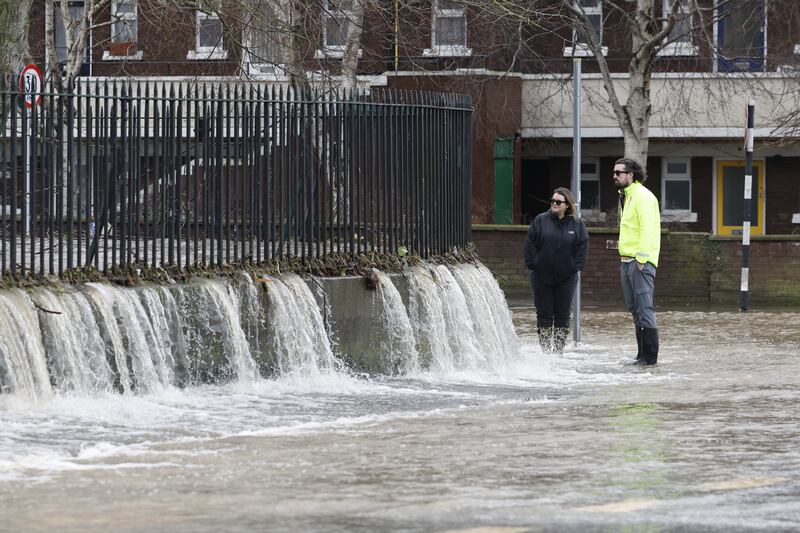
The recent wet spell and the rainfall brought by Storm Chandra last month has led to areas in the east flooding that do not typically flood. Wetter conditions as a result of climate change make future weather patterns unpredictable but more frequent and more extreme flooding is expected.
The regulator intervened to try to stop 288 sites at flood risk being zoned for housing or other vulnerable developments in the past six years. In most cases, the councillors backed down. In 30 cases, they did not and the minister had to be called on to issue a formal direction. Direction is currently being sought for a further nine sites, all in Co Donegal.

Two of the cases were in Co Wicklow and help to show why there can be resistance to taking the regulator’s advice.
In Rathnew village, a corner of the Charvey Court estate was left undeveloped when building stalled during the financial crash in 2008. Its residential zoning was changed to open space following the CFRAM mapping as it is bordered by the Rathnew river.
In recent years, the owner of the site wanted to put houses on it and a majority of councillors supported restoring its previous residential zoning for that purpose.
When a ministerial direction was sought to overturn this, the owner wrote to plead his case. He said a residential zoning would at least allow the carrying out of detailed, site-specific investigations into flood risk and mitigation and even if only part of the site could be established as usable, it could provide a few badly needed homes.
“The intentions of this proposed direction are meritorious,” he wrote of the flooding concerns, but added: “The instrument to achieve them is simply inappropriate.”
The frustration of the owners of a second site where councillors were also overruled is similarly evident in their letter asking that the minister not proceed with his direction.
Shipping company Conway Port was using lands zoned for employment at The Murrough outside Wicklow town’s port for storage and sorting of timber shipments, but Wicklow County Council moved to rezone 2.8 hectares of the land as open space/natural area, primarily because of flood risk.
The elected members blocked the move, voting to pass a compromise arrangement that would leave one hectare with the employment zoning. When they rejected the regulator’s advice to allow the full 2.8 hectares to become open space, the minister was called in.
Conway’s letter of objection states: “Our company’s land has a long and verifiable history of being unaffected by flooding, including during significant national weather events.”
[ No Government protection if building on a floodplain, warns MinisterOpens in new window ]
It says storms of recent years – named Darwin, Desmond, Ophelia, Emma and Barra – all passed without problem.
“Authorities should base flood risk assessments on robust, site-specific evidence, such as historical actual flood data, where available and reliable, rather than relying heavily on predictive flood risk models,” the company wrote.
The ministerial direction overturning the councillors’ votes on both sites was issued last October.
While most councillors who reject the regulator’s advice argue the area they want zoned for development never flooded before, no such argument could be made in a case in Co Donegal.
In 2022, councillors asked for action on flooding in the Bonagee area of Letterkenny which is close to the Swilly river and one of its tributaries.
In 2024, they wanted a site in the area adjoining the river to be rezoned from open space to commercial and employment, saying that it was located between two existing clusters of businesses and so was needed for expansion of commercial activity.
Council planning staff argued against the move, stressing the site was in flood zone A – the most at risk – and the policy was to leave as much open space as possible in the general area to minimise risk.
The rezoning was voted through, however, and a ministerial direction was required to reverse it.
Brendan O’Sullivan, a chartered planner and senior lecturer in planning at University College Cork, recognises the tensions that can play out at local level.
“The relationship between specialist advisers and councils is always a bit tricky,” he said.
“No planners would consider zoning on a flood plain but sometimes there are legacy zonings and land values are tied up in zonings so politically it can be very difficult to dezone development land or leave potential development land idle.”
Frank Fahy questions the accuracy of the CFRAM maps and the consistency with which decisions based on them are taken.

“You might ask the Land Development Agency (LDA) how come they are building on the flood plain on the Dyke Road,” he said of an apartment development currently under construction beside the Corrib river.
“Galway needs houses and we have to pull out every stop to build them. If they wanted to leave a bit of the Headford Road site open in case of flooding that would be fine but blocking off the whole site doesn’t help anyone.”
O’Sullivan says he understands frustrations around the CFRAM maps, which are based on flood modelling that doesn’t always match past experience and seldom has the precision to identify the risk to an individual property.
“They don’t pretend to be absolute but if you are taking the precautionary principle, if there is any kind of model that hints that it’s going to flood, as a planner you would not go near it,” he said.
“It’s a good thing that the regulator is picking up on stuff like this.
“In the past, a variation to a development plan was just adopted by majority vote and that was the end of it.
“It was up to the county manager, now chief executive, of the council to persuade the councillors to accept the advice and if they didn’t accept it, that was that. Flood plains got zoned for development.
“The good news story is that the regulator is doing what a regulator is supposed to do.”


