

David Bowie lived his life as an enigma, then died like a conjuror, vanishing before our eyes a decade ago today, on January 10th, 2016, just days after he released one final masterpiece.
Blackstar was his 26th studio LP. Taken together, the album and Bowie’s death were an extraordinary exercise in existential sleight of hand: death as art, mortality as an encore after a life of reinvention and innovation. As a pop star, Bowie had worked countless miracles. But, typically, he saved his best and most audacious trick for last.
When a rock star dies, things can go one of two ways. Either gravity does its worst, and they hasten towards obscurity, or their reputation grows and grows. Ten years on from his death, at the age of 69, how relevant is David Bowie in a world that has changed beyond recognition?
One answer was provided on New Year’s Day, when the final episode of Stranger Things, the TV megahit, was played off with Bowie’s song Heroes. The sadness of the series’ leave-taking was perfectly accentuated by the singer’s mournful masterpiece, on which lyrics about bravery and defiance do battle with Robert Fripp’s melancholic guitar riffs.
READ MORE


That Bowie is still relevant enough to bring down the curtains on the world’s biggest TV show is, on the face of it, not especially surprising. It nonetheless speaks to the continued relevance of a musician who has arguably grown in stature since his death – who still feels like a modern artist with a message for the modern world in a way that, say, John Lennon or Elvis Presley simply does not. They are forever frozen in their moment. Bowie’s music, on the other hand, is vital and plugged into the 21st century.
“Bowie seems to be getting bigger,” says Peter Quinn, frontman of the Irish Bowie tribute band Rebel Rebel. “We have quite a few young people coming to our shows. They tell us their dad or mum loved Bowie and they heard the songs in the car or at home. Bowie by osmosis.
“He has such a rich back catalogue. His music inspired the direction and sound that came next, so his musical DNA is in today’s music – and because of that his music is still relevant.”
One factor in that is the way in which Bowie approached death. He knew he was dying during the making of Blackstar, which he released on his 69th birthday, on January 8th, 2016.
He told the world as much, had we been paying attention, with the video for Lazarus, one of the singles from the album, which appeared in December 2015. As Major Tom, his astronaut alter ego, lies dead, gazing vacantly into the void, Bowie sings, “Look up here, I’m in heaven.”
Ten days before Christmas, without anyone much noticing, he had given us his requiem.
That sense of things coming to an end likewise suffused Blackstar, on which Bowie, working with the New York saxophonist Donny McCaslin and his band, essentially invented the genre of grimdark art‑rock jazz. But the greatest trick was to follow. Bowie’s death was announced two days after its release.
“Initially I didn’t believe it. I had started thinking it was some sort of play on Lazarus and we would have some kind of news in three days, but no,” Quinn says. “We had just played the Dublin Bowie Festival, with Gerry Leonard” – Bowie’s guitarist and musical director – “as our guest. We were on the high of highs leaving the venue only to wake up to the news Bowie had passed. I was gutted.”
With Bowie’s death, the Blackstar the world had listened to effectively ceased to be, and another record took its place.
Momentarily, while its creator was still alive, it had existed in a sort of stasis as a beautifully bruised eccentricity, suggesting that Bowie’s late period might be one of the most productive of his career. Reviews focused on the album’s restless creativity, the sense of an artist moving forwards rather than looking back. A new beginning had become a swan song, however.
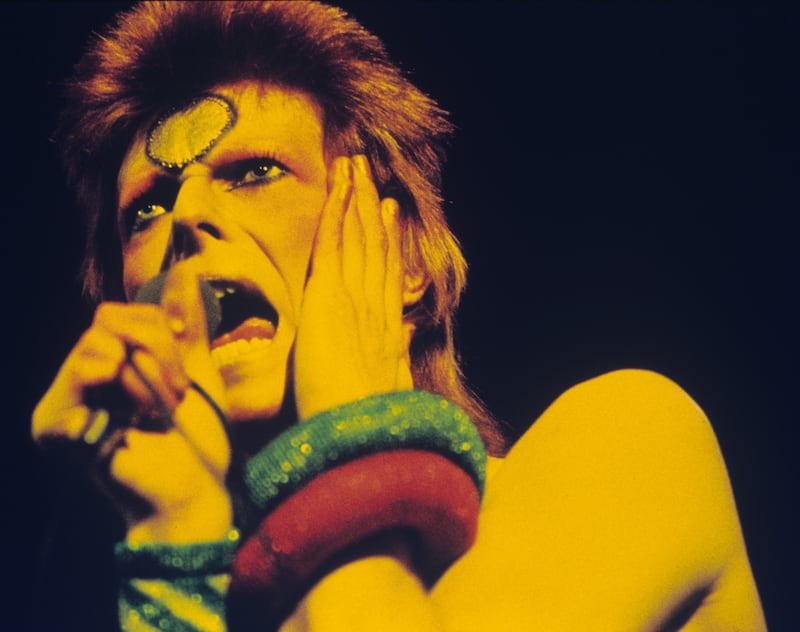
The news of Bowie’s illness and death had seemingly dropped from a clear blue sky, but the artist’s fascination with mortality – that clock ticking always downwards – had been a long‑running theme of his work. Back in his glam days he had been obsessed with My Death, or La Mort, Jacques Brel’s stark meditation on mortality. It was a centrepiece of his Ziggy Stardust tour and prominent in DA Pennebaker’s 1973 concert movie that captured the Spiders’ final show at the Hammersmith Odeon, in London.
The Ziggy Stardust album itself had opened with Five Years, a postapocalyptic ballad in which the narrator is counting down to the end of life as we know it. Bowie would also wrestle with mortality on Ashes to Ashes, his song from 1980, though it is also about his struggles with addiction and the emptiness of fame.
In his later years, even before he was diagnosed with terminal liver cancer, he had thought a great deal about death. “As you get older, the questions come down to about two or three. How long? And what do I do with the time I’ve got left?” he told the New York Times in 2002.
That Bowie’s death would be defined not by sadness, or by a sense of loss, but by supreme artistry was typical of a man who had long been a contradiction. No other singer was as lionised as Bowie, but he also endured the sort of critical smackdowns that would never have been inflicted on Paul McCartney or Bob Dylan.
In Bowie: The Final Act, Jonathan Stiasny’s new film (which is available to stream on channel4.com), the former Melody Maker journalist Jon Wilde recalls how the singer was driven to tears after Wilde’s vicious review of the second LP by Bowie’s Tin Machine project.
His assessment began by “listing some of the totally crap things about David Bowie over the last 10 years”. These included “his suits, his tan, his shoes ... his fake Cockney accent ... his tours, his ties ... Then of course there’s his records.”
The punishment beating ended with one final kick to the groin: “For God’s sake sit down man ... You’re a f**king disgrace.”

As Bowie read the review at his home in Switzerland, weeping into his Melody Maker, the singer, who was in his mid-40s at the time, might have thought he had come to the end of his relevance as both an artist and a pop star. But as Bowie: The Final Act points out, the decade that followed would be one of remarkable creativity for Bowie, as fascinating in its way as the 1970s had been for him.
[ Bowie: The Final Act - fond requiem from fan 10 years after star’s deathOpens in new window ]
It helped that a fresh generation of artists saw him not as a disgrace but as a living icon. The wave of androgynous rock bands that included Suede and Placebo openly worshipped him, as did industrial groups such as Nine Inch Nails, who took note of Bowie’s unwillingness to be tied down or to repeat himself.
Inspired by that positivity, Bowie had a remarkably productive time in the 1990s. His resurgence began with his album Black Tie White Noise, from 1993, and the single Jump They Say, a trumpet‑fuelled dirge in part informed by the suicide, in 1985, of his schizophrenic older half‑brother, Terry Burns (“He has no brain, they say / He has no mood, they say”).
He would go on to reunite with the producer Brian Eno, with whom he had worked on his masterpieces Low and Heroes, for Outside, an untethered art-rock record that featured some of his best songs in more than a decade: I Have Not Been to Oxford Town and – as played over the closing credits of David Fincher’s film Seven – The Hearts Filthy Lesson.

Refusing to stand still, Bowie went on to embrace drum and bass with Earthling, his underrated album from 1997. Panned at the time, the album contained one of his late masterpieces, I’m Afraid of Americans, a chunky neogrunge onslaught that, as we survey the world today, feels chillingly predictive.
Bowie essentially retired from music after suffering a heart attack on stage in Prague in June 2004. He’d been due to headline the Oxegen festival, at Punchestown, in Co Kildare, that summer but was replaced by The Darkness, in perhaps the greatest downgrading in rock history.
He had become a fan of Dublin across the previous decade, releasing, as A Reality Tour, a live recording of a 2003 show at the Point and playing two nights at the Olympia Theatre in August 1997.

I was at the second of those Olympia nights, and my memories of it are vivid. Someone had whipped their shirt off and flung it at Bowie, prompting him to quip, “Hello, Mum”. At one stage he looked up to where we were sitting, in the theatre’s highest seats, and waved at my friend. We were both a bit shocked, so Bowie pointed and waved again – to make it clear that, yes, he, David Bowie, was waving at a random punter in the gods.
Bowie’s death was the end of one of the most groundbreaking journeys in rock. It also marked the start of a year of loss in music: 2016 would later see the deaths of Prince, Leonard Cohen and, on Christmas Day, George Michael.
There was a strange synergy between Cohen and Bowie, in that both of them had bowed out with albums about death – in Bowie’s case Blackstar, in Cohen’s You Want It Darker, released on October 21st, 2016, 17 days before he died.
What’s striking is how different those records are. Blackstar is a raw and unsentimental stare into the void. You Want It Darker is a contemplation of mortality full of humour and warmth. I’ve listened to the Cohen album many times; Blackstar is too stark for me.
Maybe that’s its genius: it holds nothing back, has no room for sentiment or false comforts. Blackstar may not be Bowie’s greatest album, but it is surely his most haunting: a beautiful cry into the abyss, its dark sorcery undiminished a decade after the death it memorialises.


