

The President’s Cake arrives as both a rapturously received debut feature and a quiet corrective to Iraqi history’s frequent on-screen pulverisation. (American Sniper, anyone? The Hurt Locker?)
Directed by Hasan Hadi, the picture reframes life under Saddam Hussein’s regime not through retrospective othering but through the everyday pressures imposed on ordinary people, particularly children, as economic sanctions imposed by the United Nations Security Council bit during the early 1990s. There are ups among the downs.
“Life under dictatorship is like that,” Hadi says. “Moments of joy coexist with fear and sudden danger. People adapt, they cope, they laugh, until something happens and everything becomes very real again.”
Set following Iraq’s invasion of Kuwait in 1990, the film centres on a deceptively simple premise: every year, schoolchildren are selected to make offerings for Saddam’s birthday. Being chosen is not necessarily an honour. In a country undone by trade blockages, it can represent an impossible burden.
READ MORE


When nine-year-old Lamia is tasked with baking a cake in a country facing extreme shortages of sugar, flour and eggs, her assignment evolves into a journey that exposes the material and emotional cost of political loyalty.
“This idea of a child being asked to bake a cake without flour or sugar was not absurd. It was reality,” Hadi says. “That was something I knew about growing up.”
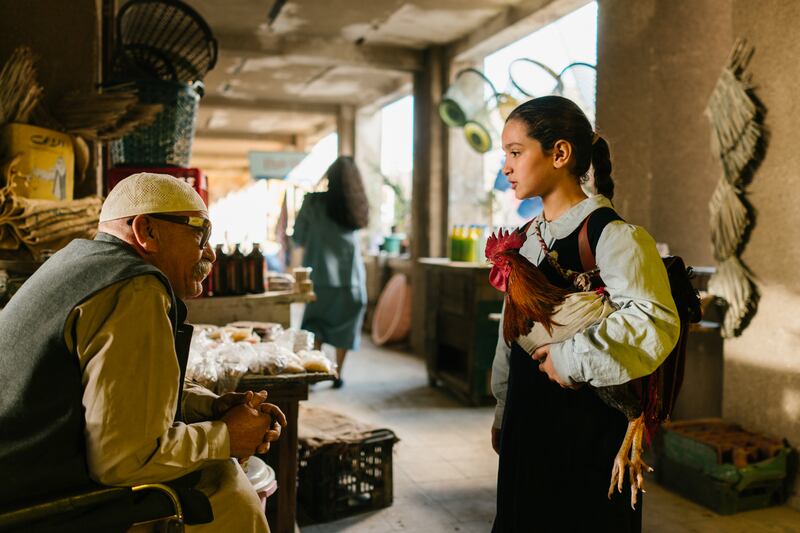
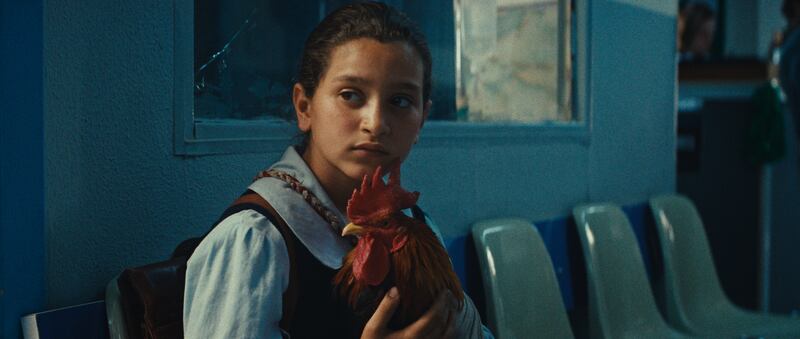
Accompanied by her grandmother Bibi, her cocky (sorry) pet rooster and, later, her classmate Saeed, Lamia travels from the southern marshes to Baghdad, navigating a landscape shaped by fear and scarcity.
Hadi, who grew up in Iraq during this period, describes the film not as a bitter political indictment but as a story rooted in lived experience and memory. As a young man he connected with cinema by ploughing through VHS tapes on the family’s TV. He won a scholarship to New York University’s Tisch School of the Arts, but, as a result of his nationality, he was initially denied a visa. It took three years of haggling to get across the Atlantic. Now the education bears fruit.
“For my first feature I wanted to draw on things close to me: childhood memories filtered through an adult understanding,” he says. “As a child my frustrations were very simple: wanting new shoes or clothes and not understanding why my parents couldn’t provide them. As an adult I see the pain that caused my parents, the feeling of being unable to protect or provide for your child. The film became a mixture of memory, reflection and reality.”

The sanctions, which lasted from 1990 until 2003, form the film’s gruelling economic and emotional backdrop. Rather than staging overt acts of repression, The President’s Cake places political imagery largely at the edges of the frame: portraits of Saddam loom in classrooms and cafes; children chant loyalty slogans at school; public processions move through the streets.
The omnipresence of power is normalised, not dramatised, reflecting what Hadi recollects about a society in which compliance was systemic.
Erecting murals of the former president for historical accuracy required some careful explanation.
“We had to be extremely careful,” he says. “Even with permits we couldn’t control how people passing by would emotionally react. Some scenes attracted unwanted attention, and there were moments where things became tense. People thought we were a new political movement. We had to constantly adjust, cover certain elements or move quickly to avoid drawing attention.”
One can understand how the people of Iraq, many of whom had lived through both the Saddam regime and the subsequent war, would find the recurrence of such iconography troubling. Those images remains politically and emotionally charged.
“It’s dangerous in a sense of triggers,” Hadi says. Even with official permits, uncertainty remained. “We really had to be very careful. Problems happened to us. People on social media would start reporting things, saying supporters are dancing or gathering together.”
He gets across the unusual, troubling responsibility a film-maker has when toying with people’s memories by reshaping current environments to conjure relatively recent history. They took a great deal of care. They liaised with authorities. They thought deeply.
“Even with that, we still cannot control some emotional or triggering reactions of regular people who are passing by,” Hadi says.
Visually, The President’s Cake is notable for beginning far from the urban ruins many audiences associate with the Iraq of the time. It opens in the sodden lands to the south, where houses sit on water and travel requires long boat journeys. Lighting was limited almost entirely to fires, lanterns and battery-powered sources.
Hadi wanted the film to feel “as if it had been shot during the regime itself, as though it had been discovered years later”, an ambition that required “a lot of research and restraint”.
The decision to shoot entirely inside Iraq, both in Baghdad and in those forbidding wetlands, was key, according to the writer-director. Despite offers to relocate production, Hadi refused. “Films have a DNA,” he says. “Some places, some textures, can’t be replicated. For my first feature, especially, that felt non-negotiable.”

That commitment came at a cost. Resetting scenes was costly in time and energy. The logistics were nightmarish. Equipment had to be brought in from outside the country. Locations were difficult to secure. Power sources were a challenge, and improvisation shaped each shooting day.
“There was a constant sense of uncertainty, and getting through each day required a lot of effort and problem-solving,” Hadi says. On the plus side, many places in Iraq “haven’t changed much, and that worked in our favour.”
Developed through the Sundance Institute’s feature-film programme, The President’s Cake benefited from early mentorship by figures such as Scott Frank, writer of Out of Sight, Marielle Heller, director of Can You Ever Forgive Me? and Eric Roth, writer of Forrest Gump. Heller and Roth later joined as executive producers. For Hadi the experience was transformative.
“Suddenly I was part of a community of artists and institutions dedicated to supporting film-makers who don’t have access to many resources,” he says. “That validation matters, especially when you’re trying to make a film in Iraq with children, limited resources and many logistical risks.”
In this emotionally honest spirit, casting was one of the production’s greatest challenges. Aside from the veteran actor Waheed Thabet Khreibat, the film relies almost entirely on amateur performers.
“It was very different from working with children elsewhere,” Hadi says. “In Iraq there are no acting schools, drama programmes or standard casting processes for children. We couldn’t just give them scenes to perform.
“So casting became about finding children who felt right for the roles and who had the ability to adapt. We weren’t asking them to ‘act’ in a conventional sense but to merge what was on the page with the reality of who they were. It was about sensitivity, patience and allowing their natural behaviour to shape the film.”
Hadi is not unaware that his debut feature included nearly everything that young directors are warned to avoid: children, animals, crowds and water. Even the rooster – actually played by several birds – was a bad omen. In local culture, he says, an unexpected cockerel crow “can signal that something terrible is about to happen”.
The President’s Cake arrives as part of a new wave of cinema from the region. Since the early 2000s, Iraqi film-makers, both inside the country and in the diaspora, have turned to low-budget, independent productions to explore themes such as identity, memory, sectarianism and the impact of violence on ordinary citizens. Directors such as Mohamed Al-Daradji and Abbas Fahdel have gained international recognition for blending documentary realism with contemplative tableaux.
In 2025 Hadi’s film became the first Iraqi feature to premiere at Cannes as part of Directors’ Fortnight, where it won both the Caméra d’Or for best first feature and the audience award in that section. The film has since gained international attention. It was selected as Iraq’s official entry for best international feature film at the 98th Academy Awards.
“Beyond the awards themselves, what has mattered most is that they have helped us reach new audiences,” he says. “It’s been meaningful to see how people from very different backgrounds respond to the film, sometimes similarly, sometimes very differently, but always on a human level.”
The President’s Cake is in cinemas from Friday, February 13th


