
Pity poor Brigid. For centuries our sainted aunt has had to play second fiddle to her male counterpart despite the fact that her roots in this country always ran a whole lot deeper – and we’re not even referring to the fact that Patrick wasn’t even Irish (to not quote Roy Keane).
For hundreds of years before there was a Patrick there was a Brigid, a strong and mystical woman rooted in our mythology who served as an inspiration for people all over the island.
But despite the fact that she was here first, it is Patrick who has consistently taken the glory. He is the one who has always had the big parades at home and abroad and the bowls of shamrock presented to those in high office and the boozy parties and – until very recently – the public holiday.
Is it any wonder a cross has been Brigid’s mark for centuries?
READ MORE


Of course, she has her day now – even if we have Covid rather than any real recognition of her to thank for that.
And it is worth remembering on her day – or at least on the public holiday to mark her day – that women are still playing second fiddle and still paying the price for their gender.
While Tammy Wynette once told us all how hard it is to be a woman, what she did not sing about was how it is also financially ruinous, probably because it is hard to fit the terms “gender pay gap” and “pension deficit” into a catchy country tune.
But even so, it is a truth universally acknowledged that the monetary consequences of being a woman are harsh and on display everywhere, from our supermarkets, pharmacies and hairdressers to our doctors’ surgeries, clothes shops, pension funds and the workplace.
In fact, it is hard to find any arena in which women are financially better off. It is almost as if the entire system upon which our society has been constructed was created and maintained for centuries by men and for the benefit of men.
But just how much does it cost to be a woman? Probably a lot more than you think.
The Pink Tax
We have discussed the pink tax on this page and elsewhere before and have highlighted the many ways women are expected to pay more for products marketed directly at them then men are for similar, if not identical, products.
We are not the only ones to report on the pink tax, however; it has been widely documented at home and abroad but there is still evidence that products marketed at women cost more than similar ones marketed at men.
Take razors. The three-blade Gillette Venus Comfort Glide Razor for Women comes, the Gillette people tell us, with a freesia-scented “gel bar with SkinCushion lubrication [that] helps protect your skin from shave irritation”.
That sounds lovely and while we like a freesia scent as much as the next, um, man, we are less concerned about the marketing spiel than we are about the price. We found a four-blade pack of this freesia-scented wonder selling in a popular supermarket for €17.40.
In the very same supermarket, not two metres away we spotted a similarly three-bladed Gillette Mach3 men’s razor which, in case you care, is “equipped with an improved lubrication strip that gives you extra glide”.
And how much was that? It cost €12.25, or more than a fiver less.
We then looked further along the shelf and came across Gillette’s Satin Care Dry Skin shaving gel. A 200ml can was priced at €4.35 while a similarly sized can of Gillette Sensitive Skin shaving gel was €3. Now we can’t say for sure but we would be confident that both gels do pretty much the same thing, which did make us wonder why the pink-hued one was priced at €1.35 more.
We then had a look at gels of the shower variety.
It is bit of a minefield and the prices are all over the shop but we feel safe in saying that Dove Advanced Care Pampering shower gel is more likely than not targeted at women while the Dove Men+Care is not.
The pampering suds were priced at €17.50 a litre while the suds for men had a price tag per litre of €14.29.
Of course these are only three of the gender-targeted products currently selling in Irish supermarkets and we found others where the price differentials between the women’s and men’s versions were either insignificant or non-existent. What we struggled to find were products aimed at men that cost considerably more than their women-targeted alternatives.
Now it is clear that price discrepancies encountered in our supermarkets will vary from person to person but, for the purpose of this article, we will – conservatively – suggest that a woman is likely to spend around €150 more over the course of a year as a result of the pink tax.
Things men don’t think of
But the higher price of comparable products is not the only way women are expected to pay over the odds. There are also all manner of things that women routinely buy that men don’t even have to consider.
[ Are women paying more than men for everyday items? Oh let me count the waysOpens in new window ]
Pricewatch has spent many, many hours over recent years standing like an eejit in the aisles of the Sephoras of Europe while the people closest to us shopped their hearts out, and we did a back-of-a-napkin calculation of the cost of it all.
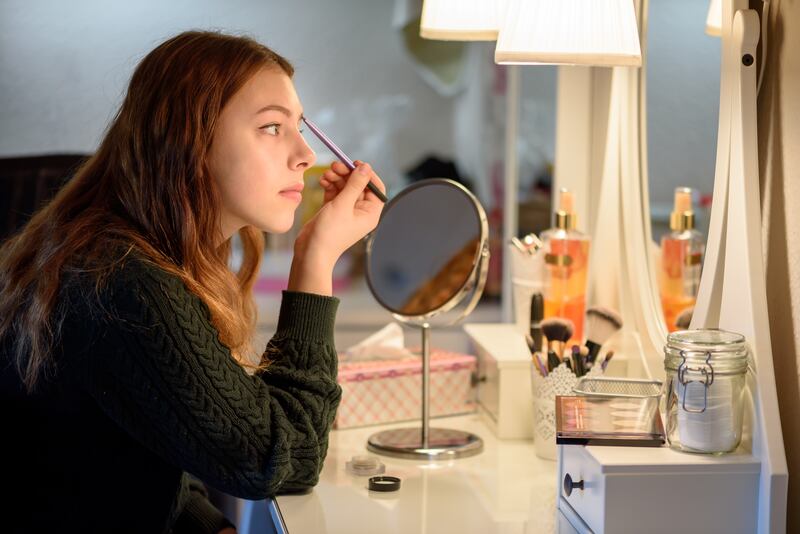
We totted up the price of the fairly mid-range cleansers, moisturisers, exfoliators, everyday sunscreens (as opposed to the ones you slap on when on your summer holidays), body lotions, hair products, wax treatments, nail polishes and nail polish removers, make-up (lip gloss, blusher, eyeshadow, eyeliner and the rest), micellar water and eye make-up remover women tend to buy that men do not have to consider.
Now, obviously, not all women will buy all the products mentioned and there are some men who spend a lot on skincare and personal grooming but we reckon a fair proportion of women reading this will spend well in excess of €1,000 on such products each year.
Sometimes this money is spent willingly and happily but it is also sometimes spent because of the societal pressures on women that men rarely if ever face. We are not going to dwell on that because, we do not want to be accused of mansplaining something to women that they have to deal with every single day.
The high cost of hair
Haircare is another thing Pricewatch knows very little about for reasons that should be obvious to anyone who looks at the picture byline accompanying this article but what we do know is women pay more than men for it.
We compared the prices of hair salons catering for men and women and found a wash and cut in a barber’s typically costs between €25 and €35 while for women their prices ranged between €50 and €100.
So, if we assume that a woman pays €30 more than a man and they both visit their salon of choice six times a year, then the woman is spending €180 more than the man.
We are using that figure knowing that – in reality – it is probably considerably higher for many women but we don’t want to be accused of exaggerating.
And in case you are keeping score, we reckon that women are already worse off to the tune of €1,330 each year and we are only really getting started.
Some other bits and pieces
There is more to life, of course, than hair and personal grooming. Just over a decade ago, New York’s Department of Consumer Affairs conducted what it said was the “first-ever study of the gender pricing of goods in New York City across multiple industries” and, while the data is old now, we don’t think things have changed all that much since 2016.
The report, From Cradle to Cane: The Cost of Being a Female Consumer, found all sorts of price discrepancies when it compared nearly 800 products with clear male and female versions from more than 90 brands sold at dozens of New York City retailers.
Alongside the average price discrepancy of 7 per cent, it also published category breakdowns.
Girls’ clothes were 4 per cent more expensive than boys’, while women’s clothes were 8 per cent pricier than men’s. Women’s personal care products cost an average of 13 per cent more. And dry-cleaning a blouse cost substantially more than dry-cleaning a man’s shirt.
Arriving at an annual cost – for our purposes – will clearly depend on the consuming habits of our notional man and woman and how often they shop for clothes and get them dry-cleaned and the like but we feel safe in saying that women are probably down another €200 in this regard.
A bitter pill
Next up are doctors. While women up to the age of 35 can get the contraceptive pill free now, many will still have to pay at least €60 every six months to get their prescription renewed. That’s another €120 a lot of women have to shell out that men don’t really think about.
Then there are the multiple scientific studies over many years that have found that women are more likely to need treatment for conditions including autoimmune diseases and coeliac disease and are more likely to seek help for anxiety and depression among other conditions. Some of this is physiological and some of it is psychological, with women simply better at managing their health and certainly less likely to pretend that nothing is wrong. But that does come at a cost and we are going to allow an additional €300 to cover the higher medical cost of women each year.
The gender pay gap
The real financial penalties that women have to confront are not to be found in the pharmacy or the supermarket or the hair salon or the clothes shop or even in GP surgeries or hospitals; they are to be found in the workplace and in the financial realities faced by many after they finish up in that workplace.
Official figures published in 2022 put the national gender pay gap at 9.6 per cent while more recent analysis from PwC, based on analysis of more than 550 Irish companies that submitted gender pay gap reports two years ago suggested that the mean hourly gender pay gap reported across all those companies was 11.2 per cent.
The PwC report found that the largest gender pay gaps were in the legal profession, where a disparity of 35 per cent was reported, followed by the aviation sector on 33.5 per cent and insurance and banking on 22.9 per cent and 18.9 per cent, respectively.

Those reports are echoed by one highlighted in this newspaper a couple of weeks ago.
A piece of research by specialist employment law firm Littler found that women held just 18 per cent – or 120 out of 659 – of executive boardroom positions in Ireland within the financial sector here in 2024.
Then there are the recent findings from the Central Statistics Office (CSO) which reported that women accounted for fewer than 20 per cent of chief executive roles in Ireland last year and made up less than a third of senior executive teams.
If we allow for a base annual salary of €50,000 for a man and use the gender pay gap figures, we can extrapolate that a woman will be earning €45,000, leaving them five grand worse off every year
It’s not much better after work
And that takes us to pensions, another area where the women of Ireland are badly let down. Last summer a survey of 1,000 adults commissioned by financial services intermediary Ask Acorn found that the average pension pot of an Irish man is €102,017 but only €60,562 for women, a gap of €41,455.
The average pension pot built up by men over the age of 55 was €144,716 but €82,674 for women, while far more men than women have pension pots worth more than €100,000 – 33 per cent of men said they have pension pots of €100,000 or more, but only 15 per cent of women could say the same.
The survey found that 34 per cent of women have no pension savings compared with 25 per cent of men.
“Despite the progress on gender equality in recent years, including female participation in the workforce reaching all-time highs, women are still falling well behind men when it comes to their pension pots,” said Keith Butler of Acorn.
Separate research based on a survey of 130 financial advisers nationwide, undertaken by pension trustees Independent Trustee Company (ITC), has found that men are saving more into their pension than women are.
The most common reasons cited are that women often leave the workforce to raise families, with 60 per cent of financial experts reporting this to be the case. The second most common reason was that men earn more money than women, with 48 per cent highlighting that.
It is obviously incredibly unfair that women are so heavily penalised for having the temerity to have children and then looking after them for a spell but it is the reality of the world we live in. It is hard to put an annual figure on it for the purpose of this exercise but we will very conservatively suggest that the pension deficit leaves women worse off by a grand a year.
So when we tot up the numbers – and they are by no means the only ways women are financially penalised – we reckon that for no other reason than their gender, women are worse off than their male counterparts by around €8,000 a year – and that is an after-tax figure.
Poor Brigid will no doubt be weeping at the news.