
Tuesday: As it happened
- Iran said it needs “credible guarantees” against more US-Israeli attacks before it can ensure security in the Gulf
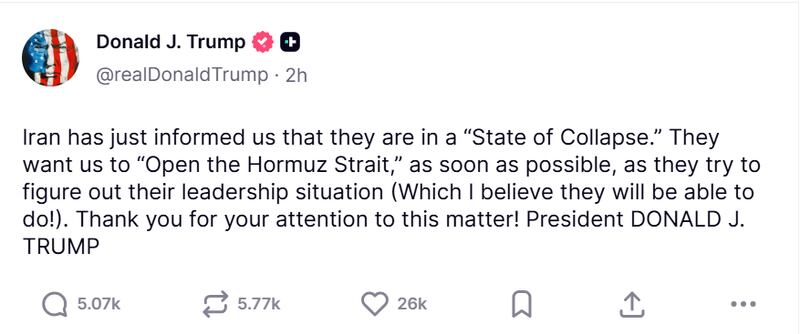
- US president Donald Trump has claimed Iran informed Washington it is in a “state of collapse” and that it wants the US to open the Strait of Hormuz “as soon as possible, as they try to figure out their leadership situation”.
- The Israel Defense Forces ordered residents of 16 southern Lebanese towns and villages to evacuate, amid reports of continuing Israeli attacks on southern Lebanon despite ceasefire
- The United Arab Emirates is quitting Opec, a heavy blow to the group of oil exporting countries amid the ongoing conflict in the region
- Ryanair chief executive Michael O’Leary said the risk of a jet fuel supply shortage in Europe due to the conflict is receding
Best reads
- Edward Luce: Get used to the long Iran war
- Iran’s hardliners clash over talks to US
- UAE leaves Opec, deepening oil market uncertainty
Three killed in strike during rescue operation in Lebanon
Lebanon’s civil defence has said three members have been killed in an Israeli strike during a rescue operation in southern Lebanon on Tuesday, Reuters reports.
German chancellor ‘doesn’t know what he’s talking about’ on Iran, Trump says
Donald Trump has said Friedrich Merz “doesn’t know what he’s talking about” after the German chancellor said Iran’s leadership was “humiliating” the US.
In a post on Truth Social, the US president he is doing something that other nations “should have done long ago”.
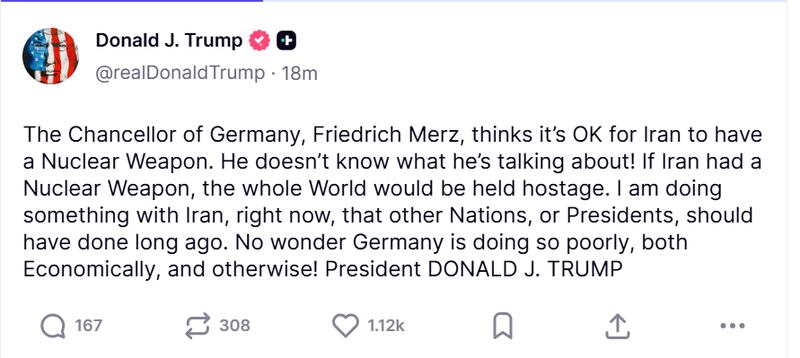
The post comes as Merz said on Monday that Iran’s leadership was “humiliating” the US.
“The Iranians are obviously very skilled at negotiating, or rather, very skilful at not negotiating, letting the Americans travel to Islamabad and then leave again without any result.
“An entire nation is being humiliated by the Iranian leadership, especially by these so-called Revolutionary Guards. And so I hope that this ends as quickly as possible,” he said.
US imposes sanctions on 35 individuals, entities for aiding Iran’s sanctions evasions
The US government has announced sanctions on 35 entities and individuals for their role in Iran’s “shadow banking" architecture, accusing them of facilitating the movement of tens of billions of dollars tied to sanctions evasion and Iran’s sponsorship of terrorism.
The US treasury department also warned any firm making “toll” payments to the Iranian government or the Islamic Revolutionary Guard Corps for passage through the Strait of Hormuz would face significant sanctions.
It said the sanctions announced on Tuesday were aimed at networks that allowed Iran’s armed forces, including the Iranian Revolutionary Guard Corps, to access the international financial system to receive payment for illicit oil sales, purchase sensitive components for missiles and other weapons systems, and transfer money to Iran’s proxies.
“Iran’s shadow banking system serves as a critical financial lifeline for its armed forces, enabling activities that disrupt global trade and fuel violence across the Middle East,” US treasury secretary Scott Bessent said in a statement.
“Illicit funds funneled through this network support the regime’s ongoing terrorist operations, posing a direct threat to US personnel, regional allies, and the global economy,” he said, adding any institution that facilitated or engaged with these networks was at risk of “severe consequences.”
Soldiers injured and others trapped under rubble following Israeli strike during rescue operation, Lebanese officials say
An Israeli strike on Lebanese troops and rescuers has wounded two Lebanese soldiers, the Lebanese army has said.
It said the strike was launched during a rescue operation in the village of Majdal Zoun in southern Lebanon
In a statement, Lebanon’s civil defence said three of its members are trapped under rubble following the strike. - Reuters
US marines board commercial vessel in Arabian Sea
US marines boarded a commercial ship in the Arabian Sea on Tuesday suspected of “attempting to transit to Iran in violation of the US blockade of Iranian ports”, US Central Command has said.
In a post on X, it added that the vessel was subsequently released after a search which confirmed the ship’s voyage “would not include an Iranian port call”.
“American forces continue to operate and enforce the blockade across the Middle East. So far, 39 vessels have been redirected to ensure compliance,” it said.
Trump approval sinks to record low as war with Iran drives cost-of-living concerns
US president Donald Trump’s approval rating fell to the lowest level of his current term, as Americans increasingly soured on his handling of the cost of living and an unpopular war with Iran, according to a new Reuters/Ipsos poll.
The four-day poll completed on Monday showed 34 per cent of Americans approve of Trump’s performance in the White House, down from 36 per cent in a prior Reuters/Ipsos survey conducted from April 15th to April 20th.
The majority of responses were gathered before the Saturday night shooting at the White House correspondents’ dinner, where Trump was due to speak.
Trump’s standing with the US public has trended lower since taking office in January 2025, when 47 per cent of Americans gave him a thumbs-up.
His popularity has taken a beating since the US and Israel launched a war against Iran on February 28th that has led to a surge in oil prices.
Some 22 per cent of poll respondents approved of Trump’s performance on the cost of living, down from 25 per cent in the prior Reuters/Ipsos poll.
The survey, which was conducted nationwide and online, gathered responses from 1,014 US adults and had a margin of error of 3 percentage points. – Reuters
Hizbullah drone strikes target Israeli soldiers in southern Lebanon
Hizbullah launched several drones at Israeli soldiers in south Lebanon on Tuesday, while Israel issued new displacement orders for south Lebanon and carried out air strikes, as the fraying ceasefire failed to stop fighting between the two sides.
Hizbullah claimed Tuesday’s attack injured several Israeli soldiers, but no confirmation was given from the Israeli military, apart from a statement saying interceptor missiles had been fired at incoming Hizbullah drones.
It comes as an Israeli soldier was killed and six others wounded in a Hizbullah drone attack on Sunday.
The Iran-back group’s use of small, fibre-optic-guided drones has managed to evade Israeli aerial defences, as the wired element of the aircraft limits the radio signals that radars detect.
Israel also carried out a series of air strikes on Lebanon on Tuesday, in addition to ordering the residents of 16 villages in south Lebanon to flee northwards.

Israeli air strikes killed 18 people and wounded 88 more in Lebanon over the weekend, according to the Lebanese ministry of health.
At least 2,534 people have been killed and 7,863 wounded by Israeli air strikes in Lebanon since the beginning of fighting between Hizbullah and Israel on March 2nd.
Hizbullah rocket fire has killed two civilians in Israel in the same time period. – The Guardian
US president Donald Trump has said the UK and the US are “the two most exceptional nations the world has ever known”.
He was speaking after greeting Britain’s king Charles III and Queen Camilla to the White House on Tuesday.

“If they could see us today, our ancestors would surely be filled with awe and pride that the Anglo-American revolution in human freedom was never, ever extinguished, but carried forward across centuries, across oceans and across history, until it became a fire that lit the entire world.
“So today we look back on 250 years. Let us remember what has made our countries the two most exceptional nations the world has ever known, and together, let us go forward with even stronger resolve to carry on our sacred devotion to liberty and to the traditions of excellence that have been our shared gift of all mankind,” he said. – PA

UK says envoy’s remarks on US ties do not reflect official stance
The UK said newly revealed remarks by its US ambassador, which appeared to play down the status of the so-called special relationship, don’t reflect the official position of the government.
The ambassador, Christian Turner, said that the US’s only special relationship is “probably Israel,” the Financial Times reported on Tuesday, citing a recording of the remarks.
He also criticised the American political system for failing to hold associates of the late sex offender Jeffrey Epstein to account, saying the scandal “hasn’t touched anybody” in the US.
“I think there is probably one country that has a special relationship with the United States – and that is probably Israel,” Turner said, according to the report.
The British foreign office didn’t dispute the remarks when asked for a response, describing them as “private, informal comments” made to a group of secondary school pupils in early February. “They are certainly not any reflection of the UK government’s position,” it said.
The remarks came to light at particularly sensitive time, just hours before British king Charles III was due to arrive at the White House for a meeting with Trump – part of a four-day state visit. – Bloomberg

Iran wants US to open Strait of Hormuz ‘as soon as possible’, Trump claims
Donald Trump has claimed Iran informed Washington it is in a “state of collapse”.
The US president also claimed Iran wants the US to open the Strait of Hormuz “as soon as possible, as they try to figure out their leadership situation”.
Iranian ambassador to UK summoned over ‘unacceptable’ social media post
Iran’s ambassador to the UK has been summoned by the British foreign office over “unacceptable and inflammatory comments” posted by the embassy on social media.
Seyed Ali Mousavi was called in by the UK’s Middle East minister, Hamish Falconer, over an online message reportedly recruiting expats to become martyrs.
The foreign office said Falconer condemned the “completely unacceptable actions”.
The intervention followed reports in Metro about a message on the embassy’s Telegram channel calling for expats to “sacrifice their lives for the homeland”.
The message called on their country’s diaspora in the UK to “lay down our lives” to “defend Iranian land”, the newspaper reported.
“Let us all, one and all, give our lives in battle. Rather than surrender our country to the enemy,” the message concluded. – PA
Elsewhere, Britain’s king Charles III and Queen Camilla have been welcomed to the White House by US president Donald Trump and first lady Melania.


Russian billionaire-owned superyacht passes through Strait of Hormuz

A superyacht owned by Russian billionaire Alexey Mordashov was able to travel through the blockaded Strait of Hormuz after undergoing maintenance in Dubai because neither Iran nor the United States objected, a source close to Mordashov said on Tuesday.
It has been unclear how the multideck pleasure vessel, worth more than $500 million, gained permission to sail on Saturday through the commercially important waterway at the heart of the US-Iran conflict, where traffic has been severely restricted since February.
Sailing under a Russian flag, the yacht, called Nord, crossed the strait on an approved route in compliance with international maritime law, the source said.
“Iran did not interfere with the movement of the yacht, as it is a civilian vessel of a friendly country conducting a peaceful transit. The American side also raised no questions regarding the yacht’s movement, as it did not call at Iranian ports and has no connection to Iran,” the source said.
Read the report in full.
Risk of jet fuel shortage in Europe receding, says Ryanair’s O’Leary
Ryanair group chief executive Michael O’Leary said the risk of a jet fuel supply shortage in Europe due to the Middle East conflict is receding and that fuel companies have told the airline they see no risk of potential disruption until the end of June.
But he predicted that rival European airlines would suffer as Ryanair uses its strong fuel hedging position to push down fares.
O’Leary warned at the start of April that jet fuel supply to Europe could be disrupted from early June if the conflict does not end this month. However, fuel companies have become much more confident in the last week or two, he said on Tuesday.
“We think the risk of a supply disruption is receding,” O’Leary told Reuters in an interview, citing a conference call with all of its suppliers across Europe on Monday.
He was dismissive of a warning from Sweden on Tuesday of a potential shortage of jet fuel.
“A month ago we were saying we’re all fine until the end of May. The fuel companies are now saying they’re seeing no supply disruption risk until the end of June,” O’Leary said.
He had singled out Britain as the market most exposed to potential shortages due to the amount of oil it imports from Kuwait. He said that risk had also receded and that some of the bigger oil companies Ryanair deals with have said they would step in in the unlikely event Kuwait runs short.
While demand for last-minute bookings in April and May has been stronger than expected, O’Leary said demand was “a little bit weaker” for flights between June and September, prompting the airline to lower some fares to stimulate demand. – Reuters
At least 72,594 killed in Gaza since October 2023
In its latest update, published on Tuesday, Gaza’s health ministry said at least 72,594 Palestinian people have been killed and 172,404 others injured in Israeli attacks on Gaza since October 7th, 2023.
At least 818 Palestinian people have been killed in Israeli attacks since a ceasefire between Hamas and Israel came into effect in October 2025, according to the ministry, whose figures the United Nations generally find reliable.
Most of the people killed have been civilians and the true death toll is likely much higher given the number of those still buried under rubble across the Gaza Strip.
The Palestinian news agency Wafa reported this morning that a 9-year-old child was killed in an Israeli air strike east of the southern city of Khan Younis after Israeli aircraft targeted the area. – The Guardian
Tuesday: The day so far
UAE quitting Opec group of oil producers
The United Arab Emirates said on Tuesday it quit Opec and Opec+, dealing a heavy blow to the oil exporting groups and their de facto leader, Saudi Arabia, at a time when the Iran war has caused a historic energy shock and unsettled the global economy.
The stunning loss of the UAE, a long-standing Opec member, could create disarray and weaken the group, which has usually sought to show a united front despite internal disagreements over a range of issues from geopolitics to production quotas.
Opec Gulf producers have already been struggling to ship exports through the Strait of Hormuz, a narrow chokepoint between Iran and Oman through which a fifth of the world’s crude oil and liquefied natural gas normally passes, because of Iranian threats and attacks against vessels.
But the UAE exit from Opec represents a big win for Trump, who has accused the organisation of “ripping off the rest of the world” by inflating oil prices.
Read the full story here.
Oil price climbs above $110 (€94) for first time in three weeks
Oil hit $110 (€94) for the first time in three weeks on Tuesday as the US and Iran appeared to make little progress towards a peace deal that would unlock energy supplies through the Strait of Hormuz.
Brent crude, the international oil benchmark, soared from less than $60 a barrel at the start of the year to as high as $119 at its peak during the conflict as Iran brought traffic through the Strait of Hormuz to a near halt and attacked energy facilities across the Gulf.
It was at $110.82 a barrel in morning trading after giving up some of its earlier gains.
“Markets have been latching on to any signs of peace talks, and the absence of that is raising fears that they are not going to happen,” said Jim Reid, head of macro research at Deutsche Bank.
This move higher in oil has also reignited bets that central banks will have to lift interest rates to contain the resulting wave of inflation, hitting bonds in the US, Europe and the UK.
The White House said on Monday that US officials were discussing Iran’s latest proposal, which has not been made public, but maintained “red lines” on any deal to end the eight-week war, including preventing Tehran from obtaining a nuclear weapon.
White House press secretary Karoline Leavitt told reporters that Trump had convened national security officials to review the proposal. “His red lines with respect to Iran have been made very, very clear,” she said, adding that Trump would address the matter “very soon”.
Asked whether the US would accept an offer by Iran to open the strait while delaying talks over Tehran’s nuclear programme, US Secretary of State Marc Rubio said he would not speculate on what Trump might do.
Gulf leaders to meet in Saudi Arabia to discuss response to Iranian strikes
Saudi Arabia is to host a meeting of the Gulf Cooperation Council in Jeddah later today, in what will be first in-person meeting of Gulf leaders since their states became dragged into the war.
A Gulf official told the Reuters news agency that the meeting aimed to craft a response to the thousands of Iranian missile and drone attacks Gulf states have faced since the US and Israel launched the war on Iran on February 28th.
Qatar’s emir, Kuwait’s crown prince, Bahrain’s king and the UAE’s foreign minister arrived in Jeddah to attend the summit, Saudi state media reported. It was unclear who would represent Oman.
Tullow secures record $130 a barrel for Ghana oil amid crisis
Tullow Oil has said it secured a record price of $130 (€111.20) a barrel for an April shipment of oil drilled off the coast of Ghana, well ahead of leading global benchmarks, amid tensions in the Middle East.
The Irish-founded company achieved an average of $90 a barrel for its first four shipments of the year, it said in an investor presentation on Tuesday that accompanied its full-year results for last year.
The company said that West African crude oil is continuing to trade at a premium as shipments from the Middle East are affected by severe disruptions.
Tullow, which said on Monday it had completed a major debt refinancing, also forecast annual production to come in at the higher end of its outlook range, after a strong start to the year.
Shares in the company soared more than 11 per cent in London trading.
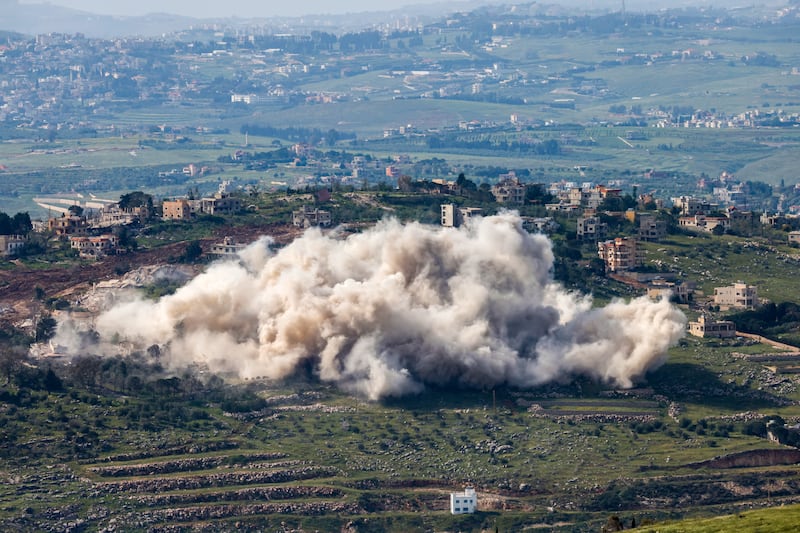
IDF orders residents of 16 southern Lebanese towns and villages to evacuate
The Israeli military has ordered residents of 16 towns and villages in southern Lebanon to evacuate immediately to the Sidon area.
The affected towns and villages are Ghndouriyeh, Burj Qlawiyeh, Qlawiyeh, al-Sawana, al-Jumayjima, Safad al-Batikh, Braashit, Shaqra, Aita al-Jabal, Tibnin, al-Sultaniyya, Bir al-Sanasil, Dounin, Khirbet Silm, Salaa, Deir Qifa, according to a social media post by the IDF’s Arabic-language spokesperson, Avichay Adraee, who claimed the attacks are being launched due to Hizbullah violating the US-mediated ceasefire agreement Israel signed with the Lebanese state in mid April.
Israeli air strikes have reportedly killed at least 40 people in Lebanon since the ceasefire there began on April 17th. Under its terms, Israel retains its “right to take all necessary measures in self-defence, at any time, against planned, imminent, or ongoing attacks”.
Hizbullah has said it would not cease its attacks on Israeli troops inside Lebanon and on towns in northern Israel as long as Israel continued its ceasefire violations.
Reports of Israeli attacks on southern Lebanon continue despite ceasefire
Al Jazeera is reporting that Israeli forces are shelling areas of southern Lebanon despite the ceasefire.
Lebanon’s national news agency reported earlier that Israeli warplanes launched three air strikes on the town of Zawtar al-Sharqiyah at 6am local time, with Israeli attacks also reportedly launched on the town of Bint Jbeil, which is about 5km north of the Israeli border and has seen heavy fighting between Israeli forces and Hizbullah.
Israel, which claims it is striking Hizbullah operatives and sites even though it has killed many civilians and destroyed civilian infrastructure with apparent impunity, was given extremely wide scope by the wording of the ceasefire that permits it the “right to take all necessary measures in self-defence, at any time, against planned, imminent or ongoing attacks”.
The ceasefire deal, which took effect on April 16th and was extended by three weeks last Thursday, was agreed between Israel and the Lebanese state, not Hizbullah, the Iranian-backed Lebanese militant group and political party.
Iran says it needs ‘guarantees’ against attacks before Gulf can be stable
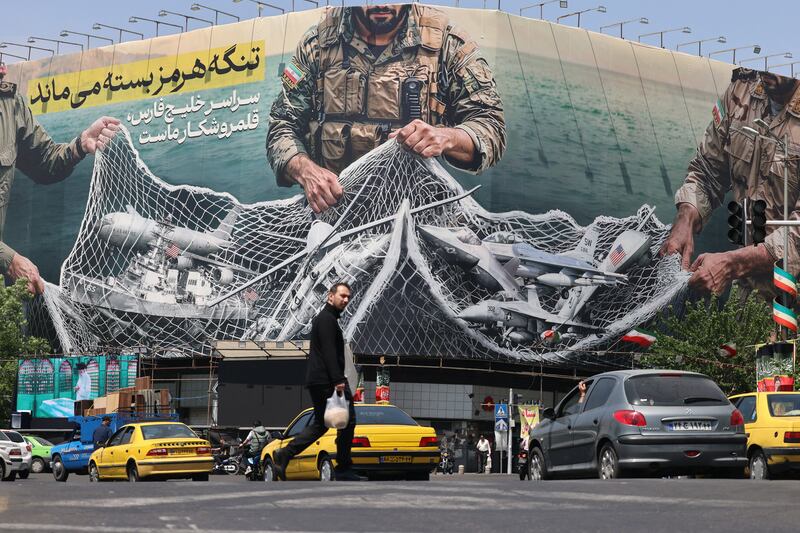
Iran needs “credible guarantees” against more US-Israeli attacks before it can ensure security in the Gulf, Tehran’s envoy to the UN has said, while on a Russian visit Iran’s foreign minister blamed Washington for the failure of peace talks.
“The US approaches caused the previous round of negotiations, despite progress, to fail to reach its goals because of the excessive demands,” the minister, Abbas Araghchi, said.
Trump on Sunday had told Fox News that if Iran wanted talks, “they can call us” – adding that his cancellation of sending his envoys to Pakistan at the weekend did not signal a return to hostilities.
On Monday, Amir Saeid Iravani, Tehran’s UN ambassador, told a security council session: “Lasting stability and security in the Gulf and the wider region can only be achieved through a durable and permanent cessation of aggression against Iran supplemented by credible guarantees of non-recurrence and full respect for the legitimate sovereign rights and interests of Iran.”
BP criticised after revealing profits more than doubled since Iran war
Oil giant BP has been criticised after revealing profits more than doubled in the first three months of the year thanks to the soaring cost of crude caused by the Iran war.
The firm revealed its preferred profit measure – underlying replacement cost profit – surged by more than 130 per cent to a better-than-expected $3.2 billion (€2.7 billion) in the first quarter, up from $1.38 billion a year earlier.
Most analysts had expected first quarter profits of $2.67 billion.
Campaigners accused the group of profiting at the expense of households, who have seen fuel prices rocket at the pumps and are set to see energy bills jump higher.
Mike Childs, head of science, policy and research at Friends of the Earth, said: “Just as we saw in 2022 following Russia’s invasion of Ukraine, fossil fuel giants are quids in when global instability drastically inflates fuel prices”.
“But again, it’s ordinary people who pay the price,” he said.
The campaign group’s co-ordinator, Simon Francis, said: “These astronomical profits are a startling reminder that when conflict drives up the price of oil and gas, energy companies profit and households pay.”
BP’s new chief executive, Meg O’Neill, who took over at the helm on April 1st, said the group was ensuring fuel supplies were met across the UK.
She said: “The teams across BP are playing their part to keep oil, gas and refined products flowing during an incredibly challenging time – focused on maintaining safe, reliable and cost-efficient operations.”
She added: “We are working with customers and governments to get fuel where it’s needed, helping minimise disruption and the impact it can have on people’s lives.”
Oil prices have raced higher since the US-Israel war on Iran started on February 28th and are more than 60 per cent up so far this year. – PA
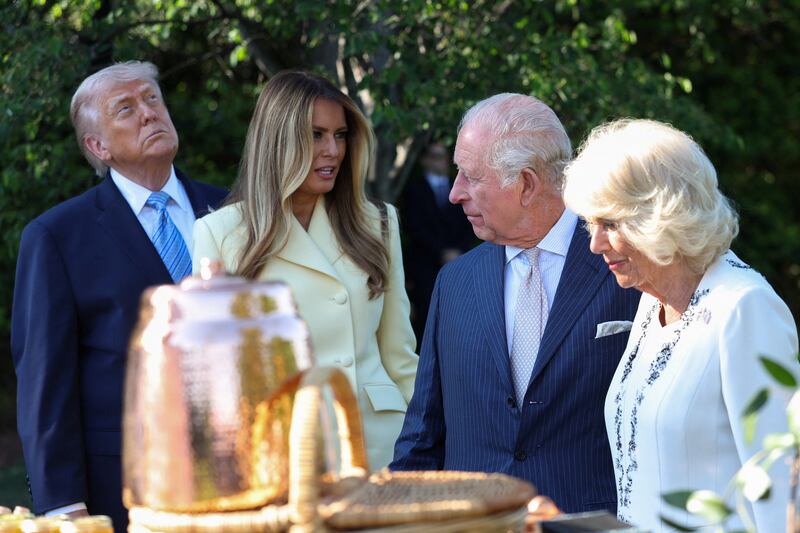
Britain’sking Charles and Queen Camilla arrived at the White House on Monday for a state visit in Washington, a city still rattled by a weekend shooting and a transatlantic alliance showing fresh signs of strain.
The four-day tour, intended to mark the 250th anniversary of US independence, begins against the backdrop of a diplomatic rift over Donald Trump’s war in Iran and a dramatic security scare at the White House correspondents’ dinner last Saturday.
British flags could be seen lining lamp-posts outside the White House, where Trump and the first lady, Melania Trump, greeted Charles and Camilla with handshakes. The four appeared to exchange pleasantries and posed for several photographs before heading inside the White House for a private tea.
The British monarch was spared the potential humiliation of being upbraided in public by the US president this week after the White House agreed that any meeting between the two men should be held off-camera.
UK ministers have pinned great hopes on the state visit, which they are hoping will help repair the relationship between the two countries at one of its most difficult periods in decades.
With Trump threatening retaliation for criticism of the Iran war by the British prime minister, Keir Starmer, and the chancellor, Rachel Reeves, the UK government is hoping the king might be able to talk Trump down from some of his more aggressive statements. – The Guardian
First LNG shipment in two months exits Gulf
The first liquefied natural gas shipment since the war in the Middle East began two months ago appears to have traversed the Strait of Hormuz to exit the Gulf.
The Mubaraz – which loaded a cargo from Abu Dhabi National Oil Co’s Das Island facility in the United Arab Emirates around early March – is now passing the southern tip of India, according to ship-tracking data. The tanker had been idling inside the Gulf, but stopped sending a signal around March 31st, before reappearing west of India on April 27th, the data shows.
The global energy market is laser-focused on traffic through Hormuz, which has dwindled to almost zero over the past two months as Iran and the US imposed rival blockades. The closure of the waterway for roughly a fifth of global LNG supply has tightened the market, sending prices sharply higher.
While the potential passage may raise hopes of increased LNG exports from the region, other vessels in the gulf appear to be remaining in place. Before the war, roughly three loaded LNG carriers transited Hormuz each day.
At present, the Mubaraz is signalling a terminal in China as its destination, with the ship estimated to arrive there by May 15th, the data shows.
Trump ‘unhappy’ with latest Iran proposal to end war
US president Donald Trump is unhappy with the latest Iranian proposal on resolving the two-month war, a US official said, dampening hopes for a resolution to the conflict that has disrupted energy supplies, fuelled inflation, and killed thousands.
Iran’s latest proposal would set aside discussion of Iran’s nuclear programme until the war is ended and disputes over shipping from the Gulf are resolved.
That is unlikely to satisfy the US, which says nuclear issues must be dealt with from the outset, and Trump was unhappy with Iran’s proposal for that reason, a US official briefed on the president’s Monday meeting with his advisers said.
White House spokeswoman Olivia Wales said the US “will not negotiate through the press” and has “been clear about our red lines” as the Trump administration looks to end the war against Iran it began in February alongside Israel.
A previous agreement in 2015 between Iran and multiple other countries including the US sharply curtailed Iran’s nuclear programme, which it has long maintained is for peaceful, civilian purposes. But that deal fell apart when Trump unilaterally withdrew from it in his first term in office.
Hopes of reviving peace efforts have receded since Trump scrapped a visit planned for last weekend by his special envoy Steve Witkoff and son-in-law Jared Kushner to Islamabad, the Pakistani capital, where Iranian foreign minister Abbas Araghchi shuttled in and out twice during the weekend. Araghchi also visited Oman and on Monday went to Russia, where he met Vladimir Putin and received words of support from a long-standing ally. – Reuters


