
Monday: As it happened
- US president Donald Trump claimed Iran would ‘like to work a deal’ on ending the war. Talks between the US and Iran collapsed without an agreement over the weekend
- The US began blockading the Strait of Hormuz, with Trump saying and Iranian vessel that approached would be ‘immediately eliminated’
- Israel launched a fresh assault in southern Lebanon against Hizbullah. Israeli and Lebanese envoys are due to begin peace talks in Washington on Tuesday
- Oil prices climbed above $100 again, as European crude oil prices climbed to a record high of near $150 (€128.33) a barrel
- Trump was accused of blasphemy after posting AI image of himself as Christ-like figure
Read More
- Trump’s naval blockade on Iran amounts to a dramatic comedown
- Why did the US enter this war? Psychology offers some answers
- What now? Failure of talks leaves US facing unpalatable questions
That concludes Monday’s live coverage of the crisis in the Middle East on irishtimes.com.
UN chief pushes US and Iran to resume negotiations
UN secretary general António Guterres is pushing for the US and Iran to resume negotiations that would end the war.
“After weeks of destruction & distress, it is clear that there is no military solution to the current conflict in the Middle East. I call for resumption of talks for an agreement to be reached,” Guterres said on X.
“The ceasefire must absolutely be preserved. All violations must cease. All parties to the conflict must respect the freedom of navigation, including in the Strait of Hormuz, in line with international law.”
Guterres’ post comes hours after Donald Trump confirmed that his blockade of the Strait of Hormuz had gone into effect. Meanwhile, the prospect of resumed talks remains uncertain.
US officials are reportedly having internal discussions related to logistics for a possible second meeting with Iranian officials, in the event such an opportunity comes up. But Iranian President Masoud Pezeshkian reportedly told French President Emmanuel Macron that irrational US demands had thwarted an agreement during this weekend’s peace talks, per CNN.
“We have clearly stated the ceasefire conditions and remain committed to them,” Pezeshkian said to Macron, according to an Iranian state media report cited by CNN. “The US excessive demands prevented reaching an agreement ... Iran will continue negotiations only within the framework of international law.” – The Guardian
UK and France host summit on Hormuz as depleted British fleet limits role
The UK will co-host an international summit of more than 40 nations this week to discuss how to safeguard shipping through the strait of Hormuz when the Iran conflict finally comes to an end.
Keir Starmer has said the continuing closure of the waterway is “deeply damaging” and that getting global shipping moving is crucial to ease cost of living pressures.
Iran is believed to have laid at least a dozen mines to prevent oil tankers and other vessels from passing through the strait, through which about 20 per cent of global oil flows.
But Tehran has thousands of naval mines in its arsenal, and while the US bombing campaign may have destroyed much of Iran’s naval capacity, mines can be dropped from relatively small boats.
With a depleted navy, the UK is likely to play a more limited role in keeping the strait safe and open for commercial shipping once hostilities do cease.
The UK’s last vessel in Bahrain, HMS Middleton, was brought home from the Gulf days before US and Israeli strikes on Iran began.
The UK has seven minehunting vessels in its fleet, but four are unavailable for immediate operations. The remaining three are deemed crucial to protect UK waters from Russian threats and to ensure the safe passage of the nuclear submarine fleet from Faslane, west Scotland.
The royal navy response is instead expected to be largely autonomous and remote minehunter drones, which trick mines into detonating safely by flying in a pattern that makes them look like passing ships.
Military officials are understood to be considering sending a vessel which would act as a mother ship for mine-clearing drones – widely regarded as the future by western navies – to make the strait safer.
Downing Street said on Monday that HMS Lyme Bay, which is already in the Mediterranean, is being equipped with drones. Other vessels are likely to follow, with the prospect of sending crewed ships to the strait looking remote.
All options will be under discussion at the UK-France convened Hormuz summit this week, with everybody looking for a solution for when the conflict is over.
UK defence secretary, John Healey, has already strengthened the UK military presence in the Gulf, with approximately 1,000 personnel deployed to support regional air defences, defend allies against threats, and monitor regional security.
RAF Typhoons and F-35 jets, together with Wildcat helicopters, have continued their defensive missions over the weekend, while additional air defences have been set to the Gulf to help protect allies. – The Guardian
Iran responds with fresh threats as US military says blockade of Iranian ports has begun
Iran has responded to US efforts to block Iranian ports with threats on all ports in the Gulf and the Gulf of Oman, taking aim at US-allied countries.
In Washington DC, US president Donald Trump said the blockade started at 3pm Irish time.
Minutes before the scheduled start of the blockade, the United Kingdom Maritime Trade Operations agency issued a notice to mariners that the restrictions included “the entirety of the Iranian coastline, including ports and energy infrastructure”.
The US military’s central command announced that the blockade would be enforced “against vessels of all nations entering or departing Iranian ports and coastal areas”.
It said that would include all of Iran’s ports on the Gulf and Gulf of Oman.
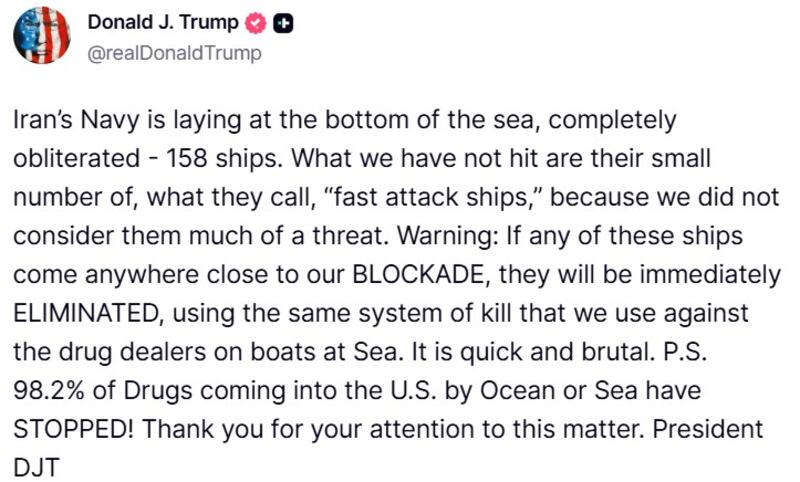
In a social media message posted shortly after the blockade was due to begin, Trump said Iran’s navy was “laying at the bottom of the sea, completely obliterated”, but he added that Tehran still has “fast attack ships” and warned that “if any of these ships come anywhere close to our BLOCKADE, they will be immediately ELIMINATED”.
However, Iran responded with threats of its own.
“Security in the Gulf and the Sea of Oman is either for everyone or for NO ONE,” the Islamic Republic of Iran Broadcasting reported on Monday.
“NO PORT in the region will be safe,” read a statement from the Iranian military and the Revolutionary Guard.
The threats halted the limited ship traffic that resumed in the strait since the ceasefire, according to a report from Lloyd’s List Intelligence.
Marine trackers say over 40 commercial ships have crossed since the start of the ceasefire last week, down from roughly 100 to 135 vessel passages per day before the war.
Ebrahim Rezaei, a spokesman for the Iranian parliament’s National Security Commission, dismissed US warnings of a potential blockade as “more bluffing than reality”, while warning that Tehran was prepared to respond if the situation escalates militarily.
“It will make the current situation [Trump] is in more complicated and makes the market – which he is angry about – more turbulent,” he said in a post on X.
“And we may also reveal other cards that we have not used in the game.”
The Iranian parliament speaker, Muhammad Bagher Qalibaf, addressed Mr Trump in a statement, saying: “If you fight, we will fight.”
Iran’s ambassador to India, Muhammad Fathali, said the main sticking points for Tehran were its nuclear programme, war reparations and sanctions relief.
Pakistani foreign minister Ishaq Dar said his country will try to facilitate a new dialogue in the coming days.
IEA is ready to further tap global oil reserves if needed, chief says
The head of the International Energy Agency (IEA), Fatih Birol, said on Monday he hopes another oil stockpile release is not needed but “we stand ready to act” if the energy shock resulting from the war with Iran requires it.
The 32-member IEA agreed last month to release 400 million barrels of oil from reserves, the largest co-ordinated release ever, in a bid to calm oil markets. The US, the world’s largest oil and gas producer, agreed to release 172 million barrels from its Strategic Petroleum Reserve.
“I hope, very much hope, we don’t need to do it but if it is needed we are ready to act,” Birol said. Birol reiterated at an Atlantic Council event that the war has resulted in the worst global energy disruption ever and said that more than 80 oil and gas facilities including production, terminals and refineries across the Middle East have been damaged by war with Iran.
Benchmark oil prices are trading near $100 a barrel. Due to the vast extent of the production shut-ins and closure of the Strait of Hormuz, the oil releases are “not a solution,” Birol said, “it’s just reducing the pain”. – Reuters
Macron, Starmer tout plan to open up Hormuz to shipping
France and the UK are convening a summit aimed at restoring free transit through Hormuz, even as their US ally places a fresh blockade on the strait.
“We are not getting involved in the proposal to blockade the strait, on the contrary, we’re working with other countries to try to get the strait open and fully open for free, navigation” British prime minister Keir Starmer said in an address to parliament on Monday.
His French counterpart president Emmanuel Macron posted on social media that “no effort must be spared” to solve the conflict through diplomacy.
The two leaders announced they would be corralling international efforts to safeguard the waterway just as president Donald Trump was orchestrating a new US-led blockade. Trump said Iranian ships coming near it would “be immediately ELIMINATED,” testing the durability of a fragile ceasefire after talks collapsed over the weekend.
Starmer told lawmakers the UK-French summit would press for a negotiated end to the conflict, and make military plans for giving assurance to shipping once stability is restored. He also called for Lebanon to be included in the ceasefire, saying Israel’s strikes were “wrong.”
In the course of updating parliament on his trip to the Gulf, the UK premier added: “All of the leaders that I met were crystal clear that freedom of navigation is vital and must be restored, no conditions, no tolls and no tolerance of Iran holding the world’s economy to ransom.” – Bloomberg
Trump says Iran wants to make a deal
Donald Trump said on Monday that Iran wants to make a deal and that he will not come to any agreement that allows Tehran to have a nuclear weapon.
Trump said talks had hit a roadblock related to nuclear issues and that a “blockade” of ships transiting the Strait of Hormuz had begun.
He said that Iran had “called this morning” and that “they’d like to work a deal.” Reuters could not immediately verify the claim.
“Iran will not have a nuclear weapon,” Trump told reporters at the White House. “We can’t let a country blackmail or extort the world.” – Reuters
Protracted Hormuz crisis could trigger agri-food catastrophe, UN food agency says
A prolonged crisis in the Strait of Hormuz could trigger a global agri-food catastrophe by disrupting fertiliser and energy exports, driving up food prices and squeezing crop yields, the UN Food and Agriculture Organisation (FAO) said on Monday.
Reuters report that FAO chief economist Maximo Torero said poorer countries were most exposed because planting calendars meant delays in access to key inputs could quickly translate into lower output, higher inflation and slower global growth.
Monday’s key events

Trump says Iranian ships will be ‘eliminated’ if they come close to blockade
In a post on Truth Social in the last few minutes, US president Donald Trump said Iranian ships will be “immediately ELIMINATED” if they come close to the US blockade.
It will be “quick and brutal”, he wrote.
Trump accused of blasphemy after posting AI image of himself as Christ-like figure
As we reported earlier, Trump last night posted an AI-generated images of himself as a Christ-like figure.
The move has not gone down well with some of the US president’s supporters.
Riley Gaines, Fox News host and conservative commentator, said she “cannot understand why he’d post this”.
“Is he looking for a response? Does he actually think this? Either way, two things are true. 1) a little humility would serve him well 2) God shall not be mocked,” she wrote in a post on X.
Megan Basham, a writer at the conservative publication Daily Wire, called the post “OUTRAGEOUS blasphemy”.
“I don’t know if the President thought he was being funny or if he is under the influence of some substance or what possible explanation he could have for this,” she wrote on X.
She demanded Trump “take this down immediately and ask for forgiveness from the American people and then from God”.
In a separate post, Basham said she had “no problem” with Trump saying Pope Leo XIV was “weak” on crime and “terrible for foreign policy”, adding: “It’s true.”
US blockade of Iranian ports begins
Donald Trump’s blockade of Iranian ports has begun, deepening the global economic impact from the Middle East crisis.
The United Kingdom Maritime Trade Operations (UKMTO) agency said it has been informed that effective from 3pm (Irish time), maritime access restrictions are being enforced affecting Iranian ports and coastal areas, including locations along the Gulf, Gulf of Oman, and Strait of Hormuz.
“Access restrictions apply without distinction to vessels of any flag engaging with Iranian ports, oil terminals, or coastal facilities,” it added. – Reuters
Pakistan PM says ‘full effort’ still on to resolve US-Iran conflict
Full efforts are still being made to resolve the conflict between the US and Iran, Pakistani prime minister Shehbaz Sharif said on Monday, a day after talks between the two sides, held in Islamabad, ended without agreement. – Reuters
Wall Street’s main indexes open lower
Wall Street’s main indexes opened lower on Monday.
The Dow Jones Industrial Average fell 198.4 points, or 0.41 per cent, at the open to 47,718.21. The S&P 500 fell 10.4 points, or 0.15 per cent, to 6,806.47, while the Nasdaq Composite dropped 53.7 points, or 0.23 per cent, to 22,849.23. – Reuters
Red Cross ‘gravely’ concerned by attacks on medical workers in Lebanon

The International Committee of the Red Cross (ICRC) has said it is deeply concerned about attacks on medical workers in Lebanon after a Red Cross centre was struck by Israel on Monday, and the killing of a health worker on Sunday.
“The loss of those who dedicate their lives to saving others is gravely concerning, given the impact on the civilians who depend on their help,” said Agnes Dhur, head of delegation of the ICRC in Lebanon.
“Saving lives must never cost a life. Humanitarian and medical personnel must be protected. They must be allowed to reach and help the wounded and return unharmed.”
The ICRC called on all parties to the fighting to “uphold their obligations under international humanitarian law”.
Red Cross paramedic Hassan Badawi was killed in an Israeli strike on Sunday. His funeral has taken place, and his family and colleagues are in mourning. – The Guardian
Wall Street set for subdued open as failed peace talks fuel investor angst
Wall Street’s main indexes were set to open lower on Monday after weekend talks between the US and Iran failed to deliver a deal to end the war, threatening a nascent recovery in equities and risking a renewed bout of volatility.
The declines indicate that any relief from the ceasefire reached last week could be fleeting, underscoring the risks of leaning too heavily into bullish bets when the geopolitical environment remains uncertain.
The main US stock indexes had logged their second consecutive week of gains on Friday on hopes that the peace talks in Pakistan would bear fruit.
On Monday, however, Dow E-minis fell 509 points, or 1.06 per cent, S&P 500 E-minis dropped 43.25 points, or 0.63 per cent, and Nasdaq 100 E-minis slipped 157.5 points, or 0.62 per cent.
Adding to the unease, the US military will soon begin a blockade of all maritime traffic entering or leaving Iranian ports and coastal areas, in a move aimed at ramping up pressure on Tehran.
The CBOE Market Volatility Index, the market’s fear gauge, climbed to 21.29 points. – Reuters
Indian tankers that have transited through the Strait of Hormuz did not pay tolls to Iran, Tehran’s ambassador to New Delhi said on Monday.
“You can ask the Indian government if we have charged anything up to now,” Ambassador Mohammad Fathali told reporters at a briefing at Iran’s embassy.
“In this difficult time, we have good relations. We believe Iran and India share common interests and a common fate,” he added.
India has repeatedly denied paying any toll to secure the exit of nine ships carrying liquefied petroleum gas (LPG) through the strategic waterway since Iran effectively barred transit following the outbreak of the Iran war.
India says 15 India-flagged vessels remain stuck in the Gulf. About half of India’s crude oil and LPG supplies pass through the Strait of Hormuz. – Reuters
Israel presses assault on Lebanon border town in advance of US-hosted talks

Israeli troops launched an attack to seize a key south Lebanon town from Hizbullah fighters holed up inside on Monday, pressing the war on the Iran-backed group on the eve of historic talks between Israeli and Lebanese government envoys.
With the Lebanese and Israeli ambassadors to the United States set to meet on Tuesday in Washington, Lebanon’s foreign minister said Beirut would use face-to-face negotiations to press for a ceasefire in the war that has complicated wider diplomacy to halt the conflict in the Middle East.
But the outlook for the meeting – a rare, face-to-face encounter between countries formally in a state of war – has been overshadowed, with Israel saying it won’t discuss a ceasefire while Hizbullah has objected to negotiations with Israel, reflecting sharply worsening political tensions in Lebanon.
On the ground in south Lebanon, the Israeli military completed its encirclement of the town of Bint Jbeil just over the border and had begun a ground assault there, an Israeli military spokesperson and Lebanese security sources said.
The Lebanese sources said Hizbullah fighters holed up inside were ready to fight to the death, citing the strategic and symbolic significance of Bint Jbeil, a Hizbullah stronghold, provincial capital, and gateway to surrounding villages. – Reuters
US military to enforce blockade in Gulf of Oman and Arabian Sea, note to seafarers says
The US military will enforce a blockade in the Gulf of Oman and Arabian Sea east of the Strait of Hormuz and it will apply to all vessel traffic regardless of flag, the US central command said in a note to seafarers seen by Reuters on Monday.
The note said the blockade would come into effect at 3pm (Irish time) on Monday (5.30pm local time).
“Any vessel entering or departing the blockaded area without authorisation is subject to interception, diversion, and capture,” the note said.
“The blockade will not impede neutral transit passage through the Strait of Hormuz to or from non-Iranian destinations.”
The blockade “encompasses the entirety of the Iranian coastline to include but not limited to ports and oil terminals”, the note said, adding that humanitarian shipments including food, medical supplies, and other essential goods would be permitted, subject to inspection.
Tehran has threatened to retaliate against ports of its Gulf neighbours, after weekend talks failed to reach a deal to end the war, leaving a ceasefire in jeopardy. – Reuters
Israel supports Trump’s naval blockade of Iran
Binyamin Netanyahu, Israel’s prime minister, said on Monday that Israel supports Donald Trump’s decision to impose a naval blockade on Iran.
Tel Aviv is co-ordinating with Washington on the situation, AFP reports.
“Iran violated the rules [of the peace talks in Pakistan], president Trump decided to impose a naval blockade,” Netanyahu said at a cabinet meeting, according to a video statement released by his office.
“We, of course, support this firm position, and we are in constant co-ordination with the United States.”
US central command said it would begin a blockade of all Iranian Gulf ports and coastal areas on Monday at 3pm (Irish time), effectively seizing control of maritime traffic in the Strait of Hormuz. – The Guardian
Von der Leyen worried Israeli strikes in Lebanon could ‘derail’ ceasefire
More from Jack Power on von der Leyen’s press conference:
Pressure on the world’s supply of oil and gas would continue, even if the “fragile” ceasefire between the US and Iran held up, von der Leyen said.
The German politician said she was worried continuing Israeli strikes in Lebanon could “derail” the entire process.
“You cannot have stability in the Middle East or the Gulf while Lebanon is in flames, so we call on all parties to respect the sovereignty of Lebanon and to implement a complete cessation of hostilities,” she said.
“What we are seeing in the Middle East is not some distant crisis, but in a world in which everything is connected, the effects are direct and they are immediate,” she said.
Von der Leyen says emergency relief should be ‘targeted and temporary’
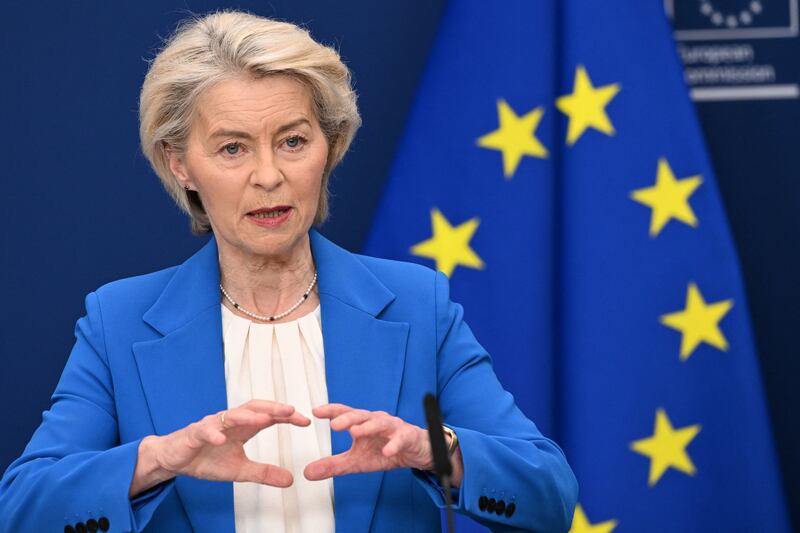
European Commission president Ursula von der Leyen has said emergency relief provided by governments to help people or businesses cope with steep energy costs should be “targeted and temporary”, Europe Correspondent Jack Power reports from Brussels.
The energy crunch has inflated Europe’s bill for fossil fuel imports by an extra €22 billion since the start of the war in Iran.
The EU’s executive arm is drawing up a package of energy reforms, part of which will involve giving extra flexibility to governments. The proposals will be published next Wednesday, a day before EU leaders meet in Cyprus for a summit now likely to be dominated by the energy crisis and Iran war.
The European Commission plans to relax state-aid restrictions to give governments “more space” to intervene and financially subsidise the “most exposed” sectors of the economy, von der Leyen told a press conference in Brussels.
The plan will also include a mechanism to try to avoid all EU states going to the market at the exact same time when buying gas, in effect competing against each other. Any release of strategic stocks of oil reserves will be co-ordinated at EU level, to maximise impact on the market.
Broad economic interventions should be kept to a minimum to avoid governments’ debt levels ballooning, von der Leyen said.
State support schemes would need to be time limited. “You have to make sure that you get out of the measures in a timely manner,” she said.
The Irish Government’s additional reductions in taxes charged on petrol and diesel at the weekend went below minimum excise rates set for the EU countries.

Ireland is far from the only country looking for forgiveness rather than permission from Brussels, in its response to the energy crisis. The commission recently chastised Poland and Spain for slashing VAT charged on fuel, asking both governments to consider reductions in excise duties instead.
A significant energy package in Spain included a cut to VAT on fuel from 21 per cent to 10 per cent. Poland similarly more than halved VAT on fuel from 23 per cent to 8 per cent, and cut excise duty to the minimum allowed under EU law.
The conditions necessary to allow national capitals to temporarily break rules limiting government debt levels were “currently not met,” von der Leyen said on Monday.
Farage refuses to say if UK should support Trump’s blockade
Nigel Farage, the Reform UK leader, has refused to say if the UK should be supporting Donald Trump’s blockade of the Strait of Hormuz. When asked that question at a press conference on Monday, he sidestepped it.
Farage said he was pleased the UK was going to send minesweepers, but added: “We can’t get involved – we haven’t got a navy. Even if we wanted to help with the blockade, we do not have the means to do so.” – The Guardian
EU’s bill for fossil fuels has increased by €22bn since start of war
The EU’s bill for fossil fuels has increased by €22 billion since the start of the Iran war, president of the European Commission Ursula von der Leyen has said.
“We are paying a very high price for our global dependency on fossil fuels, and the grim reality for our Continent is fossil fuel energy will remain the most expensive option in the years to come,” von der Leyen said.
During an ongoing press conference, she said that measures to ease energy prices should be targeted to vulnerable groups, timely and temporary.
Von der Leyen also said co-ordination of member states’ gas storage activities was under consideration. – Reuters
Physical oil in Europe hits record high near $150 a barrel
European crude oil prices climbed to a record high near $150 (€128.33) a barrel on Monday as the US plan to blockade the Strait of Hormuz added to concern about tight supplies.
The price of Brent crude futures for June delivery rose 6 per cent to more than $100 (€85.55) a barrel as the US navy prepared to block ships to and from Iran via the Strait of Hormuz in a move that could restrict Iranian oil exports after Washington and Tehran failed to reach a deal to end the war.
This is far short of Brent’s all-time high of $147 (€125.76) a barrel set in 2008.
However, the price of physical crude cargoes for immediate delivery is significantly higher as the effective closure of Hormuz has sent buyers in Europe and Asia scrambling to secure supplies.
The outright price of North Sea Forties crude reached $148.87 (€127.36) a barrel on Monday, LSEG data showed, exceeding its 2008 peak.
Repsol chief executive Josu Jon Imaz commented on the premium at which physical cargoes are trading to the prices fetched on financial markets at an event on Monday. “Physical transactions are under a lot of strain,” he said. – Reuters
UK and France to co-host talks on possible defensive naval mission for Hormuz
Britain and France will this week co-host talks aimed at restoring freedom of navigation in the Strait of Hormuz, including discussions on what president Emmanuel Macron described as a possible strictly defensive naval mission.
The talks are intended to bring together Britain, France and other countries willing to join a peaceful multinational mission aimed at restoring freedom of navigation in the strait.
“This strictly defensive mission, which will be separate from the warring parties, is intended to be deployed as soon as the situation allows,” Macron said in a post on X.
Tensions in the Gulf have intensified after the United States said it would begin a blockade of maritime traffic entering and exiting Iranian ports, while Iran has effectively shut the strait, a route that carries about a fifth of the world’s oil consumption.
British prime minister Keir Starmer said the continued closure of the Strait of Hormuz was deeply damaging global shipping and was adding to cost-of-living pressures.
“This week the UK and France will co-host a summit to advance work on a co-ordinated, independent, multinational plan to safeguard international shipping when the conflict ends,” Starmer posted on X.
Britain has previously convened representatives of more than 40 countries that share the aim of restoring freedom of navigation. The United States was not involved in those talks. – Reuters
Kremlin criticises Trump’s plan to blockade Iranian ports
The Kremlin on Monday criticised Trump’s announcement that the US would blockade the Strait of Hormuz, saying this would hurt global markets.
The US military said it would block shipping traffic in and out of Iran’s ports starting at 3pm on Monday (Irish time), a move that would prevent roughly two million barrels of Iranian oil a day from entering the world’s markets, further tightening global supply.
“Such actions will likely continue to negatively impact international markets. This can be assumed with a high degree of certainty,” Kremlin spokesman Dmitry Peskov told reporters.
He declined to comment further, saying many details of the US plan remained unclear. – Reuters
Israeli fire kills three in Gaza following new ceasefire talks

As the fragile two-week ceasefire between Iran and the US hangs in the balance, the ceasefire in Gaza has been dealt yet another blow.
An Israeli air strike killed at least three Palestinians in the Gaza Strip, health officials said on Monday, as mediators met leaders from Hamas in an effort to shore up a US-brokered ceasefire deal.
Medics said the strike had hit a group of men outside a school in Deir al-Balah in the central Gaza Strip. There was no immediate comment by the Israeli military.
At Al-Aqsa Hospital in Deir al-Balah, the bodies of those killed lay on the ground in white shrouds outside the morgue as relatives and friends arrived to bid them farewell. Some kissed the victims’ foreheads before holding special prayers.
“This isn’t a truce; it’s a trap for our young men. Every day there are martyrs, every single day. How long can this continue?” said Umm Hussam Abu El-Rous, a woman relative of one of the victims.
“Isn’t it unjust that a three-year-old child is afraid of seeing his [dead] father? He says, ‘My father went to bring me something from the shop,’” she added.
The ceasefire that began last October halted two years of full-blown war but left Israeli troops in control of a depopulated zone demarcated by yellow-painted blocks that comprises well over half of Gaza, with Hamas in power in a narrow coastal strip and Israeli air strikes continuing.
More than 750 Palestinians have been killed since the deal took effect, while militants have killed four Israeli soldiers. Israel and Hamas have traded blame for ceasefire violations. – Reuters
Questions over cost of ‘social tariff’ proposed to help poorer households with energy bills in UK
Former British chancellor Jeremy Hunt has argued that if the UK introduces a new ‘social tariff’ to help poorer households with their energy bills, other households could stump up the cost.
The Conservative MP told today’s Resolution Foundation event that the UK Treasury are “mindful of our fiscal position”, so they will say “we want the people who are not on the social tariff to have slightly higher bills, to pay for lower bills for people on the social tariff”. That, Hunt argues, would kill the policy “stone dead”.
Hunt said: “It is definitely politically easier for Rachel Reeves to say, ‘This is something I’m going to deal with when I come to the budget in November’. But if the moment she announces a social tariff, she announces that bills for the 80 per cent are going to go up in order to fund lower bills for the 20 per cent of poorer households, that is a way to kill a policy stone dead from the outcome.
“You can’t really duck that because people are going to ask, ‘How are you going to pay for this?’ And that, I think, is why in the end, the quantum is very, very important. I mean, are we talking about a £5 billion (€5.7 billion) package for one year, or are we talking about a £25 billion (€28.7 billion) package for five years?” – The Guardian
Iran’s and Saudi Arabia’s foreign ministers discussed Iran-US talks in Islamabad during a phone call, Iran’s foreign ministry said on Monday.
The phone call comes after weekend talks failed to reach a deal to end the war, jeopardising a fragile two-week ceasefire. – Reuters
‘I will continue to speak out loudly against war’ – Pope Leo

Pope Leo XIV has said he plans to continue speaking out against the war after Trump’s criticism.
In comments aboard the papal flight to Algiers, where the first US pope is starting a 10-day tour to four African countries, the pontiff also said the Christian message was being “abused”.
“I don’t want to get into a debate with him,” Leo told Reuters as he greeted journalists on the plane.
“I don’t think that the message of the Gospel is meant to be abused in the way that some people are doing.
“I will continue to speak out loudly against war, looking to promote peace, promoting dialogue and multilateral relationships among the states to look for just solutions to problems,” he said, speaking on English.
“Too many people are suffering in the world today. Too many innocent people are being killed. And I think someone has to stand up and say there’s a better way.”
He continued: “The message of the church, my message, the message of the Gospel: blessed are the peacemakers. I do not look at my role as being political, a politician,” he said.
Leo, originally from Chicago, has emerged as an outspoken critic of the US-Israeli war on Iran in recent weeks and decried the “madness of war” in a peace appeal on Saturday. – Reuters
Trump’s attack on pope shows he has ‘no boundaries’
Donald Trump’s stinging criticism of Pope Leo XIV shows the US president has “no boundaries”, Katie Rogers writes.
Trump last night said the pontiff was “weak on crime” and “terrible for foreign policy”.
“Leo should be thankful because, as everyone knows, he was a shocking surprise,” he wrote in a lengthy social media post.
“He wasn’t on any list to be Pope, and was only put there by the Church because he was an American, and they thought that would be the best way to deal with President Donald J. Trump. If I wasn’t in the White House, Leo wouldn’t be in the Vatican.”
Rogers writes: “The antagonistic post showed that there were really no boundaries when it comes to people Trump might target – the leader of the world’s 1.4 billion Catholics is apparently fair game ...
“Trump’s angry counterpunch to the soft-spoken Leo, who was born Robert Francis Prevost in Chicago, illustrated how differently two of the world’s most powerful Americans handle conflict. One pleads for resolution, while the other reflexively increases the temperature.”
Read her full analysis.
Starmer says UK is ‘not supporting the blockade’

UK prime minister Keir Starmer on Monday reiterated his government’s position that the UK will not be involved in any blockade of the Strait of Hormuz.
In an interview with BBC’s Radio 5, Starmer said all British efforts at the moment are focused on getting the strait fully open.
“All the time the strait is shut or not free for navigation in the way it should be, that means oil and gas is not getting to market, that means the price is going up and everybody listening to this is facing higher energy bills,” Starmer said. “I don’t want that to happen. I want their energy bills to be stabilised and lower.”
He added: “We’re not getting dragged into the war. The UK is not getting dragged in. That’s not in our national interest, because I’m not going to act unless there’s a clear, lawful basis and a clear thought through plan.” – The Guardian
Gas prices rise after US-Iran talks fail to reach deal
Dutch and British gas prices rose on Monday after US-Iran talks over the weekend failed to reach a deal to end the war, jeopardising a fragile two-week ceasefire.
The benchmark Dutch front-month contract at the TTF hub was up 8.8 per cent at €47.50 per megawatt hour (MWh) this morning, data from the Intercontinental Exchange showed.
The British contract for April was up 9.2 per cent at 119.83 pence per therm.
Saul Kavonic, head of energy research at MST Marquee, said: “The market is now largely back to conditions before the ceasefire. The key remaining question is if the US renews strikes on Iran, raising the risk of strikes on energy infrastructure across the region which could have a further lasting impact beyond the duration of the war.”
European gas prices will rise on the geopolitical developments. Gains will probably be bigger than for oil, given the higher volatility over recent weeks in reaction to such news updates, another analyst said. – Reuters
US blockade of Iranian ports to start
The US military announced it will begin a blockade of all Iranian ports and coastal areas on Monday, a step down from president Donald Trump’s earlier vow to entirely block the Strait of Hormuz as early reports indicated that ships had stopped crossing the waterway.
The move came after marathon US-Iran ceasefire talks in Pakistan ended without an agreement, and it set the stage for a showdown as Iran responded with threats on ports in the Gulf and the Gulf of Oman.
“Security in the Gulf and the Sea of Oman is either for everyone or for NO ONE,” according to the Islamic Republic of Iran Broadcasting.
“NO PORT in the region will be safe,” the Iranian military said.
US Central Command announced the blockade would involve all Iranian ports, beginning on Monday, to be “enforced impartially against vessels of all nations”.
It would still allow ships travelling between non-Iranian ports to transit the strait, a step down from the president’s earlier threat to blockade the entire waterway.
The announcement of the blockade halted the limited ship traffic that resumed in the strait since the ceasefire, said an early report from Lloyd’s List intelligence. Marine trackers say over 40 commercial ships have crossed since the start of the ceasefire, down from roughly 100 to 135 vessel passages per day before the war. – AP
Message from the Editor

UK to announce support package for businesses
UK chancellor of the exchequer Rachel Reeves said she would set out a support package this week to help businesses in the UK struggling with soaring energy costs as a result of the Iran war.
Like other countries, the UK is exposed to the economic fallout from the Iran war, which has driven oil and gas prices sharply higher on world markets, thereby increasing energy bills and fuel prices for households and businesses.
Writing in The Sunday Times, Reeves said: “The war in Iran will come at a cost to British families and business ... We don’t yet know the full scale of those costs, but the immediate priority must be to ensure that the ceasefire holds.”
She added: “That is the best protection we have against higher costs at home and at the IMF meetings in Washington this week I will be working with allies on the action we can take to guarantee freedom of navigation, including the Strait of Hormuz, to keep energy supplies moving again.”.
Reeves and other finance ministers along with central bankers are heading to Washington for the International Monetary Fund and World Bank’s spring meetings starting on Monday. – The Guardian
FTSE 100 and airline shares drop
London’s stock market has opened with a bump, as traders react to the lack of progress in the US-Iran peace talks. The FTSE 100 index of blue-chip shares has lost 0.6 per cent at the start of trading, falling by 67 points to 10,533 points.
AB Foods (the grocery, sugar, agriculture, ingredients and retail group) are the top faller, down 2.7 per cent, with airlines, miners, banks and housebuilders all lower. Energy companies are rallying, though; BP and Shell are both up more than 1 per cent.
Shares in European airlines are dropping in early trading. IAG, British Airways’ parent company, is down over 2 per cent this morning, with budget rivals Wizz Air (down 6.5 per cent) and EasyJet (down 3.8 per cent) falling more sharply. In Germany, Lufthansa has dropped by 4 per cent. – The Guardian
Nine people killed in Israeli strike in Lebanon
Nine people were killed and 13 wounded in an Israeli attack on the town of Tefahta in southern Lebanon on Sunday, the state-run National News Agency said.
Since March 2nd, at least 2,055 people have been killed and 6,588 wounded in the conflict in Lebanon, according to the Ministry of Public Health. – The Guardian
Fuel protests continue as protesters criticise €505m package
The Government has unveiled a €505 million package of supports for farmers, hauliers and others impacted by the fuel crisis caused by the war.
The measures were dismissed by some central figures in the recent protests as “insulting” and “not enough”.
Blockades at fuel depots in Cork, Limerick and Galway were stopped over the weekend and O’Connell St in Dublin city centre fully reopened this morning, but rolling protests could slow traffic on a number of roads around the country today.
Read the latest updates in our live story.
German coalition announces fuel price relief worth €1.6bn
Germany’s governing coalition on Monday announced a fuel price relief for consumers and businesses worth €1.6 billion, following a spike in oil prices due to the Iran war.
“We will reduce the energy tax on diesel and petrol by approximately 17 cents gross per litre, for a period of two months,” a joint paper by the Conservatives and their centre-left coalition partners said. – Reuters
World Bank chief sounds alarm about looming jobs crisis even after war ends
The Middle East war will dominate global finance officials’ talks this week in Washington, but World Bank President Ajay Banga is sounding the alarm about a bigger, looming crisis: a huge gap in jobs for the 1.2 billion people who will reach working age in developing countries in the next 10 to 15 years.
At current trajectories, those economies will generate only about 400 million jobs, leaving a deficit of 800 million jobs, Banga told Reuters.
The former Mastercard chief executive admits that focusing people on the long-term is daunting, given a series of short-term shocks that have buffeted the global economy since the Covid-19 pandemic, the most recent being the war in the Middle East.
He says he’s determined to ensure that finance officials stay focused on those longer-term challenges like creating jobs, connecting people to the electricity grid and ensuring access to clean water.
“We have to walk and chew gum at the same time. Short-velocity cycle is what we’re going through. Longer velocity is this jobs circumstance or water,” Banga said in an interview taped on Friday. – Reuters
Australian PM calls for Lebanon to be included in ceasefire

Australian prime minister Anthony Albanese has called for the full reopening of the Strait of Hormuz and free navigation for all countries.
“We want to see the strait of Hormuz opened and with freedom of navigation taking place, so obviously, the lack of a resolution in the negotiations that took place on the weekend were disappointing,” Albanese said.
“We want to see de-escalation and we want to see those negotiations resumed.”
Albanese stressed that the Australian government’s view was that the ceasefire should extend to Israel’s fighting with Hizbullah militants in southern Lebanon.
Lebanon and Israel have agreed to hold their first meeting on Tuesday at the US state department, to discuss a possible ceasefire and broader peace talks. – The Guardian
Association of Southeast Asian Nations (ASEAN) foreign ministers on Monday urged the United States and Iran to continue negotiations for a permanent end to their conflict, as well as the full and effective implementation of the ceasefire.
Ministers from the 11 ASEAN members, who met virtually to discuss the war in the Middle East, called for the restoration of safe, unimpeded and continuous transit passage of vessels and aircraft in the Strait of Hormuz. – Reuters
The US blockade of the Strait of Hormuz, due to begin at 3pm on Monday (Irish time), is a blow to the 20,000 seafarers who have been trapped in the Gulf for the last six weeks.
One said last week: “I gave my notice exactly one month ago. I’ve informed the master, I’m not willing to sail through the strait. It’s about safety, it’s all about safety.” – The Guardian
Starmer refuses to join Trump’s Hormuz blockade
UK prime minister Keir Starmer has refused to join Trump’s blockade of the Strait of Hormuz, which could compound economic pain for Britons with higher petrol costs.
The US president threatened stop tankers from entering or leaving the key oil and gas shipping lane, a move that is expected to further drive up oil prices.
The prime minister will discuss cost-of-living pressures with local people on a visit to Greater Manchester on Monday.
And chancellor Rachel Reeves will travel to Washington for International Monetary Fund meetings this week, after warning that “the war in Iran will come at a cost to British families and business”.
MPs return to Westminster from the Easter recess on Monday with no resolution to the Middle East crisis in sight and the fate of a shaky two-week ceasefire uncertain. – PA
Oil prices rise again after Trump blockade comments
Iran’s Revolutionary Guard warned that “approaching military vessels to the strait of Hormuz is considered a violation of the ceasefire”.
Oil prices rose in early market trading after Trump’s blockade announcement. The price of US crude oil rose 8 per cent to $104.24 (€89.16) a barrel and Brent crude oil – the international standard – rose 7 per cent to $102.29 (€87.50).
Australia’s share market dropped sharply on Monday morning.
Iran’s parliamentary speaker Mohammad Bagher Ghalibaf, who led Tehran’s negotiators at the weekend talks with Washington, taunted Trump on X, saying in a post: “Enjoy the current pump figures. With the so-called ‘blockade’, Soon you’ll be nostalgic for $4 –$5 gas.” (about €3.42 to €4.27)
Earlier he said Trump’s new threats would have no effect on the Iranian nation: “If you fight, we will fight ... We will not bow to any threats.” – The Guardian
Trump orders naval blockade of Strait of Hormuz after Iran peace talks break down
As our Washington correspondent Keith Duggan reports, Donald Trump ordered the US navy to impose a full blockade on the Strait of Hormuz following the breakdown of peace talks with Iran after a marathon meeting in Pakistan.
“No one who pays an illegal toll will have safe passage on the high seas,” the US president stated in a lengthy post on his Truth Social platform on Sunday.
“We will also begin destroying the mines the Iranians laid on the Straits. Any Iranian who fires at us, or at peaceful vessels, will be BLOWN TO HELL!”
Trump was attending an Ultimate Fighting Championship (UFC) event in Miami on Saturday night, along with his secretary of state Marco Rubio, when US vice-president JD Vance decided to conclude what had been the highest level direct US-Iranian talks for half a century.
A clearly frustrated Vance exited the negotiations with Iranian officials, held in Islamabad and brokered by Pakistan, after 20 hours. While he made few comments, it was apparent that the breakdown hinged on the future capacity of Iran to develop a nuclear capability.
Why did Trump choose Vance to negotiate difficult peace talks with Iran?
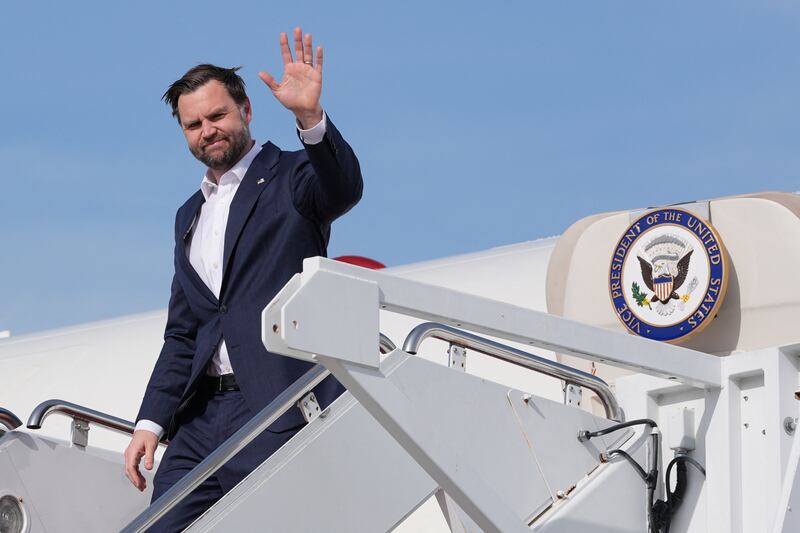
“We’ve made very clear what our red lines are,” Vance told reporters before leaving Pakistan, “and what things we’re willing to accommodate them on. They have chosen not to accept our terms.”
Trump confirmed that in his social media post and, in a later phone interview with Fox News, he elaborated on the purpose of the blockade, saying it was to place a chokehold on Tehran’s access to oil revenues.
“It’s called all in and all out. There’ll be a time when we’ll have them all come in and all come out. But it won’t be a percentage, it won’t be a friend of yours like a country that’s your ally,” he said.
“We’re not gonna let Iran make money selling oil to people that they like and not people that they don’t like. You saw what we did with Venezuela. It will be something similar to that but at a higher level.”
Spanish PM urges China to ‘do more’ to end wars
Spain’s prime minister Pedro Sánchez began his trip to China on Monday by calling on Beijing to leverage its influence internationally and help bring the wars in Iran and Ukraine to an end.
“China can do more – for example, by demanding, as it is already doing, that international law be upheld and that conflicts in Lebanon, Iran, Gaza, the West Bank, and Ukraine come to an end,” Sánchez said during a speech at Tsinghua University in Beijing.
China, which is preparing to host a visit by US president Donald Trump next month, has condemned as “unacceptable” the US and Israeli strikes against Iran.
President Xi Jinping, who is scheduled to meet Sánchez during his visit, has so far stayed silent on the conflict engulfing a major Chinese friend.
The war now entering its seventh week has lifting oil prices and raised the prospect of further economic pain around the globe.
Spain has been one of the European countries most strongly opposed to the military operations, which Sánchez openly considers “illegal.” The country has closed its airspace to flights by US warplanes participating in the conflict and is preventing Washington from using its two bases on Spanish territory for that purpose.
But Spain has also condemned Iran’s response to the US and Israeli attack and the destabilisation of the entire region.
Sánchez believes that Beijing can contribute more to halting the conflicts in the Gulf and Ukraine by using the influence China still exerts over Iran and Russia – two countries with which it has extensive ties.

“International law is the foundation of everything,” he said in the Chinese capital.
Spain has strengthened relations with Beijing in recent years, presenting itself as China’s closest ally in Europe. Sánchez, who’s making his fourth trip to China in just over three years, plans to meet political and business leaders – in addition to Xi.
Embracing China is an approach that has come with considerable risks for Spain, as Trump’s return to the White House has triggered upheaval both in Europe’s ties with Washington and in the US-China relationship.
Last year, Sánchez travelled to Beijing days after US tariffs were imposed on nearly every country. It was a move seen as a provocation in Washington, with US treasury secretary Scott Bessent calling it “cutting your own throat”. – Bloomberg
US to begin blockade of Iranian ports
The US military announced it will begin a blockade of all Iranian ports on Monday, tempering Donald Trump’s earlier vow to entirely block the strategic Strait of Hormuz as early reports indicated that ships had stopped crossing the waterway.
The move came after marathon US-Iran ceasefire talks in Pakistan ended without an agreement, and it set the stage for a showdown. Iranian leaders vowed to counter the blockade.
US central command announced the blockade would involve all Iranian ports, beginning on Monday, to be “enforced impartially against vessels of all nations”.
It would still allow ships travelling between non-Iranian ports to transit the strait, a step down from the president’s earlier threat to blockade the entire waterway.
The announcement of the blockade halted the limited ship traffic that resumed in the strait since the ceasefire, said an early report from Lloyd’s List intelligence. Marine trackers say over 40 commercial ships have crossed since the start of the ceasefire, down from roughly 100 to 135 vessel passages per day before the war.
The blockade is likely intended to add pressure on Iran, which has exported millions of barrels of oil since the war began, much of it likely carried by so-called “dark” transits that evade western government sanctions and oversight.

Trump also hopes to undercut Iran’s control over the Strait of Hormuz after demanding that it reopen the waterway where 20 per cent of global oil transited before fighting began. A US blockade could further rattle global energy markets.
Oil prices rose in early market trading after the blockade announcement.
Iranian officials threatened retaliation. Mohsen Rezaei, a military adviser and a former Revolutionary Guard commander, wrote on X that the country’s armed forces had “major untouched levers” to counter a Hormuz blockade. He said Iran would not be coerced by “tweets and imaginary plans”.
Iranian parliament speaker, Mohammad Bagher Qalibaf, who led Iran’s side in the talks in Pakistan, addressed Trump in a statement on his return to Iran: “If you fight, we will fight.”
Iran’s Revolutionary Guard later said the strait remained under Iran’s “full control” and was open for non-military vessels, but military ones would get a “forceful response”, two semi-official Iranian news agencies reported. – AP
Iran war could plunge 32 million into poverty, says United Nations
More than 32 million people worldwide could be plunged into poverty by the economic fallout from the Iran war, with developing countries expected to be hit hardest.
In a report issued amid doubts over a fragile ceasefire, the United Nations Development Programme (UNDP) said the world was facing a “triple shock” involving energy, food and weaker economic growth.
The agency tasked with tackling poverty said the conflict was reversing gains in international development, with the impact expected be felt unevenly across regions.
Alexander De Croo, administrator of the UNDP and former prime minister of Belgium, said: “A conflict like this is development in reverse. Even if the war stops, and a ceasefire is obviously very, very welcome. But the impact is already there.
“You will see an enduring impact, especially in the poorer countries, where you push people back into poverty. That’s the most heartbreaking element. The people being pushed into poverty are very often the people who used to be in poverty, got out of it, and are now being pushed back.”

Energy prices have surged in the six weeks since the first US-Israeli air strikes on Tehran, as Iran’s closure of the strait of Hormuz chokes oil and gas supplies to the world economy. With a knock-on impact on fertiliser supplies and global shipping, experts warn that a “food security time bomb” has been set for the developing world.
Even if a durable peace in the Middle East can be sustained, the head of the International Monetary Fund has said the “scarring effects” from the conflict have permanently damaged the global economy.
Publishing its report as world leaders gather in Washington for the IMF’s spring meetings, the UNDP said a global response was required to support countries hardest hit by the economic fallout.
It said targeted and temporary cash transfers were needed to protect the most vulnerable households in developing nations, at a cost of about $6 billion (€5.1 billion) to neutralise the shocks for those falling below the poverty line.
De Croo said international agencies and development banks could provide the financial support. “There is a positive economic payout for giving short-term cash transfers to avoid people getting back into poverty,” he said. Second-best interventions could include temporary subsidies or vouchers for electricity or cooking gas.
However, the UNDP warned against blanket subsidies because they would unnecessarily support wealthier households, and would be financially unsustainable over time. – The Guardian
Trump attacks Pope Leo over Iran war criticisms

US president Donald Trump has attacked Pope Leo XIV for his criticisms of the US-Israeli war on Iran, calling the leader of the Catholic Church “WEAK on crime”.
The American-born pope has issued a series of rebukes to his leadership, most recently challenging the administration’s argument that God is on the side of the US in the conflict with Iran.
“I don’t want a Pope who thinks it’s OK for Iran to have a Nuclear Weapon,” Trump said in a post on Truth Social. “I don’t want a Pope who thinks it’s terrible that America attacked Venezuela, a Country that was sending massive amounts of Drugs into the United States and, even worse, emptying their prisons, including murderers, drug dealers, and killers, into our Country.”
Moments later, Trump posted a picture to social media that echoed images of Jesus, depicting himself in robes healing a sick patient surrounded by a medical worker and military members.
Amid the conflict in Iran, the pontiff wrote on X on Friday: “God does not bless any conflict. Anyone who is a disciple of Christ, the Prince of Peace, is never on the side of those who once wielded the sword who today drop bombs. Military action will not create space for freedom or times of #Peace.”
Leo didn’t specifically cite Trump but his remarks followed repeated comments from the president and defence secretary Pete Hegseth couching the US war against Iran in religious terms, comparing a downed US fighter pilot to Jesus Christ and arguing that God has given divine protection to US troops. – Bloomberg


