Iran has threatened to resume rocket and drone attacks on the ports of its Gulf neighbours after the US implemented a blockade of Iranian ports and coastal areas on Monday.
Oil prices climbed upwards, with no sign of a swift reopening of the Strait of Hormuz to ease the biggest ever disruption in supplies and broader concerns over the durability of a two-week ceasefire agreement reached last week.
The US blockade covers vessels of any flag engaging with Iranian ports, oil terminals or coastal facilities, extending across the Arabian Gulf, the Gulf of Oman and the Arabian Sea east of the Strait of Hormuz.
US president Donald Trump warned that if any Iranian ships came close to the blockade they would be “immediately eliminated”.
READ MORE


The US deployment consists of more than 15 warships including an aircraft carrier, guided-missile destroyers and an amphibious assault ship, according to reports in the Wall Street Journal.
Trump declared plans for a naval blockade after weekend talks in Islamabad between vice-president JD Vance and an Iranian delegation collapsed, even though the temporary ceasefire technically lasts for another nine days.

An Iranian military spokesperson called the US measures “piracy,” warning that if Iranian ports were threatened, no port in the Gulf or Gulf of Oman would be secure. The Islamic Revolutionary Guard Corps separately said any military vessels approaching the Strait of Hormuz would be considered in violation of the ceasefire.
During the 40-day war, Iran blocked the passage to and from the Gulf for most non-Iranian ships and demanded during the talks that it be allowed to charge transit fees.
Now, the US is seeking to block the movement of Iranian oil through the Gulf, thereby depriving the cash-strapped regime of an economic lifeline.
Israeli prime minister Binyamin Netanyahu, who was uncomfortable with the announcement of a two-week truce, said Israel supported the US naval blockade and was fully co-ordinated with Washington.
Speaking on Monday, he said the main issue in the Pakistan talks was removing enriched uranium from Iran, adding that Vance promised Iran would not have the ability to enrich uranium for the coming decades.
Nato allies said on Monday they would not participate in the blockade, proposing instead to intervene only once fighting ends.
British prime minister Keir Starmer said the United Kingdom would not be dragged into the Iran war.
In a BBC interview he blamed Iran for the disruption to shipping and said it was vital to reopen the Strait: “That’s the way we get energy prices down as quickly as possible.”
Turkey’s foreign minister raised concerns on Monday about Iran and the US proposing in their talks new regulations for passage via the Strait of Hormuz, warning that there were many difficulties around the idea of an international force overseeing the reopening of the waterway.
The ambassadors of Israel and Lebanon to the US are due to begin formal peace talks on Tuesday in Washington, while fighting continues between Israel and the Iran-backed Hizbullah militia in Lebanon.
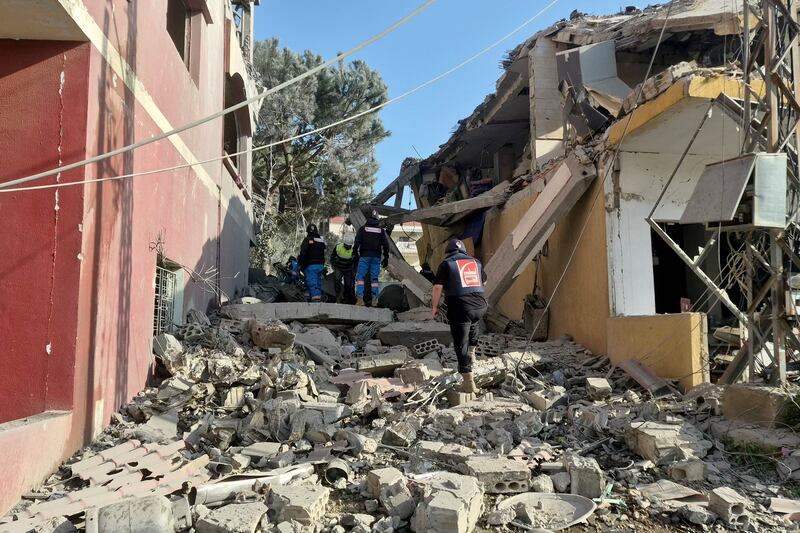
Israel has refused Beirut’s demand for a ceasefire in advance of the negotiations but, under pressure from Washington, has stopped attacks in Beirut and the Beqaa valley while continuing to engage Hizbullah fighters in southern Lebanon.
The Lebanese embassy in Washington said top of the agenda will be discussion on the terms for a ceasefire.
The direct talks in Washington are opposed by Hizbullah, which is resisting pressure by the Beirut Government to disarm.
The Lebanese health ministry said the death toll from last Wednesday’s massive Israeli bombardment had risen to more than 350, with more than 1,000 people injured. UN aid agencies are warning of a growing humanitarian crisis in Lebanon, with more than a million people displaced, and rising food costs.