
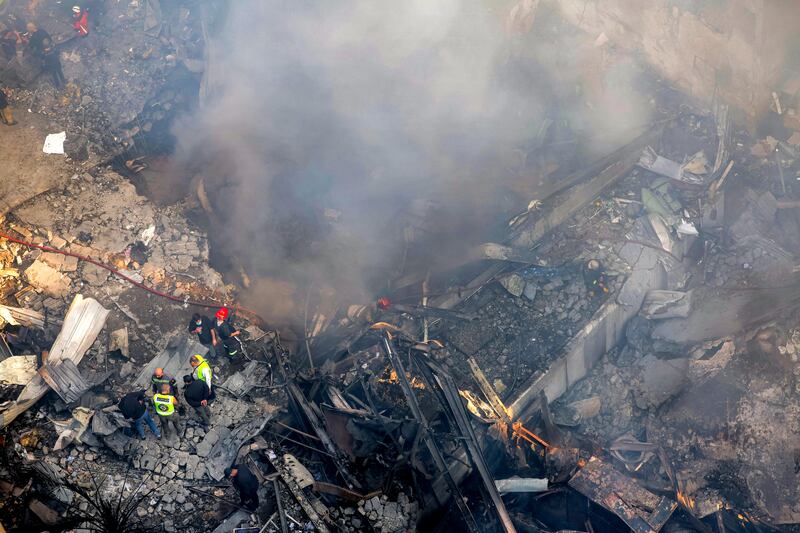
A large wave of Israeli air strikes struck across Lebanon on Wednesday afternoon, hours after Lebanese hopes of an immediate ceasefire were dashed. According to the Lebanese Civil Defence, at least 254 people were killed and more than 1,100 injured. Casualties were expected to rise.
Following a series of explosions, people stood shocked in the streets in Beirut, peering upwards, filming on their phones or asking each other for information about where had been hit. Rising smoke and the sound of sirens quickly followed, with ambulances rushing through the streets.
A statement from the ministry was issued, asking people to refrain from driving and to make way for emergency services.
The priority was to rescue people still under the rubble, the ministry’s statement said. Calls for blood donations went out through social media.
READ MORE


The Israeli military called Wednesday’s wave of air strikes the biggest ones “since the start of Operation Roaring Lion”, the code name for its recent attacks on Iran and Lebanon. It said more than 100 sites were hit within 10 minutes: targets which included “headquarters and military infrastructure belonging to Hizbullah”.
It called this operation “Eternal Darkness” and accused Hizbullah of using civilians as “human shields,” according to Israeli media.
Locations hit included busy areas of the capital city. Lebanese prime minister Nawaf Salam accused Israel of killing unarmed civilians and “showing no regard for regional and international efforts to end the war, let alone the principles of international law and international humanitarian law, which it has never respected in the first place.”
In a statement, medical charity Médecins Sans Frontières (MSF) – which works in Lebanon – said it condemned strikes “that targeted densely populated areas”.
Emergency co-ordinator Christopher Stokes said MSF teams were responding to a “heavy influx of injured people, including children, at Rafik Hariri University Hospital in Beirut”.
He said the injured were “arriving with shrapnel wounds and severe bleeding. One of the wounded arrived at the hospital after losing both his legs. The situation is growing more chaotic.”
The strikes prompted speculation that this escalation might actually mean a ceasefire could still come into force, after Israel denied that Lebanon would be included in the ceasefire agreed between the US and Iran on Wednesday, running contrary to other announcements.
The loud sound of an Israeli drone woke up many people across Beirut early on Wednesday morning – where displaced people sleep in locations including tents, cars, and on mattresses on the floors of schools – even as news of a potential ceasefire came through.
While Pakistani prime minister Shehbaz Sharif originally said Lebanon was included in the two-week ceasefire, the hopes of Lebanon’s residents were dashed just over three hours later when an announcement from Israeli prime minister Binyamin Netanyahu’s office said Israeli forces will not stop their assault.
This did not stop some of the country’s roughly 1.1 million displaced people from attempting to return to their homes, prompting the Lebanese army to close roads to prevent people from going back to unsafe areas.
Hizbullah also issued statements, saying no parties will adhere to a ceasefire if Israel does not stop its attacks on Lebanon.
The Iran-backed group also called on displaced people to exercise “further patience, resilience, and restraint, and to refrain from heading to the targeted villages, towns, and areas in the south, the Bekaa, and the southern suburbs of Beirut” before an official, final ceasefire announcement.
It said it was standing “on the threshold of a major historic victory, one that will be achieved through the sacrifices of the fighters, the blood of the martyrs, and your unmatched steadfastness and patience”.
Israeli officials previously announced that they planned to occupy southern Lebanon, up to the Litani river, with the stated goal of making northern Israel safe for residents.
Since March 2nd, Israeli attacks across Lebanon have killed at least 1,530 people, including 130 children, 102 women and 57 healthcare workers. Those numbers are expected to rise following Wednesday’s attacks.