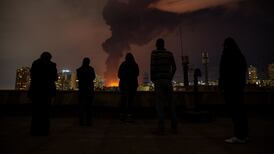
Israel and the US continued to launch wide-scale strikes against regime infrastructure across Iran on Monday.
Missile sites, security centres and Islamic Revolutionary Guard Corps (IRGC) and Basij facilities were targeted in the attacks.
Video footage published by investigative journalists and verified by The New York Times appears to show a US Tomahawk missile striking an IRGC compound adjacent to a school in Minab in southern Iran – adding to growing evidence the US military was behind the strike that ended up killing an estimated 175 people, mostly children, at a girls school.
Petrol stations in Tehran began rationing fuel after Israeli strikes on oil depots, with kilometre-long queues forming.
READ MORE


The war has effectively shut the Strait of Hormuz, a chokepoint for a fifth of global oil and liquefied natural gas, leaving tankers unable to sail for more than a week and forcing producers to halt pumping as storage fills.
Sources said Saudi Arabia had curbed production at two oilfields, becoming the latest Gulf producer to curb supply after Iraq and Kuwait.
The prospect of a prolonged energy crisis sent global share markets into a tailspin.
US-Israeli attacks have killed at least 1,332 Iranian civilians and wounded thousands, according to Iran’s United Nations ambassador.
In the capital Tehran, thousands gathered to support new supreme leader Mojtaba Khamenei. He succeeds his father, Ayatollah Ali Khamenei, who was killed by Israeli air strikes on the first day of the war.
US president Donald Trump said he was “nowhere near” deciding whether to send troops into Iran to secure any stockpiles of highly enriched uranium.
“We haven’t made any decision on that. We’re nowhere near it,” he told the New York Post.
Trump’s secretary of state Marco Rubio accused Iran of taking the world “hostage” through its retaliatory strikes across the Gulf region and insisted that the US is on track with its war objectives.
“I think we are all seeing right now the threat this clerical regime poses to the region and to the world,” he said. “They are trying to hold the world hostage.”
Iran’s foreign ministry spokesperson played down chances of a ceasefire as long as attacks continue.
“There is no point to talks about anything but defence and crushing retaliations against enemies,” Esmaeil Baghaei said, before reiterating that Tehran is not at war with its Muslim neighbours in the Gulf but must target “facilities used by aggressors”.
He also denied any Iranian aggression against Turkey, Azerbaijan or Cyprus, instead blaming what he called “false flag attacks”.

The exchanges between Israeli troops and the Iranian-allied Hizbullah militia continued in Lebanon. Israel Defense Forces attacked what it described as militant cells and infrastructure in southern Lebanon and more buildings in Beirut’s Dahiyeh quarter after issuing fresh evacuation notices.
Israeli attacks have killed 486 people in Lebanon since last week, according to the country’s health ministry. Nearly 700,000 residents have been displaced.
Lebanese president Joseph Aoun called for “direct” negotiations with Israel to end the fighting.
One person was killed and two seriously wounded in central Israel following Iranian missile strikes. Additional injuries were reported across central and northern Israel from projectiles fired from Iran and Lebanon. Shrapnel also fell in 106 locations across the West Bank.
Israel issued an updated travel advisory for the three largest countries in the Caucasus region – Armenia, Azerbaijan and Georgia – over fears that Iran will target Israelis there.
A missile from Iran penetrated Turkish airspace and was intercepted by Nato air defence systems. This is the second time a missile has been fired toward Turkey during the war.
Turkish officials said interceptor debris fell in Gaziantep in southeastern Turkey. Qatar and the UAE also reported the interception of Iranian missiles. – Additional reporting: Reuters