
Ten things that happened on Monday
- US president Donald Trump described the war in Iran as “just an excursion into something that had to be done”, adding the conflict would be over “very soon”. Earlier, he said he had yet to decide on whether or not to send US troops into the country.
- US and Israeli war planes launched fresh waves of strikes at targets across Iran, as Tehran continued strikes on US targets in neighbouring countries. More than 1,300 people have been killed in Iran since the war began.
- The price of Brent crude oil peaked at high cost of $119 per barrel before dropping below $90
- Israel further pressed its offensive against Iran-back Hizbullah, with raids on the ground in southern Lebanon and air strikes on the capital Beirut. Israel’s attacks have killed more than 400 people in Lebanon and displaced nearly 700,000.
- Thousands gathered in Tehran’s Enghelab Square to offer allegiance to the country’s new supreme leader, Ayatollah Mojtaba Khamenei, son of Ali Khamenei, who was killed on the first day of the conflict.
- Tánaiste and Minister for Finance Simon Harris said Government wants to avoid rushing into any response to spiking energy prices that ends up being the “wrong” decision.
- Minister for Foreign Affairs Helen McEntee said a second Government-chartered flight is being arranged to assist Irish citizens in the United Arab Emirates to return to Ireland from Abu Dhabi later this week.
- Turkish president Recep Tayyip Erdogan said on Monday that his country’s main goal is to keep the country out of the “blaze” of the Iran war after Turkey said that Nato air defences had shot down a second Iranian ballistic missile that had entered its airspace.
- A newly released video adds to the evidence that a US missile likely hit an Iranian elementary school where 175 people, many of them children, were reported killed.
- Five members of the Iranian women’s football team have been granted asylum in Australia after reportedly escaping their government minders following a tournament, Trump said.
Key reads
- What are the Government’s options for easing rising energy costs and will they happen?
- An extraordinary day in the market as oil prices collapse after Trump comments
Reaction to Donald Trump’s suggestion the war in Iran could be over “very soon” is still coming in but after a day in which its impact continued to be very much felt there and across the Middle East, that’s where we are leaving our live updates for this evening. Thanks for reading. There will be ongoing coverage again throughout the day tomorrow from The Irish Times.
US poll makes grim reading for Trump

Most Americans think petrol prices are going to rise in coming months following US president Donald Trump’s decision to launch military strikes on Iran, and many expect a protracted conflict, according to a Reuters/Ipsos poll published on Monday evening.
Some 67 per cent of respondents in the four-day poll – including 44 per cent of Republicans and 85 per cent of Democrats – said they expect fuel prices in the US to get worse over the next year. Sixty per cent of Americans expect US military involvement in Iran will “go on for an extended period of time”.
The poll, which closed before the president had suggested the conflict could be close to ending, found just 29 per cent of Americans approve of the strikes, little changed from a 27 per cent approval rate in a Reuters/Ipsos poll conducted in the hours immediately following the start of the military campaign.
Both polls had margins of error of about 3 percentage points. Some 64 per cent of poll respondents – including one in four Republicans and nine in 10 Democrats – said Trump has not clearly explained the goals of US military involvement.
Trump says he had ‘a very good call’ with Putin
There were very few specifics from Trump regarding his conversation with Russian president Putin today but it was described as having been “positive”.
“I had a very good call with president Putin,” Trump said. “A lot of people on the line, from our side, from his side.
“We were talking about Ukraine, which is just a never-ending fight. And look, there’s tremendous hatred between president Putin and president Zelenskiy, they can’t seem to get it together.
“But I think it was a positive call on that subject, and we obviously talked then about the Middle East, and he wants to be helpful.
“I said, ‘you could be more helpful by getting the Ukraine-Russian war over with, that will be more helpful’. But we had a very good talk, and he wants to be very constructive.”
Trump says oil-related sanctions to be waived in effort to boost supply
Donald Trump has said the United States is waiving certain oil-related sanctions as a way to ensure adequate oil supply and lower prices.
At the news conference at his Doral golf club, Trump said oil prices have not spiked as much as he had feared.
He said, however, the United States is waiving certain oil-related sanctions to cut prices.
“We have sanctions on some countries. We’re going to take those sanctions off till the strait [of Hormuz] is up,” Trump said.
He was not specific, but the United States last week issued a temporary, 30-day waiver to allow for the sale of Russian oil currently stranded at sea to India to alleviate pressure on the global oil market. – Reuters
Trump tells press in Florida war could end, but could start again
Trump suggested the war in Iran could be close to be ending on Monday as he described the conflict as “just an excursion into something that had to be done,” and said “we are getting very close to finishing it”.
During a press conference in Florida, Trump said Iran had lost “two levels of its leadership” and the conflict would be over “very soon”.
“It’s going to be ended soon,” he said. “And if it starts up again they’ll be hit even harder.”
The president claimed Iran had been “trying to take over the Middle East” before the US intervention to curtail their military capabilities.
He said the region, and the passage of the world’s oil supplies, would be safer in the wake of the war.
Asked about the missile strike at a primary school in southern Iran where Iranian authorities said 168 people, including around 110 children, were killed, Trump said he continues to believe Iran was responsible.
Pressed on the mounting evidence that the strike involved a Tomahawk missile, a US weapon which has been repeatedly used in the current conflict, he said these are sold to other countries and claimed Iran was in possession of some.
He acknowledged, however, that he does not have all of the facts in relation to the incident and said it was being investigated, adding: “Whatever the report shows, I’m willing to live with.”
Oil prices fall on foot of suggestion war could be nearing end
The price of Brent crude oil briefly dropped to $80 per barrel after US president Donald Trump suggested the war in Iran might be nearly over.
It is back up to almost $85 now but that’s from a high earlier today of $119.
Critics of Trump have been suggesting Trump’s declaration was prompted by fear of the impact high soaring oil and petrol prices would have on the US economy.
Trump tells Republicans war could be ‘short-term excursion’

Trump has now said the war on a Iran could be “short-term excursion”.
Addressing a conference of congressional Republicans at his golf course in the Doral, Miami, Trump said the US forces had already won the war “in many ways but we haven’t won enough”
He called Operation Epic Fury “one of the most complex and stunning operations ever conducted” and said how much he loves the name, “even better than Midnight Hammer, where we knocked out [Iran’s] nuclear potential”.
He said that had been an important day because if the US hadn’t acted in the way it did, Iran would have had a nuclear weapon within two weeks. – Guardian
Putin advises Trump on how to achieve peace in Iran – Russian official

Russian president Vladimir Putin, in a telephone conversation on Monday with Trump, put forward proposals for a quick settlement of the conflict around Iran, Kremlin foreign policy aide Yuri Ushakov said.
Ushakov described the discussion as “very substantial” and said it would “likely have practical significance for further work between the two countries”.
Ushakov said Putin “expressed several thoughts aimed at a quick political and diplomatic end to the Iranian conflict, including contacts that have taken place with leaders of Gulf states, the president of Iran and leaders of other countries”.
He said Trump “offered his assessment of developments in the US-Israeli operation. Let me say that a very substantial and, without doubt, useful exchange of ideas took place.”
Ushakov said Trump believed it was in the US interest to see a “rapid end to the conflict in Ukraine with a ceasefire and a long-term settlement”. – Reuters
Trump’s ‘very complete’ claim causing some surprise
Lots of reaction on social media to US president Trump’s sudden claim the war in Iran is “very complete, pretty much” with many, like New York Times chief White House correspondent Peter Baker, linking the announcement to surging oil prices ...
Trump thinks war ‘is very complete’
US president Donald Trump thinks the war against Iran “is very complete” and that Washington was “very far ahead” of his initial four to five week estimated time frame, according to a CBS News interview with him.
“I think the war is very complete, pretty much. They have no navy, no communications, they’ve got no air force,” Trump told CBS News.
When asked about the Strait of Hormuz, Trump said that ships are moving through now, but he is “thinking about taking it over”.
The war has left the critical shipping passageway all but shut.
Trump has thus far offered shifting objectives and timelines for the war that has killed scores in Iran, including supreme leader Ayatollah Ali Khamenei.
Trump told CBS News the US is “very far” ahead of his initial 4-5 week estimated time frame for the war.
On Iran’s new Supreme leader Mojtaba Khamenei, who is the son of the slain supreme leader, Trump told CBS News: “I have no message for him.” Trump said he has someone in mind to lead Iran, but did not elaborate.
Trump has previously said he wants to have a say in determining Iran’s leader, which Tehran has rejected. – Reuters
US senator Lindsey Graham seems to be issuing veiled threats to Saudi Arabia on social media now ...
Much of Iran’s enriched uranium likely to have survived June attacks – IAEA
Almost half of Iran’s uranium enriched to up to 60 per cent purity, a short step from weapons-grade, was stored in a tunnel complex at Isfahan and is probably still there, UN nuclear watchdog chief Rafael Grossi has said.
The tunnel complex is the only target that appears not to have been badly damaged in attacks last June by Israel and the US on Iran’s nuclear facilities.
Diplomats have long said Isfahan has been used to store 60 per cent uranium, which the International Atomic Energy Agency (IAEA) confirmed in a report to member states last month, without saying how much was there.
The IAEA estimates that when Israel launched its first attacks in June, Iran had 440.9kg of 60 per cent uranium. If enriched further, that would provide the explosive needed for 10 nuclear weapons, according to an IAEA yardstick.
“What we believe is that Isfahan had until our last inspection a bit more than 200kg, maybe a little bit more than that, of 60 per cent uranium,” IAEA chief Rafael Grossi told reporters in Paris.
He said the stock was “mainly” at Isfahan, and some held elsewhere may have been destroyed. – Reuters
Air strikes continue as crowds in Tehran celebrate new leader
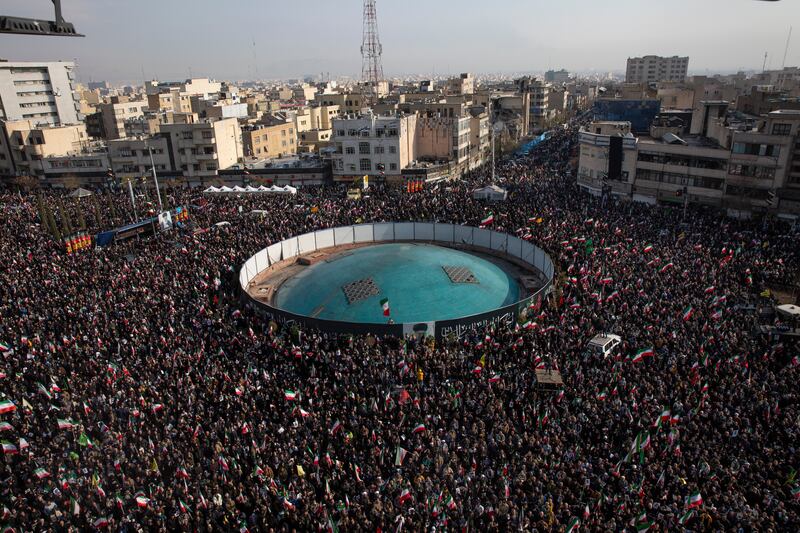
US and Israeli warplanes launched new waves of strikes on targets across Iran on Monday, as large crowds took to the streets in Tehran in a defiant show of support for Mojtaba Khamenei, the country’s newly appointed supreme leader.
The conflict, now in its second week, continued to escalate, with fresh Iranian missile and drone attacks targeting Israel, US bases across the Middle East and energy infrastructure in the Gulf.
In Lebanon, Israel pressed its offensive against Hizbullah with raids in the south and air strikes in Beirut, while an Iranian missile was shot down over Turkey. As drone strikes were reported in Bahrain, the United Arab Emirates and Saudi Arabia, President Emmanuel Macron said France and its allies were preparing a “defensive” mission to the Gulf protect oil supplies.
In Tehran’s Enghelab Square on Monday, thousands gathered to offer allegiance to Iran’s new supreme leader, hours after the appointment was formally announced.
Chanting “Death to America, Death to Israel,” and “God is Great,” some waved Iranian flags, others banners bearing the portrait of Ayatollah Ali Khamenei, the new leader’s father, who was killed after 37 years in power by an Israeli air strike in the first moments of the war.
Armoured vehicles lined nearby roads and security personnel were stationed on the rooftops of surrounding buildings. – Guardian
Government wary of acting too quickly on fuel prices, says Harris
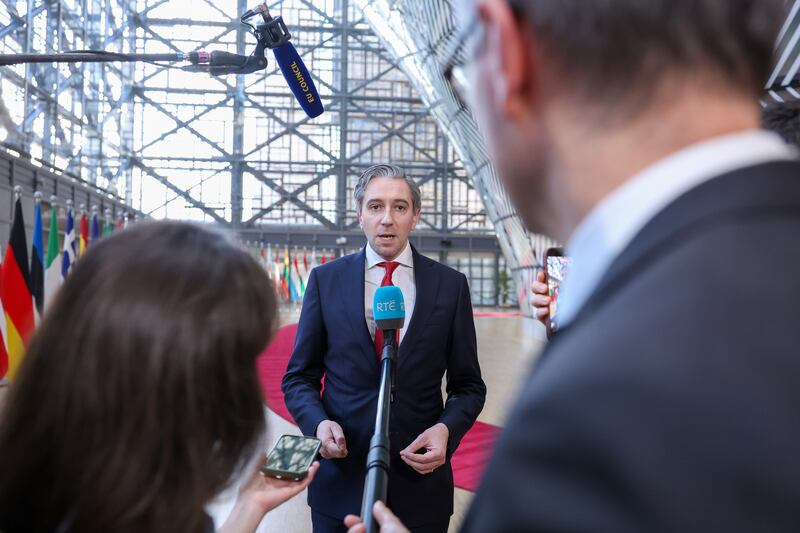
The Government wants to avoid rushing into any response to spiking energy prices that ends up being the “wrong” decision in the coming weeks, Tánaiste and Minister for Finance Simon Harris has said.
A significant rise in inflation would have a much wider economic impact than the current concerns about energy prices, he told Europe Correspondent Jack Power and other reporters in Brussels.
“So what we need to do is be very conscious of the fact that, if you got into a prolonged conflict in the Gulf region, the inflationary impact of that could be very significant for a whole swathes of the Irish economy,” Harris said.
“This is a conflict that is a week old, and at the moment it’s hard to predict whether this is something that lasts for a period of more days or weeks, or indeed something that lasts for months,” the Fine Gael leader said.
Harris was speaking on his way in to a meeting of euro zone finance ministers in Brussels, which will be dominated by discussions about how Europe might respond, should energy prices continue to spike.
Any economic intervention by the Government, or the EU, would need to look different in the event of a protracted war, he said.
“Something that could seem right this month could indeed turn out to be wrong next month. So we’re monitoring this situation very, very carefully,” he said.
“The best way of addressing cost issues is to increase supply, and we really need to see what can be done in relation to that in the hours and days ahead,” he said.
Government responds to President Catherine Connolly comments
The Government has responded to President Catherine Connolly’s intervention on Iran by reminding her that it has executive responsibility for foreign affairs, writes Irish Times Political Editor, Pat Leahy.
Speaking to political correspondents after the today’s Cabinet meeting, the Government’s official spokesman said that “successive governments have voiced support for international law” adding that this was “especially important for a small country”.
He said that the Government “fully respects the constitutional role of the President” but then went on to say: “It’s important to recall that the responsibility for foreign affairs rests with the Government.”
The spokesman declined to comment further but the statement is likely intended as a direct riposte to Connolly’s comments on Sunday when she condemned the “violations of international law” in the Gulf, which she said were “shocking and numbing”, adding, “but we cannot afford inaction.”
Though not naming the United States, the President’s words were taken as a clear message that she believes Ireland should speak out against US actions against Iran, just a week before the Taoiseach Micheál Martin visits president Donald Trump at the White House.
“What we have witnessed in recent days in the Middle East, and beyond, are not political disputes. They are deliberate assaults on international law, the international laws that have underpinned global peace for eighty years. We must name them as such, without euphemism and without equivocation,” she said. “Ireland is uniquely positioned to do precisely that.”
The Government’s response today, reminding the President of her role – and by implication of the limits of her role – is in contrast to its previous policy of not commenting on the interventions by Michael D Higgins.
Senior sources declined to discuss the issue citing the sensitivity of the issue, though did not contradict the suggestion that Government Buildings was intending to send a message to the Áras.
McEntee says second Abu Dhabi charter flight being arranged
Iranian footballers granted asylum by Australia, says Trump
Five members of the Iranian women’s football team have been granted asylum in Australia after reportedly escaping their government minders following a tournament, according to US president Donald Trump who announced the news on social media on Monday.
The US president said he had spoken to Australian prime minister Anthony Albanese who had told him that five members of the team had been “taken care of” amid fears they could be punished if they returned home.
Posting on Truth Social, however, Trump added that other members of the team, who have been in Australia for the Women’s Asian Cup, “feel they must go back because they are worried about the safety of their families, including threats to those family members if they don’t return”.
It is not clear how many Iranian players remained in Australia.
Speculation had mounted for days that some of the players would try to seek asylum in Australia after reports that they had been called “traitors” for refusing to sing their national anthem before their opening game of the Women’s Asian Cup which started in Australia last week. – Guardian
Message from the Editor

Trump says he has yet to decide whether to send troops into Iran
US president Donald Trump has said on Monday he is “nowhere near” to having decided whether to send US troops into Iran to secure any stockpile of highly enriched uranium there.
“We haven’t made any decision on that. We’re nowhere near it,” Trump told the New York Post when asked about reported discussions between Israel and the United States on possibly deploying special forces to Iran to seize and secure the material.
Without providing evidence, Trump said last month said Tehran was beginning to rebuild the nuclear program he had previously claimed was “obliterated” by US strikes in June of last year.
Iran denies seeking to establish a nuclear arsenal, saying its enrichment of uranium – a process that produces fuel for power plants and nuclear warheads depending on its duration – is strictly for civilian use. – Reuters
Turkey aiming to stay out of Iran war “blaze”, says Erdogan
Turkish president Recep Tayyip Erdogan said on Monday that Turkey’s main goal is to keep the country out of the “blaze” of the Iran war.
Turkey said earlier on Monday that Nato air defences had shot down a second Iranian ballistic missile that had entered its airspace and warned that it would move against any such threats.
Erdogan said that Turkey made the necessary warnings to Iran after the second missile was shot down.
Speaking after a cabinet meeting, Erdogan said Iran continues to take wrong and provocative steps. He added that Turkey will continue to take additional measures after deploying six F-16 jets in northern Cyprus on Monday. – Reuters
Kuwait held a military funeral on Monday for two interior ministry officials it said were killed “while performing their duty”.
The state – which hosts US military installations and has come under Iranian drone and missile fire during Tehran’s war with Israel and the US - said the–two men died early on Sunday, but did not go into further details.
Kuwait’s army separately said areas near the international airport were hit on Sunday and its forces had intercepted missiles and drones. – Reuters
The Israeli military on Monday said that it was unaware of any clash with Hizbullah fighters in eastern Lebanon, after the Iran-backed Lebanese group said it had fought Israeli soldiers approaching from Syria.
Hizbullah said in a statement that its fighters had observed 15 helicopters flying over eastern Lebanon just after midnight, dropping Israeli troops who were observed approaching Lebanese territory from an area on the Syrian side of the border.
It said that its fighters “confronted the helicopters and the infiltrating forces with appropriate weapons”. The Israeli military, however, said that it was unaware of any such incident.
Reuters was unable to immediately verify Hizbullah’s account. – Reuters
Nearly 700,000 flee homes in Lebanon, says UN
Escalating hostilities have forced nearly 700,000 people to flee their homes in Lebanon, a United Nations agency said on Monday, as the war between Israel and the Iran-backed Lebanese group Hizbullah entered a second week.
Lebanon has been pulled deep into the war in the Middle East since Hizbullah opened fire to avenge the killing of Iran’s supreme leader, igniting an Israeli offensive which has killed more than 400 people in Lebanon, according to Lebanese authorities.
Israeli strikes sent columns of smoke billowing from Beirut’s Hizbullah-controlled southern suburbs, and over the hilltops of southern Lebanon.
Security sources in Lebanon said Israeli air strikes hit five branches of a financial institution run by Hizbullah, Al-Qard Al-Hassan, in the southern suburbs after Israel announced it would act against it.
The Israeli military has ordered people out of the southern suburbs, a swathe of south Lebanon, and parts of the eastern Bekaa Valley region – all areas that have served as political and security strongholds of Shia Muslim Hizbullah.
“Mass displacement across Lebanon has forced nearly 700,000 people – including around 200,000 children – from their homes, adding to the tens of thousands already uprooted from previous escalations,” Edouard Beigbeder, Unicef regional director, said in a statement.
“Children are being killed and injured at a horrifying rate, families are fleeing their homes in fear, and thousands of children are now sleeping in cold and overcrowded shelters,” he said.
Lebanon’s health ministry reported on Sunday that the dead in Lebanon included at least 83 children and 42 women. The toll does not otherwise distinguish between combatants and civilians. – Reuters
G7 ministers signal they are ready to release oil reserves
The finance ministers of the G7 countries said on Monday that they were ready to take “necessary measures” to support the global supply of energy, which could include the releasing of stockpiles, following the current conflict in the Middle East and its effects on the oil and gas prices.
“We stand ready to take necessary measures, including to support global supply of energy such as stockpile release,” they said in a statement after France hosted a video call on Monday – Reuters
New York investigates possible Islamic State-inspired terrorism incident
New York City’s police commissioner said authorities are investigating whether an incident in which two men allegedly brought improvised explosive devices to a protest outside the mayor’s residence in New York was an act of “Isis-inspired” terrorism. Isis is also known as Islamic State.
New York Police Department commissioner Jessica Tisch said at a news conference on Monday that the devices, which didn’t detonate, could have caused serious injury or death. The men are in custody, Tisch said.
“The department has determined that these were improvised explosive devices made to injure, maim or worse,” mayor Zohran Mamdani said at the news conference.
Tisch said police are working with federal prosecutors and the Federal Bureau of Investigation on the case. Officials from the US attorney’s office for the southern district of New York are expected to hold a news conference on their investigation of the incident on Monday afternoon. – Bloomberg

World body calls for emergency oil reserves to be released
The International Energy Agency (IEA) called for a co-ordinated release of emergency oil reserves during an online meeting with Group of Seven (G7) finance ministers on Monday, Japanese Finance Minister Satsuki Katayama told a briefing.
“IEA called for each country to do a co-ordinated release of oil reserves,” Katayama said.
“In response to the current situation ... the G7 has agreed to continue closely monitoring developments in the energy market and to take necessary measures to support global energy supply, including the release of oil reserves.”
The ministers and IEA were joined by executives from the Organisation for Economic Cooperation and Development, as well as from the World Bank and the International Monetary Fund, Katayama said.
The G7 will hold a meeting of energy ministers soon to discuss further steps, Katayama added – Reuters.
French president Emmanuel Macron has said the attack on Cyprus by Iran is also an attack on all of Europe.
Speaking during a visit to the island after it was targeted by Iranian-made drones, Macron said the defence of Cyprus was important not just for France, but the entire EU.
He said: “When Cyprus is attacked, it is Europe that is attacked.”
Speaking alongside the prime minister of Cyprus Nikos Christodoulides and Greece’s prime minister Kyriakos Mitsotakisi, Macron added: “The defence of Cyprus is obviously a key issue for your country, for your neighbour, partner and friend, Greece, but also for France and, with it, the European Union.”
Mitsotakis urged Europe to be ready for increased refugee flows from the war on Iran.
He also called for European nations to boost EU naval force resources.
Oil remains at $100 a barrel
Oil smashed through $100 a barrel as Saudi Arabia joined other major Middle East producers in cutting output, with a standstill of tanker traffic through the vital Strait of Hormuz choking off supplies to the rest of the world.
Brent traded 10 per cent higher around $102 a barrel. Prices eased from almost $120 earlier as the world’s largest economies consider a co-ordinated release of emergency oil stockpiles, with Group of Seven finance ministers set to discuss the move on Monday.
Saudi Arabia is beginning to cut oil production as its storage tanks fill up, according to a person familiar with the situation, following similar moves in neighbouring countries.
The kingdom has been diverting supplies via a pipeline to the western Red Sea port of Yanbu, but does not have enough capacity to fully replace export volumes that typically transit through the Strait of Hormuz.
The war in the Middle East is showing no signs of abating after US and Israeli strikes on Iran more than a week ago, and the fallout is stoking fears of an inflation crisis.
The halt to shipping through Hormuz – a narrow waterway that normally handles a fifth of the world’s oil – along with attacks on key energy infrastructure have also driven up prices of natural gas and diesel. – Bloomberg
Government likely to stall on help with higher energy bills
The issue of the increase in energy prices was the subject of discussion at Monday’s Cabinet meeting, although it was not an agenda item, writes political correspondent Harry McGee.
No specific action was recommended at this time. A Government source said the situation will continue to be monitored in the coming days.
It is understood the Government is of the view that the response to the hike in energy prices will need to come at a European level.
The issue is likely to dominate the meeting today in Brussels involving finance ministers from all 27 EU states. A meeting of EU foreign ministers will take place next Monday in advance of next week’s full summit meeting.
In 2022, the Government took action to counter steep hikes in energy prices one month after the invasion of Ukraine, said the source.
While the Opposition parties have called for immediate action, it is understood the Government wants to wait to see the shape of the proposals for a Europe-wide response.
Saudi oil giant Aramco cuts production by 20 per cent
The US-Israeli war on Iran and Tehran’s attacks on Gulf neighbours have disrupted oil and natural gas exports from the Middle East and forced production stoppages.
Saudi oil giant Aramco became the latest oil producer to cut output on Monday, sources told Reuters. The war has halted shipments via the world’s most important oil artery, the Strait of Hormuz, which handles 20 per cent of global oil and LNG supply.
Iranian embassy congratulates new supreme leader
The Iranian embassy in Ireland has extended its “heartfelt congratulations” to Ayatollah Mojtaba Khamenei, the new supreme leader of Iran.
The embassy described the elevation of the son of the former supreme leader Ayatollah Ali Khamenei as a “worthy appointment”.
In a social media post on X, the embassy added: “This selection was made under sensitive wartime conditions and in fulfilment of the responsibilities stipulated in Articles 107 and 108 of the Constitution of the Islamic Republic of Iran.
“The Embassy of the Islamic Republic of Iran in Dublin prays to Almighty God for the continued honour, health, and success of the supreme leader, as well as the progress and prosperity of the great nation of Iran.” You can view the post here.

Is the Dubai dream dead for Irish migrants?
Despite its perilous location, Dubai has generally been insulated from the wars and conflicts that intermittingly roil the region.
But no matter how much the “rhinestone emirate” portrays itself as an Instagrammer’s paradise, there is no escaping the geography that places it in the middle of the region’s fiercest fault lines: the Sunni/Shia divide, and Israel and Iran’s murderous mutual obsession.
Read former resident Raymond Barrett’s account of how Dubai’s dream has already died for many Irish migrants there.
US stocks likely to drop further at the opening of trading
US stocks are poised to extend a sell-off after the biggest weekly drop since October, as the prospect of a prolonged war in Iran sent energy prices soaring and stoked fears over inflation.
S&P 500 Index futures dropped 1.1 per cent as of 7.44am Monday in New York, while contracts on the Nasdaq 100 declined 1.1 per cent. Brent crude soared 13 per cent to $104 a barrel as Saudi Arabia, the world’s largest oil exporter, started to reduce oil production. The move by the kingdom follows the United Arab Emirates, Kuwait and Iraq.
“Stagflation fears are hitting global markets as they are having trouble forecasting the length and intensity of oil and gas interruptions,” said Dec Mullarkey, managing director at SLC Management.
“The stress and volatility is unlikely to recede until there is some visibility on an end game or at a minimum, safe shipping.” – Bloomberg
Financial and energy markets have been nervous ever since the US/Israeli attacks on Iran, writes Cliff Taylor.
On Monday, these nerves led to a touch of panic, as Brent oil prices soared briefly to $119 in early trading – the highest since 2022- and Far East stock markets took a heavy hit.
Talk of the return of “stagflation” – high inflation and low growth – is unnerving investors. Consumers, already seeing higher heating oil and petrol prices, look on.
By midmorning things calmed down a little bit. The key piece of news was that the G7 finance ministers – under the aegis of the International Energy Agency – will discuss the possible release of international oil reserves which are held in storage by most of the big countries, including the US.

What now for Taoiseach Micheál Martin’s visit to Washington next week?
US president Donald Trump’s all-out war on Iran has raised the stakes further for Taoiseach Micheál Martin when he visits the White House next week.
Here’s Paul Colgan’s analysis of the dilemma the Taoiseach faces especially after President Catherine Connolly said the joint US/Israeli attack was an assault on international law.
Nato air defences in the eastern Mediterranean have shot down a second ballistic missile that was fired from Iran and entered Turkey’s airspace, the Turkish defence ministry said on Monday, warning that it will take necessary steps without hesitation.
This marks the second Iranian ballistic missile that has targeted Nato member Turkey in the last week.
In a statement, the ministry said some ammunition parts had fallen in the southeastern province of Gaziantep and that there were no casualties in the incident. It called on all parties to adhere to Ankara’s warnings. – Reuters
Hauliers demand suspension of the carbon tax
The Irish Road Haulage Association (IRHA) has threatened to bring the centre of Dublin to a halt before St Patrick’s Day because of rising fuel costs.
IRHA president Ger Hyland told RTÉ’s Today with David McCullagh programme the Government needed to suspend the carbon tax while the crisis in the Middle East is ongoing.
Hyland said the cost of diesel for one of his members had gone up by €9,000 in the nine days since the conflict between the US, Israel and Iran started.
He said his sector had paid more than €1 billion since the carbon tax was introduced in 2010 “and got nothing in return”.
No sector is more heavily taxed, he claimed, and 65 per cent of the price of fuel goes back to the Government.
“The big profiteers from all of this is the Government and it is time they gave back because it is going to put our members out of business.”
Zelenskiy seeks US Patriot missiles in return for drone help in Middle East
Ukrainian president Volodymyr Zelenskiy is trying to leverage his nation’s war savvy to keep it on the world’s agenda as the Iran conflict increasingly absorbs the attention of president Donald Trump, putting the US-brokered peace talks with Russia on indefinite hold.
On Thursday, he offered to share his country’s expertise in protecting against explosives-laden Iranian drones, which are swarming the defences of the US and its Middle East allies.
“Our appeal is very simple: we would like to fill our deficit of Patriot missiles and supply a certain number of interceptors,” Zelenskiy told reporters in Kyiv.
Earlier, he had suggested the Arab states could help persuade Vladimir Putin to agree to a ceasefire, giving Kyiv free hands to dispatch anti-drone specialists to the Middle East. He said he had fielded a frenzy of calls from Gulf leaders in recent days, as well as US requests for sharing expertise.
Zelenskiy said in a post on X late on Thursday that Ukraine received a request from the US to help protect the Middle East region against Iran’s “Shahed” drones. The president gave instructions to provide the necessary means and to ensure the presence of Ukrainian specialists who can “guarantee the required security.” – Bloomberg
Putin congratulates new Iranian leader
Russian president Vladimir Putin congratulated Mojtaba Khamenei on his appointment as Iran’s new leader, the Kremlin said on Monday.
Putin said he was confident Khamenei would continue his father’s work “with honour” and unite the Iranian people “in the face of severe trials”.
He added that Russia would continue to stand by Tehran, saying he wished to “confirm unwavering support for Tehran and solidarity with our Iranian friends.” – Reuters
Japan has reportedly told its national oil reserve storage site to be prepared to release crude as the Iran crisis deepens.
Akira Nagatsuma, senior Japanese parliament member, told Reuters that an official at the Shibushi national oil storage base had received a directive from the country’s Agency for Natural Resources and Energy on Friday.
Japan relies on the Middle East for around 95 per cent of its crude supplies, with roughly 70 per cent shipped through the Strait of Hormuz, which has been effectively closed following US and Israeli attacks on Iran.
Japan built up its own national reserve after the 1970s oil crisis nearly brought its economy to its knees. – Reuters

Iranians living abroad ‘could have property confiscated’
Iranians living abroad could have property confiscated and face other legal penalties if they express support for the United States and Israel, the Iranian prosecutor general’s office said on Monday.
Some members of the Iranian diaspora who want political change in Tehran took to the streets of European and American cities to celebrate the killing of supreme leader Ayatollah Ali Khamenei in the US-Israeli war against Iran. Iran on Monday named Mojtaba Khamenei to succeed his father.
“A warning has been issued to those Iranians living abroad who in different ways sympathise, support or co-operate with the American-Zionist (Israeli) enemy,” the prosecutor general’s office was quoted as saying by state media.
“They will be met with the confiscation of all their properties and other legal penalties in accordance with the law.”
Newly established channels on Telegram have shared details of prominent Iranians living abroad who have posted comments critical of Iran’s clerical authorities and supportive of the US-Israeli military campaign that began on February 28th.
Up to five million Iranians live abroad, the majority of them in the United States and western Europe, according to Iranian government data. Iranian media put their numbers closer to 10 million.
UK PM calls for de-escalation
UK prime minister Keir Starmer has defended his decision to send British military assets to the Gulf.
Starmer was criticised by US president Donald Trump for not allowing the US to use the Diego Garcia base to attack Iran.
He has since given permission to the Americans to use bases in Cyprus, but only to protect Gulf allies who are being attacked by Iran.
Starmer said there needed to be a way to de-escalate the situation in the Gulf.
He was “acutely aware” of the potential impact of the conflict on the cost of living.
He said he had experience growing up of his family not being able to pay the bills. “I know personally what that feels like and what people are going through.”
Quds back Iran’s new supreme leader
The Islamic Revolution Guards Corps’ elite Quds Force has pledged allegiance to new Iranian supreme leader Mojtaba Khamenei.
Quds is the Iranian equivalent of the Central Intelligence Agency and was designated a terrorist organisation by the United States in 2019 as it is the chief liaison group between the Iranian state and its proxies in the Middle East: Hizbullah, Hamas and the Houthis.
In January 2020 the first Trump administration assassinated then-leader of Quds Qasem Soleimani.
In a statement issued this morning, Quds said: “The fighters of the boundless front of truth will stand firm with all their might against the oppressors and in defence of the oppressed.”

Iranian activist: Ireland can help Iran transition to democracy
A prominent Iranian activist has suggested Ireland could play a role in helping Iran to transition towards being a democratic state.
Negin Shiraghaei is a former BBC Persian TV presenter and the founder and director of Azad Network, a grassroots initiative committed to promoting alternative voices to the current Iranian government.
She is in Ireland as a guest of Caradem, a not-for-profit pro-democracy organisation cofounded by two former ministers for foreign affairs, Simon Coveney and Eamon Gilmore.
Caradem chief executive Catherine Heaney said the organisation wanted to work with Shiraghaei to build democratic alternatives that could fill a void in the event of the current Iranian regime falling as a result of the US-Israel attacks.
You can read the full story here.
Video evidence suggests strike on girls’ school was by the US
The New York Times has provided compelling evidence that the missile that hit a primary school in Iran killing 175 people was fired by the United States military.
A newly released video adds to the evidence that indicates it was an American strike despite US president Donald Trump’s assertion that it was most likely a “friendly fire” incident by Iran.
The video, uploaded on Sunday by Iran’s semi-official Mehr News Agency and verified by the New York Times, shows a Tomahawk cruise missile striking a naval base beside the school in the town of Minab on February 28th. The US military is the only force involved in the conflict that uses Tomahawk missiles.
A body of evidence assembled by the Times – including satellite imagery, social media posts and other verified videos – indicates that the Shajarah Tayyebeh elementary school building was severely damaged by a precision strike that occurred at the same time as attacks on the naval base. The base is operated by the Islamic Revolutionary Guards Corps.

Share markets nosedived in Asia on Monday as the inflationary jolt from surging oil prices threatened to raise living costs and interest rates across the globe, while investors desperate for liquidity fled to the US dollar.
Brent crude soared 27 per cent to $117.58 a barrel, the biggest daily gain since at least 1988, which came on top of a 28 per cent rise last week. US crude shot up a staggering 28 per cent to $116.51, promising to push petrol prices quickly skyward.
You can read more here.

Trump envoys plan meeting with Netanyahu in Israel
Donald Trump’s envoys Steve Witkoff and Jared Kushner are planning to travel to Israel on Tuesday and meet Israeli prime minister Binyamin Netanyahu, according to an Axios reporter.
Barak Ravid’s post on X cited a “US official and a source with knowledge”.
The plan is yet to be officially verified.
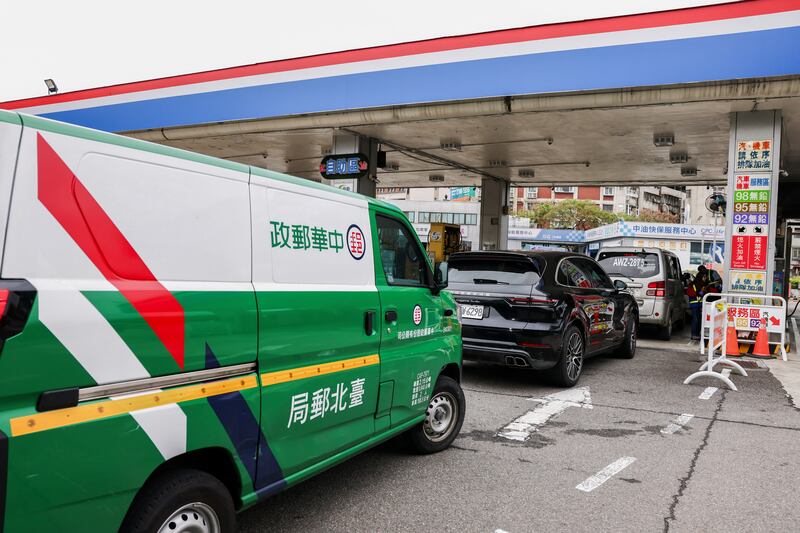
Oil prices rise above $100 a barrel
Share markets nosedived in Asia on Monday as the inflationary jolt from surging oil prices threatened to raise living costs and interest rates across the globe.
Brent crude soared 27 per cent to $117.58 a barrel, the biggest daily gain since at least 1988.
Read more here.

Saudi Arabia warns Iran it would be ‘the biggest loser’ if it continued to attack Arab states
Saudi Arabia warned Iran it would be “the biggest loser” if it continued to attack Arab states, hours after Iran had named its new supreme leader.
US president Donald Trump said the announcement of Mojtaba Khamenei, a son of the late supreme leader, as the Islamic Republic’s next ruler, was “unacceptable”.
Saudi Arabia’s statement came after a new drone attack apparently targeted its massive Shaybah oilfield and followed comments by Iranian president Masoud Pezeshkian on Saturday that said Iran had halted its attacks on Gulf Arab states.
“The kingdom affirms that the Iranian side has not implemented this statement in practice, neither during the Iranian president’s speech nor afterward,” Saudi Arabia’s foreign ministry said in a statement.
“Iran has continued its aggression based on flimsy pretexts devoid of any factual basis.”
It added the Iranian attacks mean “further escalation which will have grave impact on the relations, currently and in the future”.
The US state department issued an order for non-emergency staff and families to leave Saudi Arabia after it announced a US service member had died of injuries sustained during an Iranian attack on the kingdom.
Saudi Arabia’s Civil Defence also confirmed on Sunday that a military projectile that fell on to a residential area killed two foreign-born residents and wounded 12 others – all from Bangladesh – in Al-Kharj governorate, the first casualties of the war reported in the country. – PA

Israeli military launches fresh wave of strikes as Mojtaba Khamenei named as Iran’s new supreme leader
The Israeli military said it launched a wave of strikes targeting “regime infrastructure” in central Iran on Monday, the first such announcement since the appointment of the new Iranian supreme leader, Mojtaba Kahmenei.
The military also announced strikes on Iran-backed militant group Hizbullah in Lebanon.
Iranian state media also showed a projectile said to be launched at Israel bearing the slogan “At your command, Sayyid Mojtaba”, using an Islamic honorific.
Mojtaba Khamenei’s elevation marks the first time since the 1979 Islamic revolution that Iran’s supreme leadership has passed from father to son. It is a development likely to ignite debate inside Iran about the emergence of a dynastic system in a state founded explicitly to overthrow hereditary rule after the shah.
Ayatollah Ali Khamenei, who ruled for 37 years, was killed in a US-Israeli strike on Tehran on February 28th, on the first day of the war with Iran.


