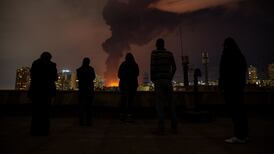
Israel has ordered hundreds of thousands of Lebanese from their homes in predominantly Shia areas, sparking a government backlash against Hizbullah and Iranian influence within the country.
While there has been a marked decrease in the number of projectiles fired by Iran at Israel each day since the start of the war on Saturday, the clashes in Lebanon have been steadily increasing since Hizbullah’s initial attack on Monday in response to the killing of Iran’s supreme leader Ayatollah Ali Khamenei.
On Wednesday, Israel ordered some 700,000 residents of southern Lebanon to evacuate the entire area south of the Litani river, in advance of what appears to be a move to set up a new buffer zone north of the Israel’s border.
Israel Defense Forces (IDF) forces have advanced beyond the five outposts that were maintained on the Lebanese side of the border following the November 2024 ceasefire and the Lebanese armed forces have pulled back 10km north of the border. The United Nations Interim Force in Lebanon, or Unifil, remains deployed in its positions and has not interfered with IDF operations.
READ MORE


On Thursday afternoon, the IDF Arabic language spokeswoman ordered residents of Beirut’s Hizbullah stronghold Dahiyeh to leave the neighbourhood en masse, in advance of heavy Israeli air strikes.
At the same time, Lebanese prime minister Nawaf Salam said he had ordered authorities to prevent any military activity by Iran’s Revolutionary Guards in Lebanon and the Lebanese council of ministers declared that visa requirements for Iranians entering Lebanon would be reintroduced.
The central government in Beirut is angry that Hizbullah fired rockets and launched drones at Israel, again dragging the country into war when it is still recovering from the 13-month conflict that broke when the militant group opened a second front the day after the Hamas attack from Gaza in October 2023.
[ How Israel and the US are co-ordinating their attackOpens in new window ]
On Monday, Salam announced that Hizbullah’s military activity was illegal and forbidden, ordering the Lebanese army to prevent any fire from Lebanese territory toward Israel and to arrest anyone attempting to initiate such an attack. Hizbullah fighters have ignored the new restrictions but it appears that both the Israeli and Lebanese governments now seek to weaken and disarm Hizbullah.
Hizbullah leader Naim Qassem said in a televised speech that the group would confront what he described as an Israeli plan of “occupation and expansion”.
“For us, this is an existential defence,” he said.

He responded to Israeli strikes in Lebanon, saying they were not a reaction to the rockets fired by the group, but rather a pre-planned aggression.
As long as there was an occupation, he said, “resistance and its weapons are a legitimate right from a legal, international, and constitutional point of view”.
Israeli officials say the aggressive military operation against Hizbullah is placing significant pressure on the group among its Shia base. Hizbullah supporters, who have not yet received compensation from the previous fighting, are now dealing with damage from renewed clashes and financial support from Iran has dried up.
The head of IDF northern command, Maj Gen Rafi Milo, said Hizbullah made a major mistake by joining the fighting, falling into Israel’s “strategic ambush”. “We will not stop until it receives a very heavy blow,” he said. “We will hit the organisation with force across Lebanon – whether in Beirut, Tyre or Sidon.”
[ How might the war in the Middle East end?Opens in new window ]
Lebanese armed forces have already acted to disarm Hizbullah south of the Litani and are now due to act north of the river, where it is believed the organisation maintains long-range missile stockpiles, ammunition depots and production facilities.
It is unclear how the group will react but with the future of the Iranian regime now in doubt, many in Lebanon are questioning if Hizbullah can survive.