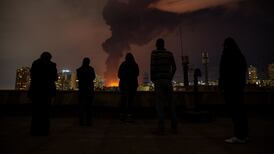
US president Donald Trump has said the objective of the United States-Israel war on Iran is regime change, but such an outcome is uncertain.
The Iranian regime has deep roots and has the protection of loyal civilian and military assets which have a stake in the survival of the Islamic republic.
Trump announced his intention to achieve regime change by claiming that since 1979, Iran’s revolutionary regime has threatened the US and its regional interests. Without evidence, he argued Iran could develop intercontinental ballistic missiles capable of targeting the US.
Although he said Iran’s nuclear facilities were “obliterated” in June’s US-Israeli attacks on Iranian sites, he continued to contend Iran is on the brink of developing a nuclear weapon.
READ MORE


Some Iranians say their country might have been a stable democracy if the US had refused Britain’s 1953 call to overthrow elected prime minister Mohammad Mosaddegh who had introduced land reform, social security and higher taxes on the rich and middle classes.
Oil became a major source of conflict when Mosaddegh initiated measures to nationalise the Anglo-Iranian oil company. He was motivated by popular pressure to take this step because Iran received less than 17.5 per cent of profits while the company enriched itself at Iran’s expense. Workers received low pay, no benefits and lived in shacks without electricity and water.
After Mosaddegh was ousted, in 1953, Shah Mohammed Reza Pahlavi took power and negotiated a 25-year deal with Britain which gave a consortium of western oil companies 50 per cent ownership of Iranian oil production as well as control of oil facilities, reserves, investment, field operations, exploration, development, levels of production, refining, and transport.
The consortium was the only customer for Iranian crude oil and natural gas and could set prices. As US companies held 40 per cent of shares, Washington obtained major influence on this sector of Iran’s economy until the Shah was overthrown in 1979.
Oil once provided Iran with 85–90 per cent of all export earnings and the government with 60 per cent of total revenues. Oil and gas still contribute 25 per cent of Iran’s GDP despite US and international sanctions.
The revolutionary government, which took power in 1979, cancelled agreements with the consortium and established the Iranian National Oil Company. The 1980-1988 war with Iraq severely cut production and it took the company two decades to produce four million barrels a day, well below pre-1979 levels. Oil exports shrank dramatically due to sanctions when radical students invaded the US embassy and held staff for 444 days.
Sanctions were reimposed in 1987 due to Iran’s sponsorship of Lebanon’s Hizbullah, Iraq’s Shia militias, Yemen’s Houthis, and Syria’s Assad government.
In 1995 sanctions were expanded to punish governments, firms, and individuals doing business with the Iranian government.
Comprehensive sanctions were imposed in 2006 when Iran refused to halt uranium enrichment under its nuclear programme which the US claimed could enable it to manufacture nuclear bombs.
Iran argued its nuclear programme was to provide fuel for electricity and medical purposes.
In June 2025, the US and Israel bombed Iranian nuclear facilities at Fordow, Isfahan and Nantaz, and International Atomic Energy Agencyinspectors have since been refused entry to Iran.