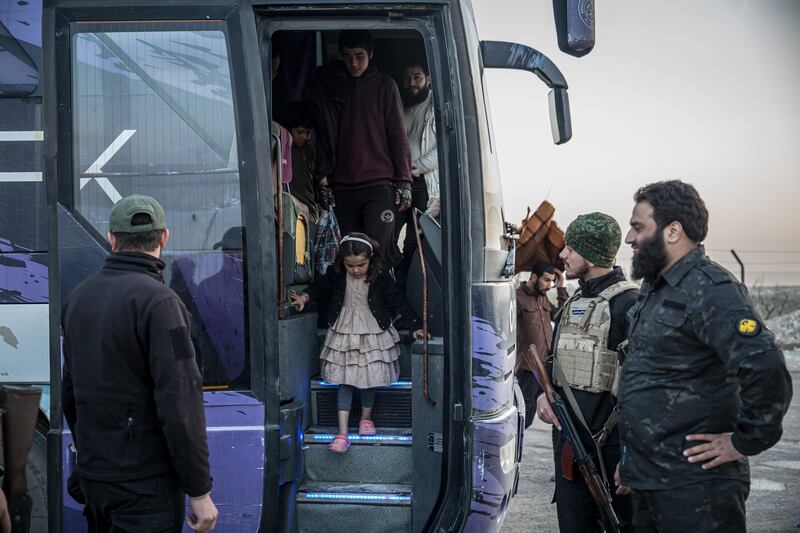
The bus doors opened and its passengers began to slowly disembark. There were elderly people on crutches; women carrying crying babies; little girls and boys; a child hugging a cat. They had travelled for more than 12 hours, they said, with little or no food and children vomiting from travel sickness.
They were among the roughly 300 people accused of affiliation with Islamic State, also known as Isis, moved by authorities from the notorious Al Hol detention camp in northeast Syria to a new camp – Aq Burhan – hundreds of kilometres away in northwest Syria this week. Roughly 2,000 people are expected to be relocated in total, a security official said. Most were Syrians, he said, though some could be heard speaking Russian.
Representatives from the UN Refugee Agency were present for their arrival as well as local organisations. It was not clear what role each will have in the future.
The notorious Al Hol camp, once home to tens of thousands of people detained for years without charge or trial, is said to be almost empty after Syrian government forces took over the area from the Kurdish-led Syrian Democratic Forces (SDF) in January.
READ MORE


At the time, Tom Barrack, the US envoy to Syria, said the role of the SDF as the “primary anti-Isis force on the ground” has “largely expired” and that the future of the region lay “in the post-Assad transition under the new government led by president Ahmed al-Sharaa”.

The Damascus government was “willing and positioned to take over security responsibilities”, including overseeing Islamic State detention facilities, he said.
In the following weeks, former residents told The Irish Times that Syrian security forces allowed many detainees to leave, while others escaped or were smuggled out. The government is not allowing journalists to visit Al Hol.
One woman transferred to the new camp – in Aleppo governorate – said she agreed to move because the government said it was necessary to “process our papers ... I hope we won’t stay 10 years like before”.
Many of those in Al Hol – like elsewhere across Syria – have no official identification papers or other documents such as marriage certificates, due to obstacles around registration and bureaucracy in a country split by war for 14 years, and fear of Bashar al-Assad’s regime.
The woman said others in Al Hol had been “too impatient to wait for the process”, and that few were left now except “families waiting to be picked up by other vehicles”.
Other women began speaking, saying they were worried they had done the wrong thing by coming there. A security official reassured them, saying: “Soon you will go home, don’t worry.”
A man who gave his name as Abu Khatab, who had arrived with his two wives and children, said it was his children’s first time out of Al Hol and they were “so surprised coming here, they never saw anything like this before”.
He said life in Al Hol was difficult, with regular arrests, patrols and raids by the SDF, and prohibitions on communication with relatives outside.
“We were displaced people ... They accused us of being Isis. We are poor people, we want to live a simple life.”
He said they left with nothing: now he needs both his documents and a work opportunity.

An official from the Syrian security forces, who did not want to be named, said more arrivals will come in the next few days, mostly Syrians.
He would not confirm if camp residents were prohibited from leaving. “It’s too early to speak about the next steps,” he said.
They had been transferred for their own safety and due to the general chaos of the situation in Al Hol, he said, and in this new area “they are strangers and they don’t know the villages ... They need a bit of awareness and then we can integrate them into society”.
One of the women transferred said her family lived less than 30km from the new camp, which is in an area previously known as an opposition stronghold against the ousted Assad regime, and is close to the Turkish border.
“I want to live a normal life,” the 41-year-old said. “I have nothing to do with Isis. We believe in the government, they have good intentions but we don’t want anyone to lie to us.”
She hung her head. “I’m really crying,” she said. “I can give you the phone number of my father and he’d say ‘where is she? I can come and pick her up and take her home’. Why should I spend Ramadan without my family?”

There were already Syrians staying in Aq Burhan camp when the hundreds of former Al Hol detainees arrived. Some stood at the front of their accommodation, seemingly stunned and questioning what was going on. Two women and a man said the authorities had transferred them from the Bab Al Salame camp in A’Zaz District, following bad flooding there. They were given no warning about the arrivals from Al Hol, they said.
“We are afraid, we don’t know anything, maybe you can tell us,” one woman said, adding they have nowhere else to go. “We got brought here from the unknown.”
The woman beside her said they had been promised money to leave Bab Al Salame, but got nothing in the end, not even blankets or food. “How would we deal with these people? Should we talk to them, should we avoid them? That is our concern,” she said.


Back by the entrance of the camp, the former Al Hol detainees were offloading possessions from a Syrian Arab Red Crescent truck: mattresses, a wheelchair, some trays and plates for food. Security forces began handing around bread and plastic bags filled with other foodstuffs.
“It’s so dirty, they tricked us. They showed us a video but it was different,” said one woman, after entering her new shelter, a small prefabricated building with a main area, a bathroom and another small section at the back.
“At the end we’re human beings, we’re not monsters as they depict us,” said the woman beside her.
“I just want to interact with humans,” said a 30-year-old, who said she was confused about why they were transferred when others just went home. “Why are they bringing us here?”
Hani Alagbar assisted with reporting.