As a youth in Dorset, England, Eddy Scott was interested in two things: sailing and conflict. He took up a career as a sailor on super yachts and was approaching the rank of captain, working for the rich and famous. “The most pointless job in the world,” he laughs. “That’s why I came here.”
When Russia staged the full-scale invasion of Ukraine on February 24th, 2022, “straight away my reaction was ‘I’ve got to do something. I’ve got to go there’,” he said.
Why Ukraine? I ask Scott. “I always said I didn’t have a dog in the fight. It wasn’t my country. I wanted adventure. It’s not every day you get a war in Europe. I needed to be part of it. And it was only after getting here and realising what this was and what Ukraine was ... the ‘Why’ of it I found once I got here.”
In 2022, Scott finished the summer yachting season, returned to the UK, bought a truck and drove it to Ukraine. He had no military experience, so he freelanced for humanitarian organisations, rebuilding roofs in liberated areas of eastern Ukraine and evacuating civilians from combat zones.
READ MORE


On January 30th, 2025, Scott was driving an armoured van out of Pokrovsk, several kilometres from Russian lines. The van was marked as a humanitarian vehicle. He and his team wore white smocks over their flak jackets. They stopped briefly to hand evacuation leaflets to civilians by the roadside.
As Scott climbed back into the van, he heard a drone overhead. A few seconds later, an armour-piercing anti-tank round shot through the armoured bulkhead and Scott’s seat, tearing off his left arm at the shoulder and mangling his left leg.
In the ambulance that took him to Dobropillia for surgery, Scott felt his life seeping away. “I knew my arm was gone because I couldn’t feel it any more. The artery in my leg was open. I knew if I didn’t get to hospital fast, I wouldn’t make it. I was lying there and I thought, ‘If I die, I die in a good way. I’ve done what I believe in’. That day we saved five people and a dog.”
Offers of medical evacuation to the best hospitals in the world poured in, but Scott chose to stay in Ukraine. “I said if I’m not taking a bed from a Ukrainian, I want to stay in Ukraine. That was before I knew about Superhumans [the medical centre for amputation victims where he underwent rehabilitation, and which now employs him]. I knew this was my home, that if I left Ukraine, coming back as a double amputee would have been very difficult.”
The overarching theme of my story is luck
— Eddy Scott
It seems strange at first to hear a 29-year-old double amputee talk about good fortune. “The overarching theme of my story is luck,” he says. “I’m right-handed. I use my right leg to drive, so I still have my dominant side to drive. I didn’t have any head injury. Everything else on me is okay. I took a direct hit from an anti-tank round, and I came out of it exactly the same person, just missing an arm and a leg.”
Fifteen months after the attack, Scott lives independently in Lviv, travels a great deal and has a sense of purpose. His unrelenting optimism is an act of resistance.

When Ukrainians see amputees, Scott says, they show gratitude by putting a hand on their heart and saying thank you. Elsewhere, people are curious and show pity. “Once I explain my story and I explain that I’m comfortable with the injuries and everything, it turns into admiration.”
Back in England, Scott’s parents are relieved he’s no longer on the frontline. “They’ve become more supportive of Ukraine, which is good. Before I was injured, if I wanted to talk about Ukraine, my Dad stopped the conversation. He said, ‘It upsets your mum’. After I was injured, my dad came to Ukraine, which was a shock, because he’s the most boring man you’ll ever meet. He’s an accountant. I would never ever have imagined him coming to a war zone. He saw Ukraine, met my friends, was taken around Kyiv by someone who was at Maidan and explained how people were shot there. He became more supportive of the concept of the war, though he still doesn’t understand why I chose to come here.”
An ordinary prosthetic leg costs about €7,000 and is provided, like all services at Superhumans, for free. Amputees who want state of the art appendages must raise funds. Again, Scott considers himself lucky. A German who, like Scott, loves sailing, read about him and donated €70,000 for a myoelectric knee. Scott bounds up and down stairs on his pogo stick-like prosthesis. He displays it proudly by wearing his trousers rolled up or zipped off at the knee.
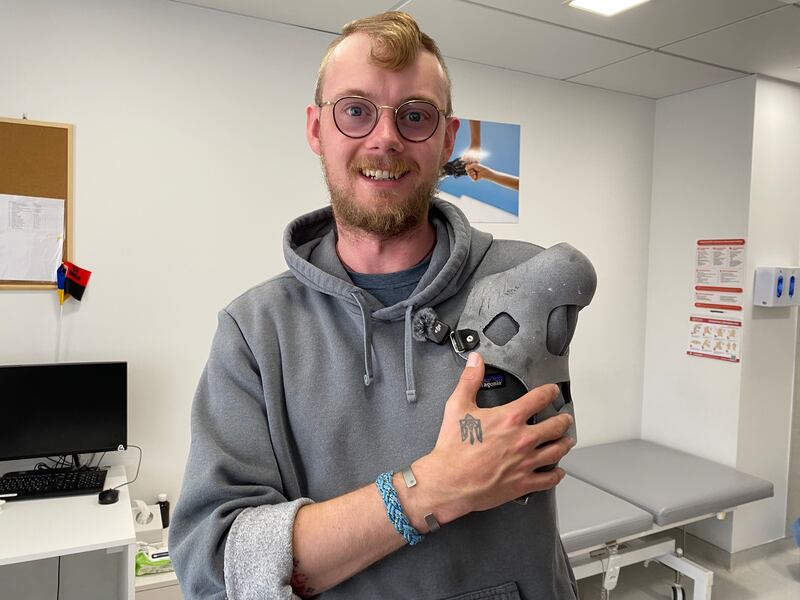
Scott is so engaging that Superhumans made him their ambassador to the English-speaking world. Because most of his shoulder bone was blown away, the new arm he recently received must be strapped on to his chest with a corset. He has a pirate’s hook instead of a left hand.
I survived a direct tank hit. That’s bad ass
— Eddy Scott
“There are of course big disadvantages to losing two limbs,” Scott admits. “But I don’t see the disadvantages. I came out of it in a positive way. I survived a direct tank hit. That’s bad ass.”
Superhumans have provided prostheses for about 4,000 amputees, of an estimated 100,000 in Ukraine. The US billionaire philanthropist Howard Buffet is their principal donor.

Superhumans seeks to instil pride and renewed confidence in wounded men and women. The emblems of Ukrainian army units whose amputees have joined Superhumans cover a wall, opposite a row of trophies and sports medals. Graduates are referred to as Supers. They compete in the Invictus games, swim across the Bosphorus Straits. One triple amputee climbed Ukraine’s highest mountain. Scott has participated in two international sailing competitions.
Fellow amputees shake hands with Scott or give him a thumbs up as we walk around the centre. We say hello to Ruslana, an attractive young woman who was a 19-year-old soldier when a Russian glide bomb destroyed her leg. With a prosthesis from Superhumans, she won Dancing with the Stars and became a professional model.
We visit the workshop, where sockets for new limbs are made with 3D printers. In the gym, a man runs on prostheses between parallel bars. A triple amputee floating on a buoy in the swimming pool greets Scott warmly. In the amphitheatre, men in wheelchairs watch Rambo on a giant screen.
Scott jokes that his negativity was stored in his amputated left arm, that his spirit animal is “a big, dumb golden retriever”.
Back in 2022, he became close friends with soldiers who protected his humanitarian team near Bakhmut. One of them, a soldier called Vasyl, and his wife Natalya asked Scott to be godfather to their baby daughter, Asya. He takes the responsibility very seriously, and talks of buying farmland near “my Ukrainian family” in eastern Ukraine. He’d like to marry a Ukrainian woman and also dreams of establishing a sailing school for veterans in Crimea, once it is liberated. He wants to equip a boat for amputees and sail his friends around the world.