
Budapest was swept by euphoria late on Sunday as the scale of Viktor Orbán’s far‑right Fidesz party’s defeat became clear. Car horns seemed to sound in unison across the city. Finding somewhere quiet enough to deliver a radio report proved almost impossible; eventually I ducked into a side street, mobile phone precariously balanced on a car roof, as the celebrations roared on around me.
Meanwhile, in and around Batthyány Square, where the challenger Tisza party – led by former Fidesz insider Péter Magyar – was holding its election‑night gathering, the jubilation tipped into something close to rapture. People clambered on to the roof of the metro station, dancing above the crowds below, passing bottles from hand to hand and offering each other swigs of wine and pálinka as the noise and disbelief swelled.
A giant conga line formed on the embankment below the square, snaking its way exuberantly back and forth along the Danube’s shore line. Meanwhile communal rhythmic chants of “Ruszkik Haza” (‘Russians Home!’), a reference to Orbán‘s alignment with Moscow, could be heard not only in the square but on public transport.
Overall, it felt more like scenes from 1989 than the result of an election.
READ MORE


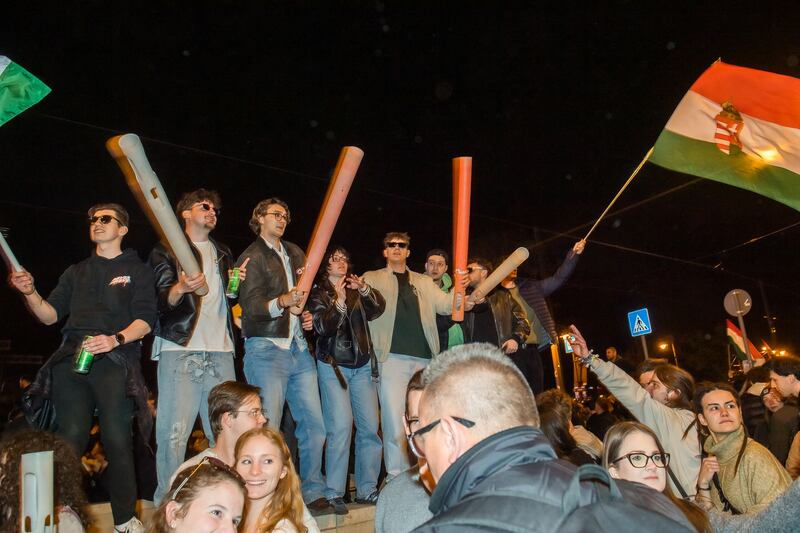
Orbán described his own party’s two-thirds constitutional majority in the 2010 general election as a “revolution at the ballot box”. Perhaps that’s not surprising. The same can be said of Tisza’s majority last night, which delivered the highest number of seats for any party in Hungary’s democratic history, supported by a record turnout just shy of 80 per cent.
On latest figures, Tisza has secured 53 per cent of the popular vote and 138 out of 199 seats in Hungary’s parliament – five above the figure needed for a constitutional majority.
The general view among most analysts and pollsters before polling day was that Tisza might win a bare majority but not the constitutional one needed to dismantle the system of “illiberal democracy” constructed by Orbán and his party over the last 16 years.
In the end, Fidesz secured a mere 55 seats.
It was also expected that Fidesz would contest the result, alleging foreign interference and seek to throw up procedural obstacles to delay the formation of a new government. In the event, though, given the scale of the result, Orbán chose to concede rapidly in a speech that was preceded by a private phone call to congratulate Magyar. In his public remarks, the outgoing prime minister made no effort to varnish the result.
“The election result is painful for us, but it is clear. The responsibility and opportunity to govern were not given to us”, he said.
The gathering in Batthyány square, already impressive before Orbán announced his concession at 9:30pm last night, grew exponentially in size during the hour afterwards. The crowd was hard to make a way through and at times oppressively warm from accumulated body heat, despite the cool April evening.
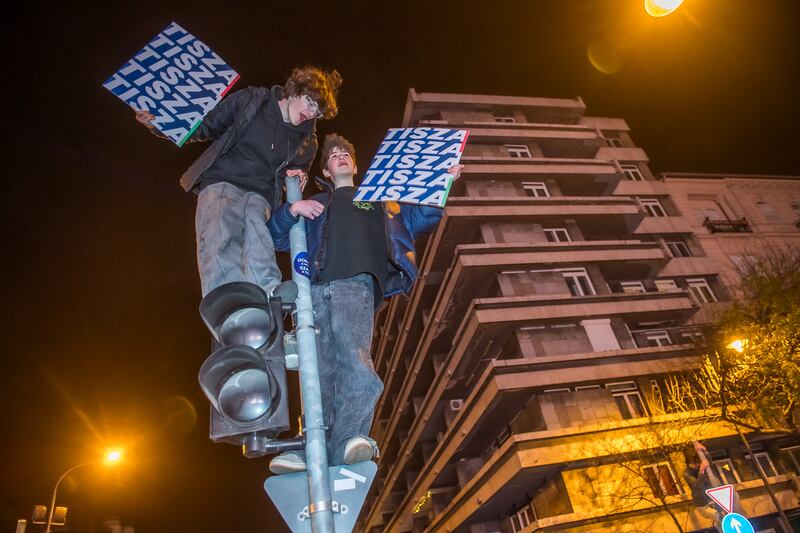
The location had been carefully chosen for both its historic and symbolic associations. Named after Lajos Batthyány, first prime minister of Hungary (during the 1848-9 war of independence against Austria), the square looks towards the country’s vast neo-gothic parliament building across the river which was brilliantly illuminated after sunset.
Magyar drew on history, too, in his speech, invoking figures from both the left and the right of Hungary’s historical canon, signalling a desire to unite the nation. While promising to be a prime minister for all Hungarians (including Fidesz voters), he also called for the swift resignation of key functionaries, including Hungary’s president Tamás Sulyok.
Hungary will no longer “be a country without consequences” for those involved in grand corruption, he said. “Those who have stolen the country must take responsibility.”


