
This month 10 years ago, Europe was mired in crisis.
More than 1.2 million people came to the EU seeking protection in 2015, many displaced by worsening conflict in Syria. There were bitter political feuds in Brussels over asylum, border and relocation policies. January 2016 set a grim record for the number of migrants dying while attempting to cross the Mediterranean.
Now things have changed, as European Commission president Ursula von der Leyen made clear in December when she took the stage at a conference on migrant smuggling.
After a major policy overhaul over the past two years, “Europe is managing migration responsibly,” she said. “The figures speak for themselves.”
READ MORE


Irregular arrivals of migrants to the EU recorded by its border agency Frontex dropped by 25 per cent in the 11 months to November 2024, and have been continuously declining since a recent peak of 380,000 arrivals registered in 2023.
New asylum applications have also decreased by about 26 per cent in the first nine months of last year, according to Eurostat data, as fewer Syrians are applying for protection since the fall of the authoritarian regime of Bashar al-Assad in late 2024.
“Our goal is to prevent the illegal journeys offered by smugglers,” von der Leyen said. “Every smuggling trip avoided is potentially a life saved.”

Von der Leyen pointed to the “comprehensive partnerships” that the EU is building with third countries to curb migration and fight people smuggling. But absent from von der Leyen’s speech that day were precise details about how the EU’s partners are preventing border crossings.
[ Sharp drop in number of asylum applications in Ireland last yearOpens in new window ]
EU countries, aided by Brussels, have been pushing for increasingly harsh measures to cut immigration in order to curb the rise of far-right and populist parties – which have gained power in several EU countries, buoyed by anti-immigration sentiment.
The commission regards the drop in numbers as the result of these policies, pointing particularly to controversial deals it has made with third countries such as Tunisia and Mauritania, which received funds to block people from departing.

A majority of member states are now in favour of restrictive asylum policies that had been unthinkable a few years ago, mirroring a hardening of voters’ views. “There has been a shift during the last years, because many Europeans are deeply concerned about how migration is changing Europe,” says Denmark’s migration minister Rasmus Stoklund.
But human rights organisations and researchers are increasingly questioning the cost and impact of the measures, and their effectiveness. They point to migrants who remain trapped in repressive environments and suffer abuse by authorities funded by the EU.
“Numbers are not falling because the drivers of migration have improved or changed,” says Ahlam Chemlali, a researcher at Aalborg University in Denmark. “They’re falling because people are increasingly stopped and detained and pushed back, long before they can appear in European statistics.”
Hardened
The EU’s immigration policy has hardened over the past two years, after more than a million people applied for asylum in the EU in 2023. That was the highest figure since 2015-2016, when some 2.3 million people applied.
The EU is also hosting some 4.3 million Ukrainians, who received temporary protection status after Russia’s full-scale invasion of their country in February 2022.
The bloc agreed a big overhaul of its asylum and migration system at the end of 2023, that included fast-tracking certain applications at its external borders from the summer of 2026. Some aspects of immigration policy – such as individual asylum decisions, granting visas or work permits – still sit with member states.
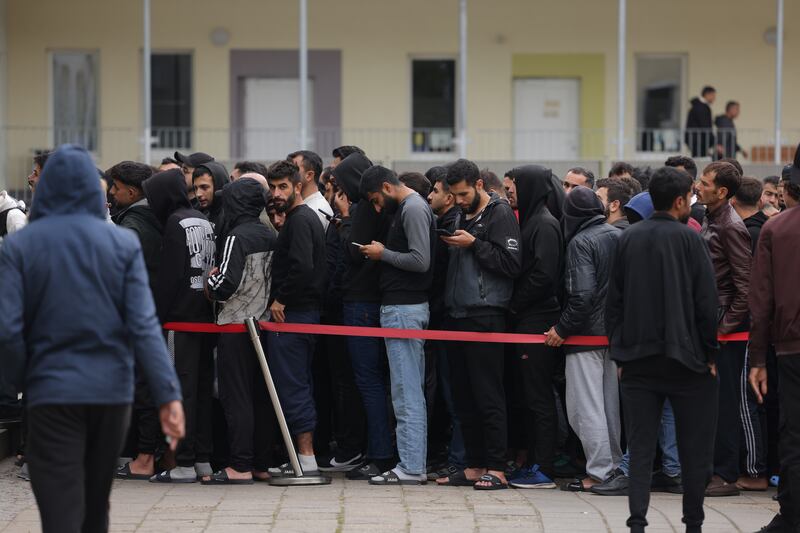
But as more right-wing governments have come into power in countries such as Germany and Luxembourg – previously vocal defenders of migrant rights – member states have called for additional measures to reduce immigration, including outsourcing the control of their borders to third countries.
“I think we are at the beginning, but yes [we] are on the right path,” said Léon Gloden, home affairs minister in Luxembourg, regarding agreements with third countries to halt migrants along the routes they travel to Europe.
The fall in the overall number of irregular arrivals recorded in 11 months of 2025 has been mostly driven by fewer people arriving through the eastern Mediterranean and western Africa.
Arrivals via western African countries such as Senegal or Mauritania declined by 60 per cent according to Frontex, the largest drop, which comes after the EU signed a €210 million deal with Mauritania in 2024 to stop people departing its shores, and increased its co-operation with Senegal.
But such agreements often simply displace traffic. Tunisia stepped up the interception of boats after signing an agreement with the EU in June 2023, after which departures from its shores fell – but those from neighbouring Libya and Algeria rose.
The result is that roughly the same numbers of people still travel across the central Mediterranean to Europe, while numbers using the western Mediterranean have actually risen 15 per cent, according to Frontex. “It’s a kind of a waterbed effect – if there is a pressure being put, or a crackdown on one route, you see a slow shift towards other routes,” says Frontex spokesperson Chris Borowski.
Deals with third countries do not address the fundamental reasons why people move, say human rights groups. “One of the direct impacts of these agreements is ... to trap people in those countries, to prevent them from reaching Europe, trapping them in a series of rights violations,” says Olivia Sundberg Diez, migration advocate at Amnesty International.
“We think that the incredible, tremendous human rights cost has to be weighed into whether we consider that a sustainable, humane policy,” she adds.
Amnesty and other groups have been particularly critical of the EU’s €105 million deal with the authoritarian government of Tunisian president Kais Saied.
Safia Rayan, Amnesty’s researcher for north Africa, says the last two years have seen “a terrible shift in the migration and refugee policies”, with Tunisian authorities often violently intercepting migrant boats at sea, and dumping people at the Algerian or Libyan borders.
These deportations to the desert have become “regular everyday routine”, says Rayan, who uses a pseudonym in order to be able to continue working in Tunisia.
She describes “a serious pattern of torture and ill treatment, including sexual violence and rapes ... post-interception and then collective deportation, also arbitrary detention.”
Tunis has also intensified its repression of political opponents and civil society more broadly, jailing opposition politicians, lawyers and human rights defenders. In the summer of 2024, it also largely barred UNHCR from operating on its territory.
Rayan says that the EU support of Saied’s government is “encouraging [and] enabling the Tunisian government in cracking down on migrants and cracking down on their own population”.
She adds that the EU is “looking away, only looking at one side of this ‘success’ ... at arrivals, but they don’t look at the cost in terms of human life and rights”.
The EU has also tried to intensify its co-operation with Libya, a country ruled by two rival governments backed by militias, and which the UN in 2023 accused of war crimes and crimes against humanity over the treatment of migrants.
According to NGOs and international organisations, conditions for migrants in Libya are still extremely dangerous as they are routinely jailed and forced to pay a ransom to be freed, as well as facing torture and sexual violence in the prisons.
“The protective environment for refugees and migrants is still incredibly weak. It hasn’t really been improving,” says a NGO employee working on the ground in Libya, who asked not to be named due to fear of reprisals. International organisations and NGOs were temporarily banned from operating in western Libya in 2025, disrupting humanitarian support.
Several boats used by NGOs to rescue migrants at sea have reported being fired upon by the Libyan coastguard, which receives funding from Italy under an agreement that was renewed in November.
Activists have repeatedly called on the EU to use financial assistance as a lever in negotiating with governments to improve the human rights situation. The 2024 agreement with Mauritania “shows how it could be done better if the focus shifted”, says Lauren Seibert of Human Rights Watch. “There are ways that they can use their support to influence things in a rights-respecting direction.”
Seibert says that while the Mauritanian authorities have stepped up their crackdown on migrants, “we’ve seen the government make some efforts to improve some things to respect migrant rights” and there has been “more conditions placed on the support” compared with Tunisia.
The authorities have adopted “standard operating procedures for migrant boat interceptions and disembarkations” and rules on humane treatment of migrants as well as screening for vulnerable people, though Seibert adds there is still “a risk that the focus is just on increasing interceptions and expulsions”.
The European Commission has repeatedly stated that it monitors human rights in countries where it funds migration control and works with UN organisations and others on the ground.
“Safeguarding protection for those in need and ensuring respect for the human rights of migrants, refugees and asylum seekers are fundamental principles that guide all the Commission’s initiatives,” it said.
Shift
Politicians and officials acknowledge that there has been a fundamental shift in the EU’s attitude towards migrants heading for Europe, and are stepping up the co-operation with third countries to halt immigration.

Stoklund, the Danish migration minister, says that about six years ago he was “considered a racist and a controversial figure”. Denmark has long pushed for more stringent policies on migration, but was until recently rebuffed by other member states. “Today when we meet, there’s been another approach from many governments,” he adds.
National capitals are now pushing for even harsher measures that in some cases echo the repressive migration policies of US president Donald Trump.
Home affairs ministers in early December agreed on new EU rules that would allow member states to send failed asylum seekers awaiting deportation to “hubs” outside the EU. They also agreed on rules that would in effect open the door to establish asylum processing centres outside the EU – similar to a UK plan, since abandoned, to send some asylum seekers to Rwanda.
The Netherlands has already signed an agreement with Uganda to send failed asylum seekers there in future and Germany and other countries are in talks to establish similar schemes.
“It’s a sort of turning point for our asylum and immigration policy, and we see the positive impact already,” home affairs commissioner Magnus Brunner said after the decision. Most plans still need to be negotiated with the European Parliament, but the right-wing majority there is broadly in favour of stricter rules.
Proponents of these policies have defended them against criticism from human rights organisations. “From my perspective, this is one of the most humane changes we’ve made for many years in the handling of migration in Europe,” says Stoklund. “Now we’re taking control back instead of organised criminals and human smugglers, it will in the future be the democracies of Europe that control access to Europe.”

But some experts say the EU’s focus on border control could actually encourage smugglers. Mark Micallef, head of the north Africa and Sahel Observatory at the Global Initiative Against Transnational Organized Crime, cites the growth of “hybrid smuggling”, where people combine legal travel with irregular border crossings. An example is Bangladeshis who fly to Libya, receiving a visa on arrival, and then pay for an irregular sea crossing to Italy.
“What we have seen in this broader whack-a-mole situation is the development of more sophisticated smuggling networks,” Micallef says, criticising the lack of a more “comprehensive vision” for controlling arrivals.
“In a perverse sense, a smuggler or a smuggling enterprise requires a border restriction – because if there isn’t, migrants manage by themselves.”
Temporary
Migration experts also warn that recent falls in irregular arrivals may be temporary, as people’s movements are influenced by factors outside Brussels’ control.
Lukas Gehrke, head of the UN International Organisation for Migration’s (IOM) global office in Brussels, cautions that “we need a longer period to really see how flows or the direction of flows go”.
The political situation in migrants’ home countries is a key factor in determining whether people leave, irrespective of restrictive policies, according to the EU’s asylum agency (EUAA).

Border crossings and asylum applications by Syrians dropped sharply in the first nine months of 2025, according to the EUAA, after Assad’s government was unexpectedly toppled in December 2024. Several European governments have suspended processing asylum claims filed by Syrians, notably Germany, which has seen the highest number of asylum applications by Syrians over the past decade.
“The civil war in Syria is over. There are now no grounds for asylum in Germany, and therefore we can begin with deportations,” German chancellor Friedrich Merz said in November.
Germany has also stepped up deportations of Afghans, but across the EU, asylum applications from Afghans have risen by 25 per cent in the nine months to September. The EUAA has linked this to the continued repression of women by the Taliban regime, and a recent decision by the European Court of Justice considering this as grounds for asylum.
[ ‘When the Taliban came, I lost everything. I found Ireland like paradise’Opens in new window ]
Experts caution that immigration numbers could rise again. “It’s a very delicate equilibrium that can change [at] every moment,” says Gehrke. “The drivers and pressures for irregular migration in the neighbourhood [of the EU] have not gone down consistently.”
While Syria has stabilised, a long civil war in Sudan intensified during 2024, with 4.2 million people fleeing the violence since 2023, according to the UNHCR. Though most remain in neighbouring countries, UN funding cuts have reduced humanitarian assistance, leading people to drift towards Libya and onwards to Europe.
Many organisations argue that to fight human smuggling, western countries need to provide alternatives to irregular journeys in the form of legal pathways – such as an easing of strict visa requirements for people from African countries.
“We must open more safe pathways, legal pathways, to Europe. We must create more bridges between our continents,” von der Leyen said at the December conference. “We have plenty of ideas for legal mobility, but only together can we make this work.”
But such policies are largely down to member states, many of which have been reluctant to soften the status quo amid growing anti-immigration sentiment among voters.
“When it comes to the implementation of a proper economic route for migrants, which would literally take the business out of the hands of smugglers, we don’t seem to be able to come together and really implement it,” says Micallef. “You would think that it’s a win-win situation, because there is no question that Europe needs the labour.”
Gehrke, of the IOM, says that legal migration paths and labour agreements should be “part of the migration management architecture” and were needed “in order to have a long-term trend” of falling overall numbers.
“Perhaps, if it continues to appear as though we have the irregular part under more control, the other parts become politically more viable.”
– Copyright The Financial Times Limited 2026


