

In March 2021 the Taliban stopped heavily pregnant Dr Sorya Ghafoor and her two-year-old son from leaving Kabul. She was terrified. “When a woman wants to travel [in Afghanistan] they have to have her husband or brother or father accompany her,” Sorya’s husband, Khalid Azim, says.
At the time Azim was living as a refugee in Dublin in the home of architect Colm Doyle and Colm’s husband, Peter O’Reilly. They were awaiting Ghafoor’s arrival. She rang from Kabul airport in the middle of the night. “She said ‘They didn’t want to let me fly’,” Azim says. “It was four in the morning and I knocked on the door for Colm.”
“It was a very stressful morning,” says Doyle. “We set up a war room here at the table. We were in our dressing gowns, at the kitchen table. We ended up engaging with the Taliban on the phone.”
“They didn’t know what the visa waiver was,” says Azim, referring to the document from the Irish government that Ghafoor was travelling with, negating her need for a visa.
READ MORE


Doyle, O’Reilly and Azim desperately contacted friends, officials and embassies. It worked. “Eventually we got a photo from Sorya of her on the plane with Sajad, as always, looking beautiful ... It was very emotional.”
[ Inside Afghanistan: What is life really like under Taliban rule?Opens in new window ]
Ghafoor gave birth to her second son, Subhan, just two weeks later. It was around St Patrick’s Day. “So we wanted to call him Paddy,” Doyle says.
Both couples are sitting at Doyle and O’Reilly’s kitchen island. Ghafoor and Azim see Doyle and O’Reilly as family. They came together as part of an ad-hoc community support programme for incoming Afghan refugees that has since become the more formalised humanitarian admissions programme facilitated by The Open Community. Ireland is one of only two countries still providing such routes to safety to people who face persecution in Afghanistan.
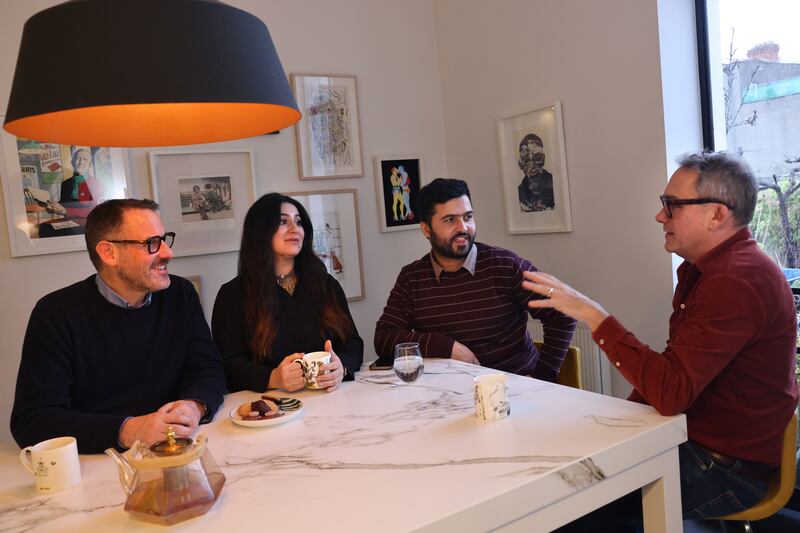
The programme involves groups of local people committing to support a refugee or refugee family. If a protection need is established for an individual or family, the locals find appropriate accommodation, raise €10,000 for a family and €5,000 for an individual for their expenses and create a very detailed support plan that includes schools, doctors, dentists and language lessons as appropriate. Then the State grants permission to enter Ireland. It’s oversubscribed. Last year there were 80 eligible applications supported by more than 500 people around Ireland. That could have seen 300 people arrive, but the numbers are capped at 50.
“When the Taliban took the power, everything changed,” Azim says. He was a dentist who had been working for American NGOs and this put him in danger. “They came to the hospital and they asked a lot of questions. ‘Why are you working with them?’ Day by day it was getting dangerous for me, so I had to leave. I left my wife and my two-year-old son.”
Ghafoor’s life changed overnight. A gynaecologist, she was suddenly unable to work. “When the Taliban came, I lost everything,” she says. “Before the coming of Taliban, I had the freedom to go out to work and wear what I wanted to wear. After the Taliban came, I couldn’t work. They didn’t let us walk in the street without a burka.”
“The burka is very difficult for her,” Azim says. “She gets asthma.”
“And I couldn’t visit my friends,” she says. “I couldn’t talk about it.”
Over in Ireland, Azim was grappling with a new country and culture. “I never knew about Ireland before,” he says. “I arrived on October 14th, 2021. I was in a hotel for 10 days. After that I came to this house.”
“The best house,” Doyle says.
Azim laughs. “The best house in all of Ireland.”
Doyle and O’Reilly knew little about Afghanistan at first. They watched the fall of Kabul on television and were horrified but they didn’t know how to help. Then a friend told Doyle about 26 Afghan refugees who urgently needed housing. “We talked about it over dinner that night and just imagined what it must be like to be in a foreign place very far from home. A couple of days later Azim was living here ... We had a 28-year-old dentist living in the spare room.”
What was that like? “[That night] we had dinner, a long chat, and the following morning, we went for a walk around the neighbourhood,” says Doyle. “We found the halal shop and I showed him the mosque. We went to the phone shop, and then we called into another pal’s house and we had tea.”
“I was very lucky to meet Colm and Peter,” says Azim. “They guided me through everything.”
“The minute people heard about it, anything we needed was solvable,” says Doyle. “When Sorya was coming and she was nine months pregnant, we needed an apartment, we needed a car, needed changing bags, highchairs, a car seat. We needed all this stuff. But you put a call out and things arrive.”
Last September they managed to get Ghafoor’s widowed mother, Razia, and her 11-year-old sister, Morowat, out of Afghanistan via the same scheme. Morowat had been denied education for several years. “She came on Friday and started school the following Monday,” says Ghafoor. “She loves school.”
“She’s the real story,” says Doyle.
Once her mother and sister were here, Ghafoor could finally relax. “I found Ireland like paradise,” she says.
“Let’s not overdo it,” says Doyle.
She laughs. “To me it’s paradise. I can be safe and secure. The people are very kind. I love them. I found beautiful Irish people. Colm and Peter were my husband’s host family and then became my family too. I love Ireland.”
Even the weather?
“Actually, she loves the weather,” says Azim.
“I love the rain,” she says.
For Doyle and O’Reilly, the process has introduced them to a whole network of kind people, Irish and Afghan. “Sorya has been hosting dinner parties,” says Doyle. “We’ve had a series of Afghan feasts and banquets at their house ... We’ve learned so much about Afghan culture, Afghan food, Afghan people, Afghan geography.”
“It’s been really lovely in our lives,” says O’Reilly. “We’ve gotten a huge amount out of it ... It actually builds a sense of community within Ireland.”
Azim and Ghafoor’s family now live in a house they rent in another suburb. She and Azim hope to practise their professions once their English has improved enough to pass the required tests. In the meantime, Azim runs a small food-packaging business. They’re still very close to Doyle and O’Reilly. “We’re all one family now,” says Doyle.
‘Irish people are like Pashtuns. They are really friendly’
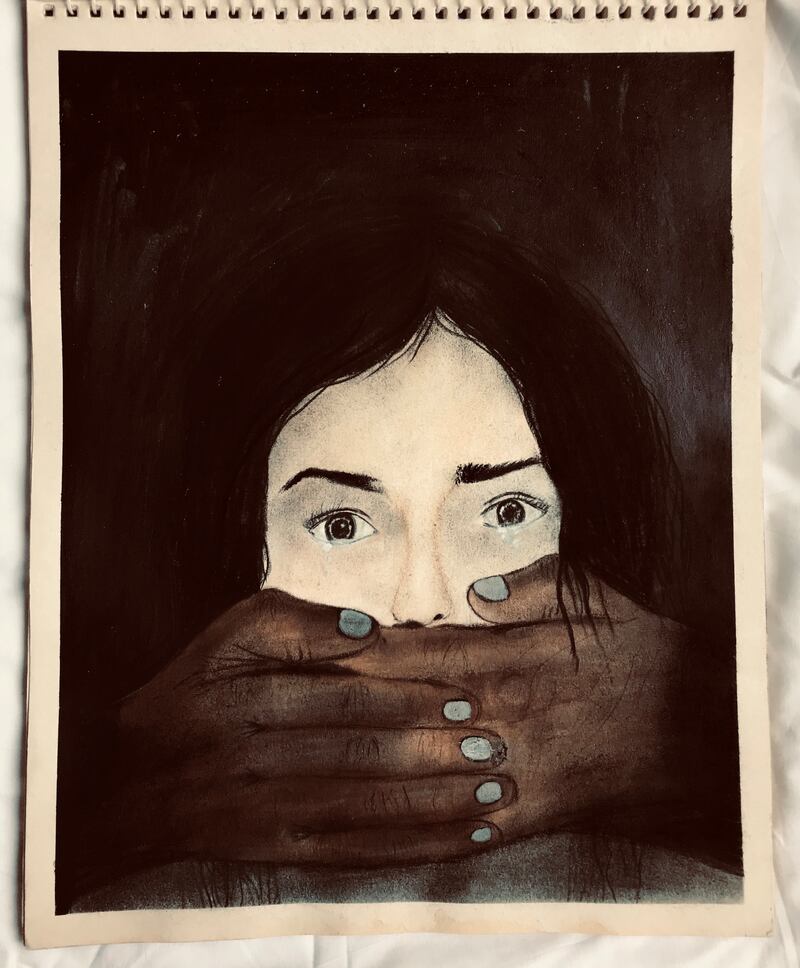
Twenty-six-year-old Durkhanai Khan creates beautiful art – women in burkas carrying caged birds, people dancing, a woman whose mouth is being covered. A lot of art is, she says, “taboo for the Taliban”.
Her brother, a doctor in an Irish hospital, arranged for her and their widowed mother to get to Pakistan from Kabul in the days before the Taliban took over. They had already captured Durkhanai’s home village. “We were hearing so many terrifying stories,” she says. “They were kidnapping young girls and forcefully marrying them. We were two women. We had no men to protect us, so we were in danger. We had to go somewhere and hide.”


They had visas for six months in Pakistan. When that date passed, they feared being repatriated. Many Afghans were being sent back or forced to pay bribes. “I didn’t have a scarf in my passport picture. I could be kidnapped at the border by Taliban, because they don’t accept any woman not covering her head.”
She couldn’t believe it when her brother told them he had arranged for them to travel to Ireland and that he had also organised a network of local people to help them get settled. “Even on the flight, my mom was like, ‘We’re going to be sent back to Afghanistan.’”
When they eventually arrived at Dublin Airport, her brother was there, as was her heavily pregnant sister, who had flown in from London. “There were happy tears,” she says.
Khan is now a freelance artist. She has a master’s degree in economics and volunteers with a group called Cultúr to help other newcomers. She is happy with her life in Ireland and the community she has found here. “Irish people are like Pashtuns. They are really friendly. They have pride. They are really loving.”
The Irish capacity for small talk still delights her. “That was a new thing: saying ‘hi’ to a stranger and talking about the weather.” She laughs. “I’ve talked to so many people, strangers on the street, about weather.”
‘My dad just said, You need to leave the country’
Twenty-four-year-old Mohadesa Shojaee was in college when the Taliban took Kabul. There was an exhibition that day. “Everything was so normal,” she says. “Suddenly the behaviour changed. Our teachers said, ‘Go straight to your home. The situation is dangerous.’ There was no public transport, no taxis, everyone was driving so fast and running. It was horrible. A nice old man said, ‘Come; I will bring you home’ and me and my friends went in his car. We were so scared. There was so much traffic. We got out of the car in the middle of the street and walked to get public transport. When I get on to that transport, one of my friends fainted, she was so scared.”
Had they expected this? “We were following the news day by day. One city, Taliban take over. Another city, Taliban take over. We were saying: ‘But they will not take over Kabul.’ We were all in shock ... We couldn’t speak. The only thing anyone said was: ‘Did this actually happen?’”
Her mother worked for an American hospital, which had promised it would evacuate the family, but after a bomb went off near the airport, those plans were shelved. “We were so hopeless.”
Shojaee was in danger of being targeted. She had been part of an American leadership through an athletics programme, Ascend. The programme arranged for some of the participants to leave. Some, including Shojaee, were given Irish visa waivers. “I’d never gone anywhere by myself, but my dad just said, ‘You need to leave the country.’”
To avoid scrutiny, they left via a small airport far from Kabul. They ducked down and hid in the bus, she says, lest Taliban guards would see them. “We were scared for the future. We were homesick, worried about Afghanistan, worried about our families.”
Twenty of them, mainly young women, went to Ireland. “We were so nervous. Our boss sent us a picture of [the Irish lawyer] Andrea Martin. She said, ‘This lady will come to collect you’, and we said, Okay, memorise this picture.”
In fact, Martin was one of a whole committee of people waiting to help them. Shojaee has been in Ireland four years. Her family managed to follow her a few years later through a sponsorship process led by Shojaee herself. She has made a short documentary about her refugee experience. She’s studying animation. When she came here, she was astonished to find that the Irish company Cartoon Saloon made the Afghanistan-set film The Breadwinner. “I thought: Maybe I want to do animation!”
Whenever the stresses of college life get to her, she thinks of her friends in Afghanistan. Unable to work or study, many married young. Some weren’t given a choice about that, she says. “Afghani women and girls don’t have the right to work or study or go to gym or go anywhere ... I have this sentence on my wall for every time that I’m not thankful for my life here: ‘You are living somebody’s dream life.’”


