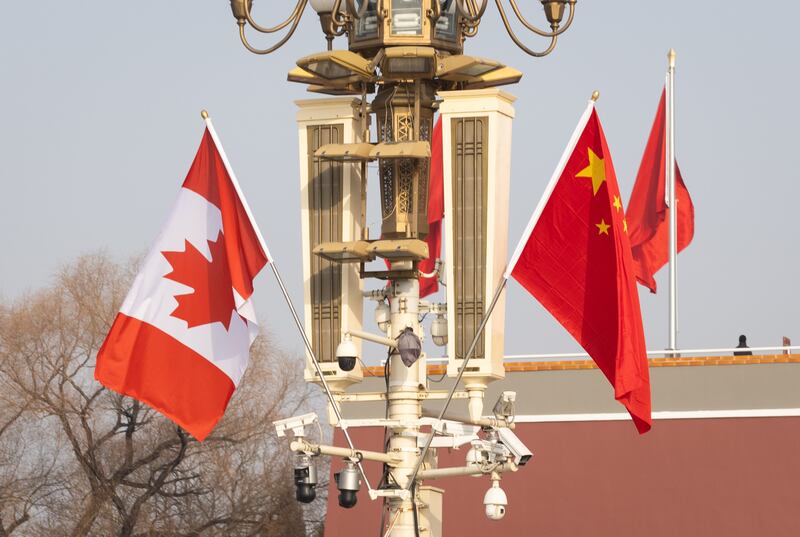
Canada’s prime minister Mark Carney has described his country’s relationship with China as a strategic partnership which “sets us up well for the new world order”. And he agreed to slash tariffs on Chinese electric cars which Ottawa had imposed in lockstep with the United States.
Mr Carney was speaking in Beijing at the end of a visit to China that saw the two countries agree to lower trade barriers and rebuild ties that had almost collapsed in recent years. In meetings with China’s president Xi Jinping and premier Li Qiang, both sides made clear that they were ready to restore the relationship and build on it.
“Our teams have worked hard, addressing trade irritants and creating platforms for new opportunities,” Mr Carney told Mr Li.
“I believe that, together, we are bringing this relationship back toward where it should be.”
READ MORE


Canada will allow up to 49,000 Chinese electric vehicles into its market at a tariff of just 6 per cent, compared to the current 100 per cent levy that Ottawa imposed in lockstep with Washington. China is expected to cut its tariff on Canadian rapeseed to 15 per cent from 85 per cent.
In a joint statement, the two sides agreed to deepen economic and trade co-operation and to work together on energy, finance, transnational crime and cultural exchanges. They affirmed their shared commitment to multilateralism, the central role of the United Nations and to strengthening the rules-based trading system around the World Trade Organisation (WTO).
“The global trading system is undergoing a fundamental change, and the effectiveness of multilateral institutions on which trading powers such as Canada and China have greatly relied, that effectiveness has been greatly reduced,” Mr Carney told reporters after his meetings with Chinese leaders.
“This is happening fast. It’s large. It’s a rupture. It’s not a transition. What we do now in Canada, how we position ourselves in the world, will shape our future for decades to come. Canada can thrive in a new system, but to do so we must be ambitious. We must work at speed and scale to find new partners, to diversify our trade and attract unprecedented levels of investment in our country, and we must be pragmatic.”
Mr Carney’s embrace of a closer relationship with China is a dramatic reversal of almost a decade of hostility, starting with Canada’s arrest in 2018 of Huawei executive Meng Wanzhou on a US warrant. Beijing then detained Canadians Michael Kovrig and Michael Spavor, who were living in China, on spying charges.
Known as “the two Michaels”, their case alarmed western diplomats and journalists based in China. After their release in 2021 as part of a deal that also saw Ms Meng freed, Mr Spavor sued the Canadian government, alleging that he may have been unwittingly used by Mr Kovrig for espionage, and received $7 million in a settlement.
[ Economic war poses biggest global threat, WEF warnsOpens in new window ]
Although Mr Carney did not mention Donald Trump by name, he made clear that Canada’s decision to diversify its trade and foreign policy towards China was prompted by the shift in US policy. He said the world was still determining what the new order would be, who would govern global trade, financial regulation and payment systems and what was the role of bilateral and plurilateral deals.
“The multilateral system that has been developing these is being eroded, to use a polite term, undercut to use another term. The question is, what gets built in its place? How much of a patchwork is it? How much is it just on a bilateral basis?” he said.
“The expectation is that rather than these being developed necessarily through the IMF, WTO and other multilateral organisations, it is going to be coalitions that develop them, not for the world, but for subsectors of the world.”