Former Cuban president Raul Castro has been indicted in the United States on murder charges, court records showed on Wednesday, in a major escalation in Washington’s pressure campaign against the island’s communist government.
Castro (94) last appeared in public in Cuba earlier this month, and there is no evidence that he has since left the island or that the government would allow him to be extradited.
State media reported on Wednesday evening that the Cuban government rejects the allegations made against Raul Castro, calling them “spurious”.
Cuba’s foreign minister Bruno Rodriguez on Wednesday said a White House statement critical of the country’s communist-run government was “superficial and misinformed”. Rodriguez did not refer to the indictment in his comments, which were posted on social media.
READ MORE


The indictment against Raul Castro, filed in federal court in Miami, charges him with one count of conspiracy to kill US nationals, four counts of murder, and two counts of destruction of aircraft, court records show. Five other people are also named as defendants in the case.
US president Donald Trump said on Wednesday that the United States is “freeing up Cuba” and he can’t say what’s next for the island nation.
Trump has pushed for a regime change in Cuba, where Castro’s communists have been in charge since his late brother Fidel Castro led a revolution in 1959.
A US justice department official told Reuters last week that the expected charges against Raul Castro were based on a 1996 incident in which Cuban jets shot down planes operated by a group of Cuban exiles.
Trump in a statement earlier on Wednesday called Cuba a “rogue state harbouring hostile foreign military” and framed his administration’s actions regarding the Caribbean island as part of a broader effort to expand US influence in the western Hemisphere.
“From the shores of Havana to the banks of the Panama Canal, we will drive out the forces of lawlessness and crime and foreign encroachment,” Trump said at a US coast guard academy event in Connecticut.
Cuban president Miguel Diaz-Canel said on Monday that the island does not represent a threat.
The indictment marks a new low in relations between the long-time Cold War rivals.
The US has effectively imposed a blockade on Cuba by threatening sanctions on countries supplying it with fuel, triggering power outages and exacerbating its worse crisis in decades.
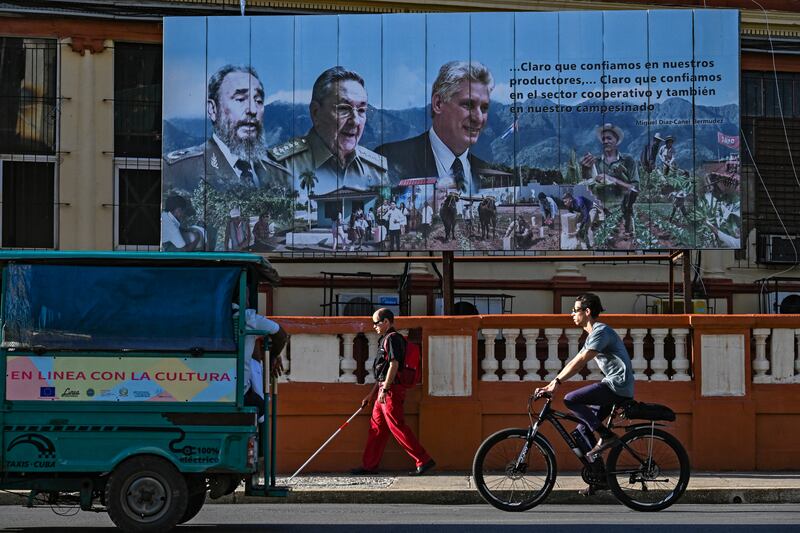
In a video message addressed to the Cuban people on Wednesday morning, US secretary of state Marco Rubio, whose parents were Cuban immigrants to the US, offered to forge a new relationship between the two countries. He said the US could provide $100 million in aid, and blamed Cuba’s leaders for shortages of electricity, food and fuel.
Speaking in Spanish, Rubio said the food and medicine must be distributed by the Catholic Church or other trusted charitable groups.
In response, Rodriguez called Rubio “the mouthpiece of corrupt and vengeful interests” but did not rule out accepting the aid.
“He keeps talking about an aid package of 100 million dollars that Cuba has not rejected, but whose cynicism is evident to anyone in light of the devastating effect of the economic blockade and the energy stranglehold,” Rodriguez wrote in a post on X.
Born in 1931, Raul Castro was a key figure alongside his older brother in the guerrilla war that toppled US-backed dictator Fulgencio Batista. He helped defeat the US-organised Bay of Pigs invasion in 1961.

He served as Cuba’s defence minister before assuming the presidency in 2008 after his brother fell ill. Fidel died in 2016.
Raul Castro stepped down from the presidency in 2018 but remains a powerful figure in Cuban politics.
The filing of the criminal case against a US adversary like Castro recalls the earlier drug-trafficking indictment of imprisoned former Venezuelan president Nicolas Maduro, an ally of Havana’s.
The Trump administration cited that indictment as a justification for the January 3rd raid on Caracas by the US military in which Maduro was captured and brought to New York to face the charges. He has pleaded not guilty.
Trump says Cuba’s communist government is corrupt, and in March threatened that Cuba “is next” after Venezuela.
Diaz-Canel said on Monday that any US military action against Cuba would lead to a “bloodbath”. – Reuters