From first concept to showroom floor, a luxury vehicle can take up to five years to develop and it is built to last many more on the road. That demands interior and exterior design rooted in restraint but rich in desirability. “Our ambition is to create timeless design that stays relevant and desirable for decades,” says Sara Erichsen Susnjar, senior colour and material design manager at Volvo Cars. “A Volvo experience that lasts beyond trends.”
Erichsen Susnjar’s colleague, senior exterior designer Gaurang Nagre, agrees. A Volvo, he says, must look great and stay appealing to buyers for as long as they own it. To get there, each department involved in a car’s development carries out extensive research. “During a project, we travel around the world in teams to look at architecture and spaces and experience them first hand. Then we translate all of our learnings into a concept sketch,” Nagre explains.
Every design begins as a sketch, which is then developed into a digital model. But a car is a physical object and the team needs to see it in the flesh before it goes into production. The team mills the design in clay or foam and refines it using virtual-reality headsets, a process that includes regular exterior testing to see how light falls on it by day and by night.
Alongside this fieldwork is something less tangible but equally important: “a story, or rather a feeling”, says Erichsen Susnjar. “Before we talk about a specific shade or textile, we ask ourselves how we want people to feel when they open the car door.”
READ MORE


It’s an approach driven by emotion rather than fashion or design cycles. “That story comes from the way light shifts through the seasons, a forest lake at dawn, a heather field in late summer. From there, colour, material and finish take shape together, like a triangle. Colour sets the mood, material gives it substance and character, and finish decides how light meets the surface. When all three tell the same story, the design feels right.”
Volvo’s EX60 is a direct descendant of the original XC60, so for Nagre, respecting the model’s design heritage is essential. It starts with the silhouette. “We have always looked at cars like people,” he says. “If you saw someone you know walking towards you from half a kilometre away, you wouldn’t be able to make out their face, their eyes or their lips, but you would still recognise them, because the human mind registers silhouette first. It’s the same with cars.
“Ask someone how long they’ve owned their car and they’ll say three years, maybe five. Then ask them whether they remember what the bumper looks like, and most can’t, because the brain doesn’t register it consciously. So when we start a programme, we think first about the character of the car, so that when someone sees it on the road, they can say, ‘That looks like a EX60’.”

Erichsen Susnjar describes Volvo’s Scandinavian heritage as the foundation of everything the brand does. “But heritage should never mean repeating ourselves,” she says. “We keep it fresh by looking at Scandinavia today – contemporary fashion, design and lifestyle – and by daring to make choices you would not expect in a car.”
She cites the pairing of a wool blend in Rye, a colour developed exclusively by Volvo, with a dark, heather-coloured carpet. Another example is the fused ash decor, which draws on the centuries-old craft of marquetry, where every scrap of wood was put to use. Whereas traditional makers concealed the joins between thin wood veneers, here the design team leaves them visible, so that the seams form a quiet, contemporary pattern.
One design Erichsen Susnjar is especially proud of is the crossing-waves pattern on the ventilated seats, inspired by Grenen, the 4km sandbar at the very northern tip of Denmark near Skagen, where two seas, the Skagerrak and the Kattegat, meet. “Even though water is so organic, the two seas create an almost geometric pattern, and I love that we could bring that small piece of nature into the car,” says Erichsen Susnjar.
Nagre’s favourite design feature is the car’s taillamp graphic. The rear lights form a distinct, segmented vertical arrangement rather than a single solid strip, framing the tailgate and breaking at the beltline. “It’s very different: technical and bold. I wanted something so strong you could imagine having it as a tattoo on your arm and it would still look good and confident.”
For Erichsen Susnjar and Nagre, two things are non-negotiable: durability and safety. Every material must pass Volvo’s rigorous testing to earn its place in the car, which is why engineers and suppliers are brought together early in the process to develop materials jointly. “This can involve many rounds of samples, until a material is both beautiful and robust, and available in the volumes and consistent quality that global production demands,” says Erichsen Susnjar.
She describes their work as a constant balancing act between sustainability and durability, premium and affordable, unique and scalable. “The most interesting ideas often come out of exactly that tension.” This mindset shapes the interior, which the design team has made to feel like a calm, welcoming room rather than a technical space. To suit different tastes, the team created four different interiors.
“People read beauty, comfort and quality in very different ways. Some will feel at home in the light, fresh Dawn interior, others in the sporty Cardamom, the rich and timeless Charcoal, or the fashion-forward Rye. The idea is that you choose the room that feels like you.”
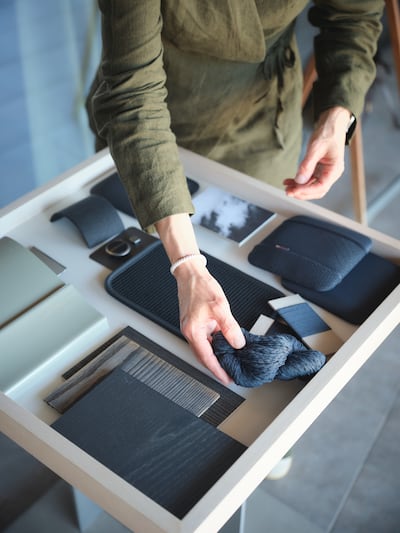
This sense of a space that feels like you explains why Erichsen Susnjar frequently looks to materials people love having in their homes, such as soft, breathable wool. “In the EX60, even the dashboard and soundbar are dressed in a tailored textile, a bit like a beautifully upholstered piece of furniture,” she says. “We take the feeling of a home and develop each material until it lives up to automotive standards.” That means coping with strong sunlight, wear, temperature changes and years of daily use, while still being easy to clean.
Safety, too, is never compromised. “We pay enormous attention to safety,” adds Nagre. “For instance, there’s a lot of technology built around the car, what I call an invisible safety shield. It has four radars at the front, two at the back, 12 parking sensors and a number of cameras. As a customer, you don’t see any of it, because much of it sits behind the bumpers.”
A beautiful idea is only the beginning, adds Erichsen Susnjar, and beautiful ideas should always be compatible with safety and sustainability goals. “You should never have to choose between sustainability and desirability, so we take a ‘secondary-first’ approach: recycled and renewable materials are the first place we look,” says Erichsen Susnjar. The same thinking extends to the end of a car’s life. A car door combines glass, metal, leather and plastic in countless variants so it is difficult to recycle. “We have started to think about designing for disassembly,” says Nagre. “How easy would it be, at the end of the car’s life, to take these apart?”
Desirability, longevity and sustainability are the three pillars of every Volvo car and together they are what makes a design transcend trends. In the EX60, that thinking shows in a quiet confidence. These cars are refined, considered and built to last. And very beautiful, too.
Meet the Volvo EX60. Scandinavian design, advanced technology and up to 810km of all-electric range, created to take you further. Discover more at volvocars.ie