
The surprise announcement by US president Donald Trump during his Irish visit in September of the lifting of US tariffs on Irish whiskey came as a welcome relief to the Irish drinks industry. Unfortunately, it hasn’t happened yet.
The announcement of the intention to lift the 10 per cent tariff on Irish whiskey came during the Irish Open at Trump’s Doonbeg resort in Co Clare.
While the industry will have toasted the sentiment, they’re still waiting on it to be executed, not least because their nearest and most important rivals, Scotch whisky, already enjoys tariff-free trade.
According to Eoin Ó Catháin, director of the Irish Whiskey Association, part of employers group Ibec, in a statement welcoming the move, nothing exemplifies the US-Ireland trade relationship better than Irish whiskey.
READ MORE



“Last year, Irish whiskey exports to the US were worth €450 million, while Irish distillers collectively purchased €80 million worth of US whiskey casks. This relationship represents thousands of jobs and millions in investment on both sides of the Atlantic, and the return to tariff-free trade for our Irish whiskey distillers will strengthen this success and lead to further growth and investment,” he said.
Even before the current US administration, however, the industry had been proactively expanding into emerging regions, successfully reducing exposure to the US market from 49 per cent of total exports in 2023 to 38 per cent in 2025.
In its submission in advance of Budget 2027, the association called for support in maintaining this momentum in high potential growth regions such as India, Japan, South Africa and Nigeria.
While the US isn’t, as yet, a huge market for Donegal’s Crolly Distillery, cofounder Conor McMenamin is watching the tariff situation with interest.
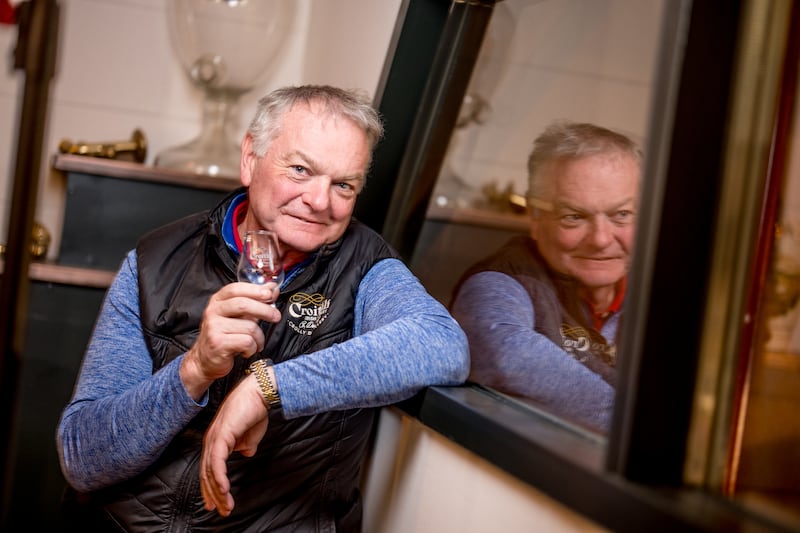
Currently only about 10 per cent of its sales are in the US, but, given the distillery’s success as a visitor experience, including for American tourists, being able to capitalise on the brand recognition that provides by having a competitively priced product in their home market when US tourists return stateside is important.
For McMenamin, however, the real value of Trump’s tariff announcement was that it resulted in a great deal of positive press coverage, on both sides of the water, something that benefits the sector as a whole from a marketing perspective.
That said, actually bringing down the tariffs would help the sector too, particularly those distillers going for mass market, he points out.
“If you were trying to do really big volumes in the States, price sensitivity is absolutely the number one priority,” he says. “And the American market has become much more competitive, price wise, in the last five years.”
Any small-scale operator “would be, to my view, quite foolish to try and put all their apples into the American market because it’s both difficult and financially costly to get into the States,” says McMenamin.
The three-tier system it operates under, which separates out manufacturers, importers and distributors, puts pressure on margins. It’s why a number of Irish distillers have been focusing on European sales instead, “and Europe has been going quite well”, he says.

Elliot Hughes, managing director of Dingle Distillery, is also upbeat. “We’ve actually had two successive years of growth in the US, despite all the headwinds, so now we’re in a very promising position and quite happy with where things have gone, in spite of the tariffs,” he says.
Dingle’s success is attributable to a combination of factors, including strong relationships with its US partners right through the three-tier system, which helped the brand to realign its pricing in a more sustainable manner in 2024.
“Throughout the chain we have all been working towards the same thing,” he says. “We were pitched a little too high.”
The benefits of that price realignment have started to come through strongly, which is good news for the brand’s biggest export market.
“The US is the one we focus on most. I know a lot of people are moving away from that, but I think that’s a bit premature,” says Hughes.
“It is still the number one Irish whiskey market and the number one premium Irish whiskey market as well.”
He is phlegmatic about tariffs. “We’ve been in the current tariff position for the last two years. If the change does come through, it will be a good bonus for us,” he says.
Pat Rigney, founder of The Shed Distillery, best known for its Gunpowder Gin and which also produces Drumshanbo Single Pot Still Irish Whiskey, is equally optimistic. His business is performing strongly in the US, up 15 per cent in the past year on the gin side, “and substantially more on the whiskey side, but off a lower base”, he says.
The key to success stateside is not so much about tariffs, in his estimation, as about a very particular set of ingredients: “superior brand, superior product, superior experience and hard work,” he says.
“The US is Irish whiskey’s number one by far. So it’s a critical market and we’ve got some great brands, such as Jameson and others, that have led the way and built a category, and we’re very fortunate in that. We punch well above our weight in the US.
“It’s a challenging market because of higher inflation and market uncertainty. But all you can do is focus on what you can control, and what you can control is having a superior product or brand, and working the market, and that’s what we’ve been doing.”